comparisons
Home Sauna vs Gym Sauna: Which Is Worth It?
Home sauna vs gym sauna: cost breakdown, hygiene facts, convenience comparison, and break-even math to help you decide which is worth it in 2026.
 Marcus Reade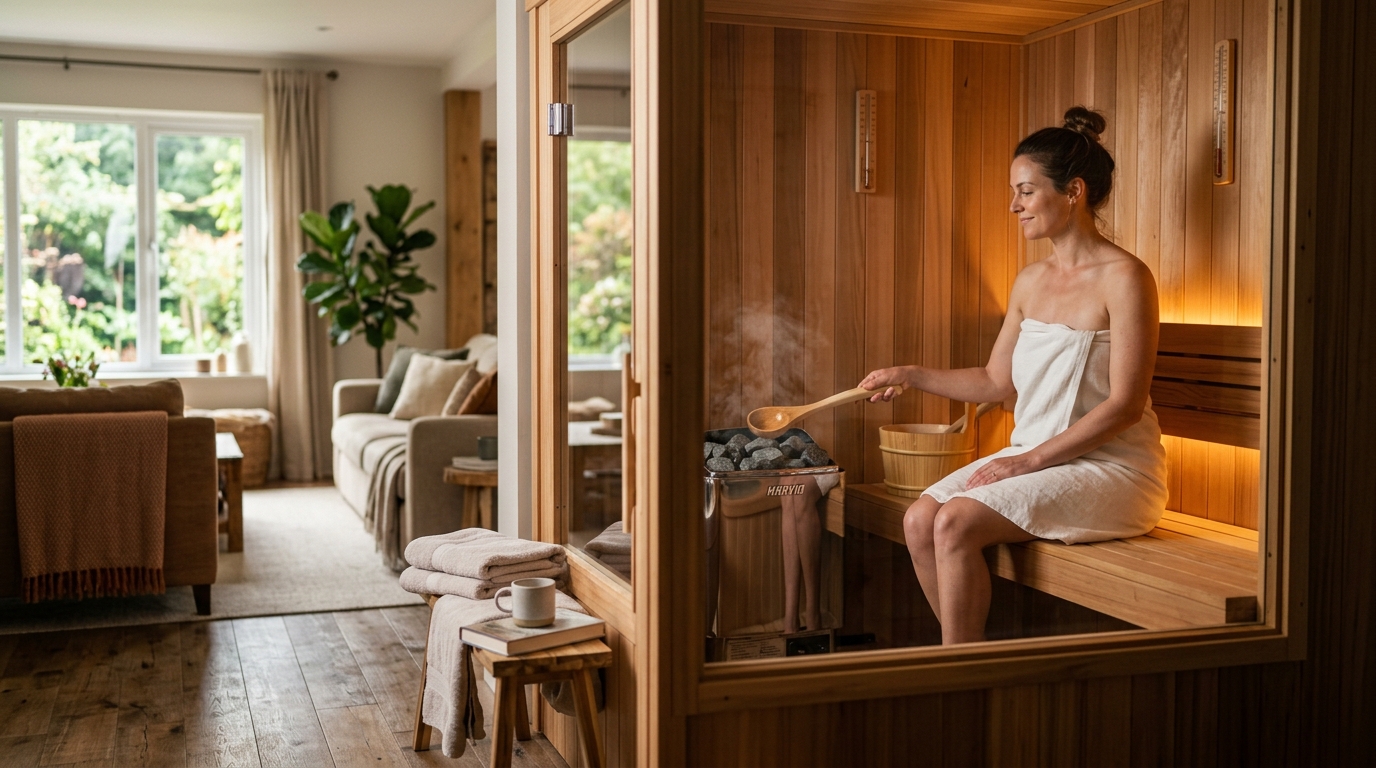
For people who sauna four or more times per week, a home unit pays for itself within 3-5 years and delivers unlimited private sessions for the life of the hardware. Gym saunas make sense for occasional users already paying a membership fee. Once you build a daily habit, convenience and protocol freedom consistently favor home ownership.
What is the difference between a home sauna and a gym sauna?
A gym sauna is a shared facility — typically a 6-10 person traditional Finnish or steam sauna in the locker room area. You use it during gym hours, within a limited session window (usually a 15-20 minute posted limit), alongside other members. Temperature is set by staff and rarely adjustable. You share benches with whoever walks in.
A home sauna is a dedicated unit installed in your residence — a backyard barrel, garage infrared cabinet, basement room, or small indoor cabin. You control the temperature, session length, timing, and access. Most infrared models assemble from flat-pack boxes in 2-3 hours and run on a standard household outlet.
The category spans a wide range: a $300 portable infrared tent at one end, a $25,000 custom Finnish sauna room at the other. For this comparison, we focus on the practical middle — standalone infrared cabins and small barrel saunas in the $1,500-8,000 range that represent realistic home ownership for most buyers.
Home sauna vs gym sauna: side-by-side comparison
| Product | Best for | Rating | Notes | |
|---|---|---|---|---|
| Upfront cost | Home: $1,500-8,000. Gym: $0 beyond membership. | — | Gym has zero capital cost; home sauna is a one-time investment that pays off over time. | — |
| Ongoing cost | Home: $10-25/month electricity. Gym: $25-80/month membership. | — | For daily users, the home cost advantage compounds with every year. | — |
| Hygiene | Home: your household only. Gym: shared with dozens per day. | — | Fungal and bacterial contamination is a documented gym sauna concern. | — |
| Availability | Home: 24/7 access, no wait. Gym: bound by hours, possible queue. | — | Early morning and late night sessions only exist at home. | — |
| Session length | Home: unlimited. Gym: usually 15-20 minute policy limit. | — | Time limits at gyms prevent full multi-round recovery protocols. | — |
| Temperature control | Home: set exact temperature. Gym: preset or locked controls. | — | Protocol-driven users need precise control to dial in their target heat. | — |
| Privacy | Home: completely private. Gym: shared with strangers at all times. | — | Privacy meaningfully improves relaxation depth and session consistency. | — |
| Installation | Home infrared cabin: standard outlet, no plumbing, 2-3 hour DIY assembly. | — | Modern plug-in infrared cabins require no permits, contractors, or remodeling. | — |
When a home sauna is the better choice
You sauna frequently. If you plan to use a sauna four or more times per week, the math quickly favors home ownership. A $2,000 infrared cabin at $15/month in electricity costs roughly $195/year to operate. A gym membership at $40/month costs $480/year — before factoring in commute time and the friction of scheduling around gym hours.
You follow a deliberate protocol. The cardiovascular and recovery benefits of sauna are maximized by multi-round sessions — two or three 15-20 minute rounds separated by cool-down periods, optionally followed by cold contrast. Gym saunas make this effectively impossible: cycling in and out of a shared sauna for an hour is not a realistic option, and gym cold plunge access is rare. At home, this protocol is available every day.
Privacy matters to you. Sauna at therapeutic temperatures should feel like deliberate recovery, not a locker room experience. Many users find they only achieve the full meditative and psychological benefit of heat therapy in a private setting where they can lie flat, breathe deeply, and stay as long as needed without social friction.
You want to pair with a cold plunge. Contrast therapy — alternating sauna heat with cold immersion — is one of the most effective recovery protocols in sports science. Home ownership makes this logistically simple. Gym contrast setups exist but are rare, shared, and time-limited.
Installation is lower-barrier than you expect. A 2-person infrared cabin fits in a 4x4 footprint, ships in flat-pack boxes, assembles with basic hand tools in 2-3 hours, and runs on a standard 110V household outlet. No permits, no contractor, no plumbing, no dedicated circuit for most models.
When a gym sauna is the better choice
You sauna infrequently. If your goal is one or two post-workout sessions per week and you already pay for gym access, the gym sauna is essentially free. You will not break even on a home sauna at that frequency within a reasonable timeframe.
Space is genuinely unavailable. An infrared cabin takes a minimum 4x4 floor footprint. Studio apartments with no garage, no outdoor access, and no spare room cannot realistically accommodate home sauna ownership regardless of the financial math.
You are still building the habit. If you are new to regular sauna use and uncertain whether you will sustain a daily practice, starting at a gym lets you validate the habit before committing capital. Three to six months of consistent gym sauna use is reasonable evidence you will use a home unit.
You prefer wet Finnish sauna. Most affordable home units are infrared cabins. Traditional wet saunas with stone heaters and steam require more space, higher voltage, better ventilation, and usually a contractor. If you specifically want the steam (loyly) experience that most gym saunas offer, replicating it authentically at home is a larger project.
The real cost math
This is where most of the conversation lives. Here are the actual numbers for a realistic scenario.
Scenario: $2,000 infrared home sauna, used four times per week
- Purchase cost: $2,000
- Electricity: approximately $0.23/session at 1.5 kWh average = roughly $48/year at 4x weekly
- Total year 1 cost: ~$2,048
- Year 2 and beyond: ~$48/year
- Cumulative 5-year cost: ~$2,192
Scenario: Gym membership with sauna access, four times per week
- Annual membership: $480/year at $40/month
- Commute time: not monetized here
- Total 5-year cost: $2,400
Break-even: approximately 4.5 years. After that point, the home sauna runs at negligible cost while the gym membership continues at $480/year indefinitely. At higher-end gyms ($80-150/month), break-even arrives in 2-3 years even on a premium home unit.
For a $3,000 home sauna at the same usage, break-even extends to approximately 6.5 years. Still financially viable for a user who plans to own the home for a decade.
Critical caveat: this math only holds if you actually use the home sauna as often as planned. A unit used twice per week instead of four doubles the break-even timeline. Be honest about your actual usage pattern before committing. A three-month gym trial at high frequency is the most reliable way to validate your projection.
Hygiene: what actually happens in a shared sauna
Gym sauna hygiene is a genuine concern that most users underestimate. A 2019 microbiological study of gym saunas found significant bacterial contamination on benches — including staphylococcus species and fungal organisms — particularly on lower benches where sweat accumulates and surface temperatures are lower. Most commercial facilities clean saunas once or twice daily; in a busy gym, that leaves hours of accumulated sweat between cleanings.
This does not mean gym saunas are dangerous for healthy users. Standard sauna temperatures (160-195°F) kill most pathogens within minutes on heated surfaces. The risk is more relevant for individuals with open skin conditions, active infections, or compromised immunity.
At home, the hygiene profile is entirely within your control. A weekly wipe of wood surfaces with diluted white vinegar or a dedicated sauna cleaner keeps a home unit in excellent condition indefinitely. There is no unknown variable from other users.
Product picks: best home saunas for replacing gym access
Best 2-person infrared cabin for gym sauna replacements
Best for daily home use replacing a gym sauna habit
Dynamic Barcelona 2-Person Far Infrared Sauna
Carbon far-infrared panels, hemlock construction, and standard 110V power make this the most frictionless entry into home sauna ownership. Heats to operating temperature in 15 minutes, fits in a 4x4 space, and assembles in under 3 hours with basic tools. Digital controls, Bluetooth audio, and chromotherapy lighting included. No contractor, no plumbing, and no dedicated circuit required.
★★★★★ 4.5 · 1,420 reviews
Check current price on Amazon→Best solo unit for small spaces
Best for solo daily sauna users with limited floor space seeking access under $1,000
Radiant Saunas 1-Person Cedar Infrared Sauna
Six carbon heating panels in a compact cedar cabinet at under $1,000 — plugs into a standard 120V outlet, no electrician needed. The 37x35 inch footprint fits a closet alcove, basement corner, or bedroom. Cedar naturally resists moisture and odor. This is the most affordable genuine infrared home sauna on the market, delivering real heat exposure without a blanket or tent compromise.
★★★★☆ 4.3 · 890 reviews
Check current price on Amazon→Best outdoor barrel sauna for the traditional experience
Best for families wanting authentic Finnish heat at home with outdoor installation
Almost Heaven Pinnacle 4-Person Barrel Sauna
A premium outdoor barrel in Canadian hemlock with a real Harvia electric heater — the closest approximation to a gym Finnish sauna in your own backyard. Seats four, heats to 195°F, and creates an outdoor focal point that adds measurable property value. Assembly takes 4-6 hours for two people. Requires a 240V outdoor outlet but no plumbing. Five-year structural warranty.
★★★★★ 4.6 · 340 reviews
Check current price on Amazon→What to skip
Portable infrared tents and sauna blankets: These reach therapeutic temperature ranges but lack the bench, full-body immersion, and ventilation of a real cabin. They are not a realistic gym sauna replacement for anyone planning a sustained daily practice.
Steam generators added to a home shower: Shower steam at 110-120°F is pleasant but does not reach the thermal stimulus of a real sauna at 160-195°F. The physiological effects — cardiovascular conditioning, heat shock protein response, deep tissue warming — are substantially weaker at shower-level temperatures.
Oversized 4-6 person home saunas for solo users: A larger unit costs more to purchase, takes longer to heat, and uses more electricity per session than a 1-2 person unit. Most daily solo users find a compact cabin more than adequate and appreciate the faster heat-up time.
FAQ
Frequently asked questions
Is a home sauna worth the investment?
Are gym saunas actually effective for recovery?
How much does it cost to run a home sauna per month?
Do you need a permit to install a home sauna?
Can a home sauna replace a gym membership entirely?
How do infrared home saunas compare to the traditional sauna at a gym?
Bottom line
Choose a home sauna if you plan to use it four or more times per week, value privacy and protocol freedom, and can invest $1,500-3,000 in a unit that breaks even within a few years of daily use.
Stick with a gym sauna if you sauna occasionally, already have gym access, lack floor space, or want to validate your usage habit before committing capital to a home unit.
For home sauna buyers ready to choose a unit, our best indoor saunas roundup covers the top picks across infrared and traditional formats. Our infrared vs steam sauna comparison goes deep on the format decision. Ready to add contrast therapy? The cold plunge vs ice bath guide and best cold plunge chillers roundup explain the full setup.