roundups
Best Cold Plunge Chillers for Home Use (2026)
Top standalone cold plunge chillers ranked by HP, cooling range, and fit with common home plunge setups. Real specs, honest operating costs.
 Marcus Reade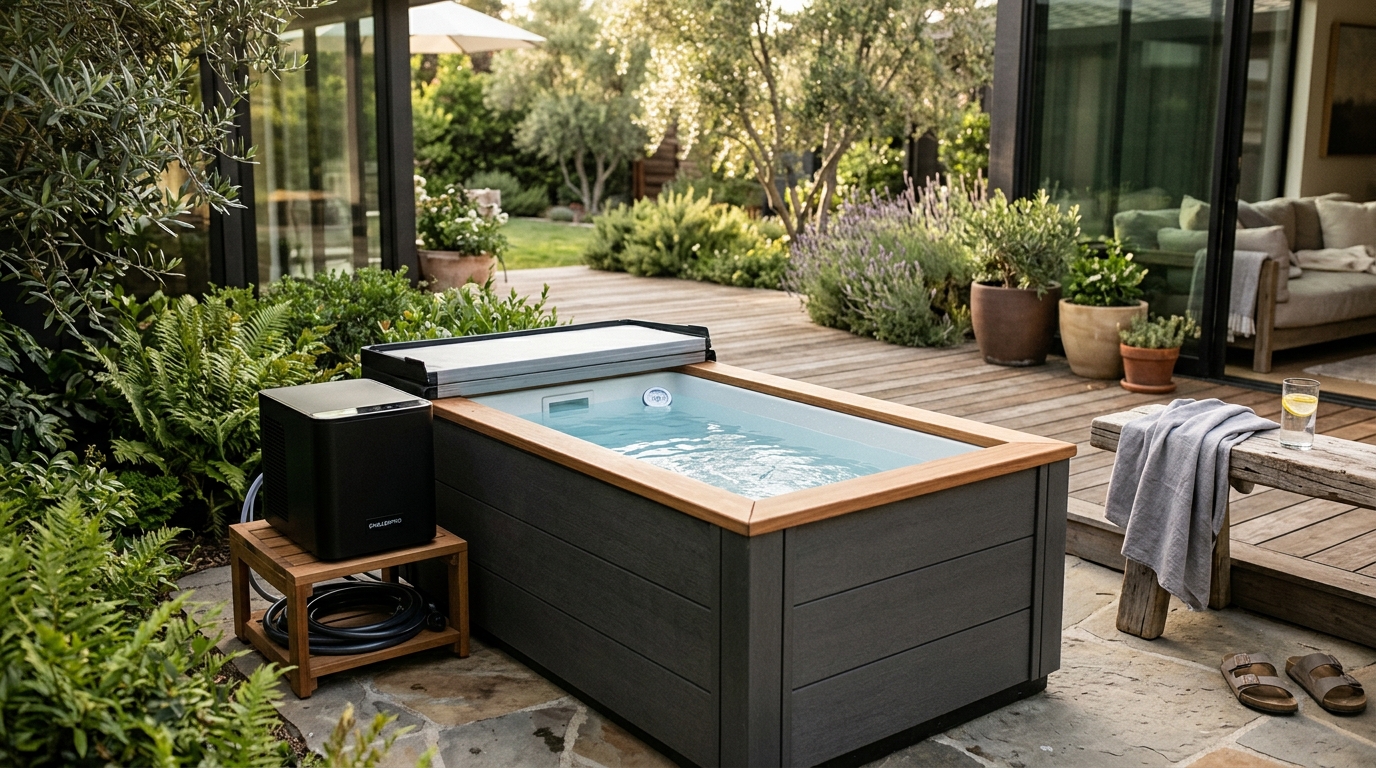
For a solo daily plunge at 50°F, a 1/3 HP standalone chiller ($350–600) is the right unit — it holds 100 gallons continuously on a standard 110V outlet, cools a fresh fill in 6–8 hours, and recovers after a session within 60–90 minutes. Two daily users should step to 1/2 HP to avoid scheduling conflicts in the morning.
A chiller converts a chest freezer, stock tank, or third-party barrel into a temperature-controlled plunge without hauling ice. The difference between a 1/4 HP and a 1/2 HP chiller is mostly recovery time between sessions: the smaller unit works fine for one user but makes a two-person household wait 3–4 hours between plunges. This guide covers four chiller tiers, what the specs mean day-to-day, and what to skip.
What the chiller specs actually mean
Before buying, there are four numbers worth understanding:
Horsepower (HP): The cooling capacity of the compressor. At 65°F ambient air temperature:
- 1/4 HP: cools 100 gallons from 70°F to 50°F in roughly 10–14 hours
- 1/3 HP: same tub in 6–8 hours; recovers after a single session in 60–90 minutes
- 1/2 HP: same tub in 4–6 hours; recovers in 30–45 minutes
- 1 HP: recovery in under 30 minutes; needed for 200+ gallon tubs or multi-user households
Flow rate (GPH): How fast the pump circulates water through the heat exchanger. A 100-gallon tub needs at least 100 GPH for one full circulation per hour. Most 1/3 HP dedicated plunge chillers ship with a 300–500 GPH pump.
Temperature range: Quality chillers cool to 37–40°F. Some units marketed as cold plunge chillers bottom out at 55°F — verify the minimum temperature in the spec sheet, not just the product title. Published cold-exposure research protocols are built on 50°F or below.
Heat exchanger material: Titanium resists saltwater, ozone, and chlorine; stainless handles freshwater without any sanitation. If you run ozone or add Epsom salts, titanium is required. The price premium at the 1/3 HP tier is about $50–80 and is worth paying.
Quick comparison
| Product | Best for | Rating | Notes | |
|---|---|---|---|---|
| 1/4 HP Aquarium-Style Chiller (DIY use) | Budget DIY with a 50-80 gallon vessel; experimenting before upgrading | ★★★★☆ | $200-350. Cools to 40F. Basic pump. Best with a small stock tank or chest freezer conversion. | Check price |
| 1/3 HP Cold Plunge Chiller with Titanium Heat Exchanger | Best overall for a solo daily user with a 100-gallon tub | ★★★★★ | $350-600. 110V. 400-500 GPH pump. Cools to 38F. Handles ozone sanitation. | Check price |
| 1/2 HP Cold Plunge Chiller (110V) | Two daily users or back-to-back 30-minute recovery windows | ★★★★★ | $550-900. 110V. Fastest home-tier recovery. Handles 100-150 gallon tubs. | Check price |
| 1 HP Commercial Cold Plunge Chiller | Multi-user households, athletes with multiple daily sessions, or 200+ gallon vessels | ★★★★☆ | $1,200-2,500. Some require 220V. Sub-30-minute recovery for serious setups. | Check price |
The picks
Best budget entry — 1/4 HP aquarium-style chiller
Best for first chilled plunge on a tight budget with a 50-80 gallon DIY vessel
1/4 HP Aquarium-Style Cold Plunge Chiller
Aquarium-grade 1/4 HP chillers in the $200-350 range were the original DIY cold-plunge solution before dedicated plunge chillers existed. They cool to 40°F, run on 110V, and connect to any vessel via standard hose fittings. The trade-off: they are rated for intermittent aquarium duty, not the continuous load of a plunge tub in a hot garage. At 65°F ambient, expect 10-14 hours for the first cool-down of a 100-gallon setup and 3-4 hours of recovery between sessions.
★★★★☆ 4.2 · 1,870 reviews
Check current price on Amazon→Pros
- Lowest-cost path to a chilled plunge — full setup under $600 with a used stock tank
- Widely available; replacement parts and repair guides are easy to find
- Standard hose fittings work with nearly any DIY vessel
- Cools to 40°F — below the threshold needed for any published cold-exposure protocol
Cons
- Recovery between sessions takes 3-4 hours at ambient temperatures above 70°F
- Pump output on most models is 200-300 GPH — tight for a 100-gallon vessel
- Stainless heat exchanger on most budget models; not safe with ozone or saltwater mixes
- Compressor is rated for aquarium duty cycles; continuous cold-plunge load can shorten service life to 3-5 years
Best overall — 1/3 HP cold plunge chiller with titanium heat exchanger
Best for solo daily user who wants a set-it-and-forget-it setup compatible with ozone or UV sanitation
1/3 HP Cold Plunge Chiller with Titanium Heat Exchanger
A 1/3 HP dedicated cold-plunge chiller with a titanium heat exchanger is where most serious single-user home setups land. Titanium handles ozone, chlorine, or saltwater that aquarium chillers corrode in. The 400-500 GPH pump cycles a 100-gallon tub completely in 12-15 minutes. Most models in this tier cool to 37-38°F. Expect a 6-8 hour first cool-down from tap water, then 60-90 minutes of recovery after a 5-minute session.
★★★★★ 4.5 · 640 reviews
Check current price on Amazon→Pros
- Titanium heat exchanger is safe with ozone, UV, chlorine, and saltwater sanitizers
- 400-500 GPH pump provides two full water circulations per hour in a 100-gallon tub
- Cools to 37-38°F — the lowest range most home plungers will ever need
- Recovers to 50°F after a single session in 60-90 minutes
- 110V plug — no electrician or dedicated circuit required
Cons
- Two-person households will find recovery time between sessions too long for a shared morning routine
- The external chiller-plus-tub setup is less polished than an integrated plug-and-play unit
- Most models ship without an inline ozone module — budget $120-180 extra for sanitation
- Compressor warranty at this price point is typically 2-3 years; extended coverage costs extra
Best for two users — 1/2 HP cold plunge chiller
Best for two daily users who need back-to-back sessions without a long wait in between
1/2 HP Cold Plunge Chiller (110V)
For a two-person household where both partners plunge in the morning, 1/2 HP is the minimum. A 1/3 HP chiller recovers to 50°F in 60-90 minutes — workable if users are 90 minutes apart. A 1/2 HP recovers in 30-40 minutes, which fits a typical morning routine. Most 1/2 HP home-tier units still run on 110V (verify before ordering) and cool 100-150 gallon vessels with room to spare.
★★★★★ 4.6 · 320 reviews
Check current price on Amazon→Pros
- Recovery to 50°F in 30-40 minutes after a 5-minute session — viable for back-to-back use
- Handles 100-150 gallon vessels comfortably; some units rated to 200 gallons
- Titanium heat exchangers are standard at this tier; ozone-compatible out of the box
- Most home-tier 1/2 HP units are still 110V — no dedicated circuit or electrician needed
Cons
- Price is $550-900 — a significant step up from 1/3 HP without a dramatic visual difference
- The cooling advantage over 1/3 HP is mostly recovery time, not minimum temperature
- At 110V the amp draw approaches the limit of a standard 15A household circuit; verify capacity
- Heavier and louder than 1/3 HP models — check decibel ratings if the unit is in a bedroom-adjacent space
Best for serious athletes — 1 HP commercial-grade chiller
Best for multi-user households, athletes with multiple daily sessions, or vessels over 150 gallons
1 HP Commercial Cold Plunge Chiller
A 1 HP chiller recovers a 100-gallon tub to 45°F in under 25 minutes and handles 2-4 daily users without noticeable lag. This is overkill for a solo plunger — the economics only make sense for households where multiple people plunge daily, or for performance athletes doing two cold sessions per day. Many 1 HP units require a 220V circuit, which means an electrician and a dedicated outlet. Factor that cost into the decision upfront.
★★★★☆ 4.4 · 175 reviews
Check current price on Amazon→Pros
- Sub-25-minute recovery from a full session — no scheduling required for multiple users
- Handles 150-300 gallon vessels; the right spec for serious home setups
- Built for continuous commercial duty; compressor service life often 10+ years
- Most units include a high-output pump (800-1,200 GPH) for rapid full-tub circulation
Cons
- Many 1 HP units require a dedicated 220V circuit — add $300-800 for electrician installation
- Initial cost $1,200-2,500 rivals a full plug-and-play plunge unit with an integrated chiller
- Physical footprint is significant; not suited for small garages or tight indoor spaces
- Overkill for a solo plunger — the cost premium rarely justifies the recovery-time advantage
What to skip
Chillers that only cool to 55–60°F. Some units marketed as cold plunge chillers have a minimum temperature of 55–60°F. That feels cold but misses the physiological response documented in published cold-exposure research, which is built on protocols at 50°F or below. Verify the minimum temp in the spec sheet, not the product title.
No-name 220V units without U.S. plug standards. International chillers built for 50 Hz often run poorly or fail early on 60 Hz U.S. power. Stick with units explicitly certified for North American power specifications.
Chillers rated for 100 gallons when your vessel holds 95+ gallons filled. The rated capacity assumes optimum ambient temperature (often 68°F). In a hot garage in summer, effective capacity drops 20–30%. If your tub is 100 gallons, buy a chiller rated for 130+ gallons.
Units with stainless heat exchangers if you plan to sanitize. Standard stainless corrodes quickly in ozone or saltwater. The repair cost — a full heat exchanger swap — often exceeds the price difference between stainless and titanium at purchase.
Sizing your chiller: quick reference
| Tub volume | Recommended HP | First fill time (65°F ambient) | Recovery after one session |
|---|---|---|---|
| Under 60 gal | 1/4 HP | 6–8 hours | 2–3 hours |
| 60–100 gal, 1 user/day | 1/3 HP | 6–8 hours | 60–90 min |
| 100–150 gal or 2 users | 1/2 HP | 4–6 hours | 30–45 min |
| 150–300 gal or 3+ users | 1 HP | 3–5 hours | Under 30 min |
How to connect a standalone chiller to your tub
Most chillers use 3/4-inch or 1-inch barbed fittings. What you need:
- Intake hose — from the bottom of your tub to the chiller inlet (cold water in)
- Return hose — from the chiller outlet back to the tub, aimed to create a gentle circulation pattern
- Submersible pump — if your chiller does not include one (most 1/3 HP+ units do; most 1/4 HP aquarium units do not)
- GFCI outlet — any water-adjacent electrical connection must be on a GFCI circuit; required by code in most U.S. jurisdictions
- Inline ozone module (optional but recommended) — installed on the return line before water re-enters the tub
The full assembly takes about 30 minutes. Fill the tub first, start the pump, verify water flow through the chiller, then power on the chiller. Never run a chiller without water flowing through the heat exchanger — a dry run damages the unit in minutes.
Operating cost comparison
All figures assume a 50°F target in a 100-gallon, well-insulated tub at 65°F ambient:
- 1/3 HP (best overall): ~400W draw, ~4 hours/day runtime = 1.6 kWh/day = ~$0.26/day at $0.16/kWh
- 1/2 HP: ~600W draw, ~3 hours/day = 1.8 kWh/day = ~$0.29/day
- 1 HP: ~900W draw, ~2 hours/day = 1.8 kWh/day = ~$0.29/day
The operating cost difference between tiers is smaller than most buyers expect. A better-insulated tub lid cuts chiller runtime more than stepping up one HP tier. If you want to reduce power draw, invest in a thicker closed-cell foam lid before upsizing the chiller.
Add roughly $5/month for ozone module consumables and $8/month for a sediment filter on a quarterly change schedule. Total monthly operating cost for a 1/3 HP setup with sanitation: roughly $20–25.
FAQ
Frequently asked questions
What horsepower chiller do I need for a cold plunge?
Can I use an aquarium chiller for a cold plunge?
What temperature can a cold plunge chiller reach?
Do I need an ozone module with my chiller?
How loud is a cold plunge chiller?
How is a standalone chiller different from a built-in chiller in a plunge tub?
Bottom line
For most home cold-plunge setups, a 1/3 HP chiller with a titanium heat exchanger is the right buy. It handles a solo daily user with a 100-gallon tub, runs on standard 110V, cools to below 40°F, and pairs with an inline ozone module for low-maintenance water management. If two people plunge daily, step to 1/2 HP — the recovery-time difference is real and eliminates the morning scheduling problem.
If you are still choosing a vessel, our best cold plunge tubs guide covers the full range from inflatable to pro-grade acrylic. For the hot side of a contrast therapy routine, see the best indoor saunas roundup. And the contrast therapy guide covers how to structure hot-cold alternation for maximum recovery benefit.