comparisons
Infrared vs Steam Sauna: Which Is Right for You?
Infrared vs steam sauna compared on heat, humidity, installation cost, health benefits, and which format suits your space and goals.
 Marcus Reade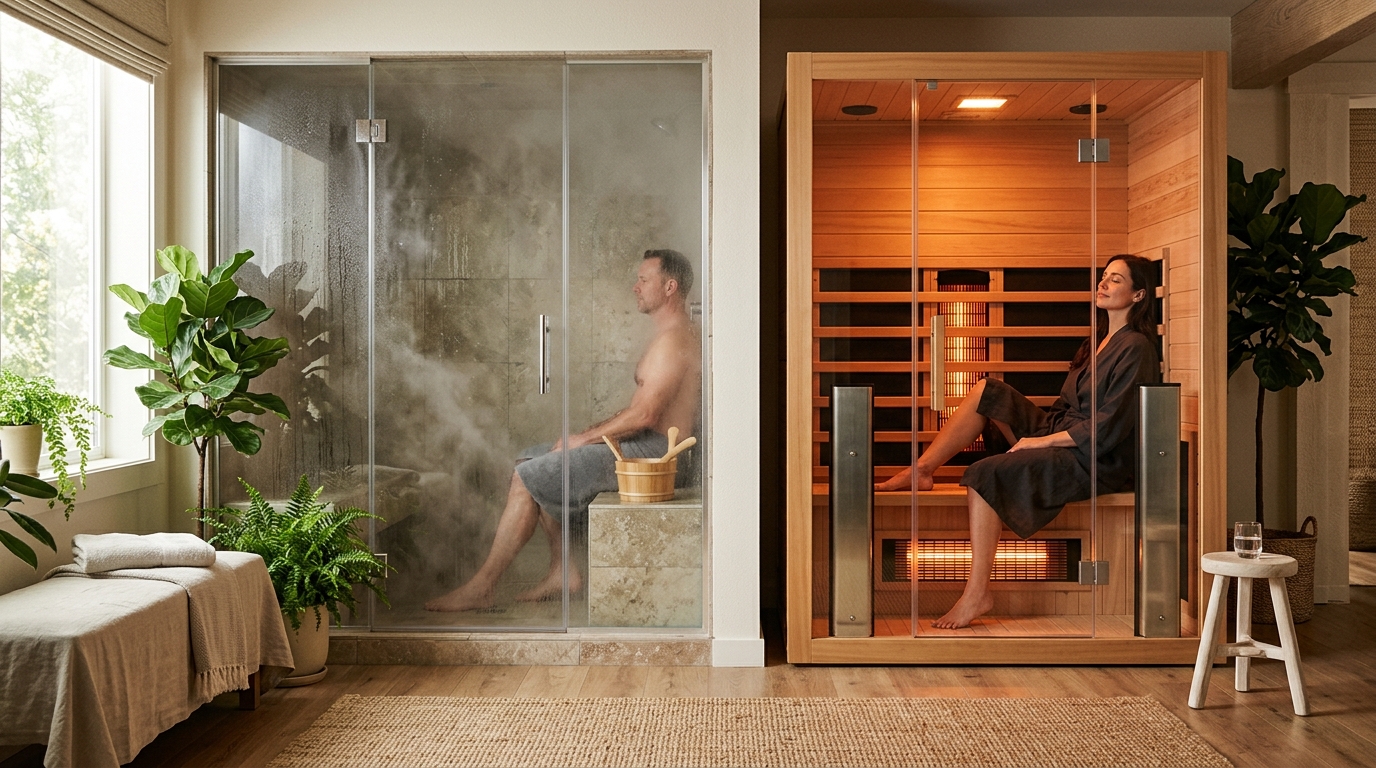
Quick answer: An infrared sauna uses radiant panels at 130–145°F in dry air and plugs into a standard outlet — easy to install and cheap to run. A steam sauna (steam room) uses a generator to fill the space with near-100% humidity at 100–115°F — wetter, more expensive to build, and genuinely superior for respiratory and skin benefits. Infrared wins for most home installs; steam wins when moist heat is the specific goal.
What is the difference between infrared and steam sauna?
An infrared sauna uses carbon or ceramic panels mounted in the walls of a cedar or basswood cabin. Those panels emit far-infrared wavelengths (7–14 micrometers) that penetrate your skin and heat your body directly. The ambient air in the cabin stays around 130–145°F and remains dry — typically 10–30% relative humidity. You sweat heavily from the inside out.
A steam sauna — more commonly called a steam room — works entirely differently. A steam generator (a water-heating unit installed in a nearby closet or mechanical chase) pumps pressurized steam into a sealed, tiled enclosure. The steam raises relative humidity to near 100% while keeping the air temperature at a more moderate 100–115°F. The wet heat drives sweating through a different mechanism and produces a very different felt experience.
Result: you can sit in both formats for 30 minutes and feel dramatically different. Infrared feels deeply warming but breathable — you can take slow, full breaths throughout. Steam feels enveloping and heavy in a way that makes your airways feel open and your pores feel flushed.
Infrared vs steam sauna: direct comparison
| Product | Best for | Rating | Notes | |
|---|---|---|---|---|
| Heat mechanism | Infrared: radiant panels heat body directly. Steam: generator pumps humidity to near 100%. | — | Infrared is dry; steam is fully saturated. | — |
| Air temperature | Infrared: 130-145°F. Steam: 100-115°F. | — | Steam feels hotter because humid air transfers heat more efficiently than dry air at the same temp. | — |
| Humidity | Infrared: 10-30%. Steam: 95-100%. | — | The defining difference in the felt experience and health applications. | — |
| Installation type | Infrared: flat-pack plug-in cabin. Steam: custom tile enclosure with generator and drain. | — | Infrared requires no waterproofing, plumbing, or special wiring in most homes. | — |
| Electrical | Infrared: 110V/15-20A standard outlet. Steam: 240V/30-60A dedicated circuit for generator. | — | Infrared needs no electrician in most homes; steam always does. | — |
| Cost to install | Infrared: $1,500-4,000 (cabin). Steam: $3,000-15,000 (custom room). | — | Pre-built steam shower cabins can be $2,000-5,000 and reduce tile work. | — |
| Per-session energy cost | Infrared: ~$0.20-0.35. Steam: ~$0.35-0.75. | — | At $0.16/kWh; steam generator run time and enclosure size vary cost. | — |
| Maintenance | Infrared: monthly wipe-down. Steam: weekly scrub for mold and scale. | — | Mold prevention is the primary ongoing task with any steam room. | — |
| Respiratory benefits | Steam: clear advantage for congestion and airways. Infrared: minimal. | — | Warm humid air loosens mucus; dry infrared air does not. | — |
| Joint and muscle recovery | Both effective; infrared penetrates deeper tissue. | — | Infrared is most common in clinical and athletic recovery settings. | — |
When infrared is the better choice
Choose infrared when:
- You want a home sauna you can install yourself in a weekend with no plumbing, tile work, or electrician call.
- Your primary goals are post-workout recovery, joint pain relief, or daily cardiovascular relaxation.
- You plan to use it five to seven times per week — the 15-minute heat-up and low operating cost make this genuinely sustainable.
- You are working with a garage corner, basement nook, or spare bedroom, not a dedicated wet room.
- Maintenance is a concern: infrared cabins need a wipe-down, not a deep scrub.
The most consistent finding among home-sauna buyers is that infrared cabins get used far more frequently than comparable steam installs, simply because setup friction is so low. A pre-built 2-person infrared cabin assembles from flat-pack panels in two to three hours and is running the same day.
When steam is the better choice
Choose steam when:
- You specifically want the moist, humid, respiratory-opening experience that infrared dry heat cannot replicate. There is no infrared setting that approximates a steam room — they are genuinely different.
- You have an active remodeling project. Adding a steam generator to a new master bath or shower addition typically costs $1,500–3,000 incremental — far less than a standalone steam room or even a quality infrared cabin.
- You have chronic sinus congestion, asthma, or upper-respiratory conditions that respond well to moist heat (consult your doctor first, but the evidence for warm humid air on airways is solid).
- The social and aromatic dimensions of steam matter to you — eucalyptus oil through a steam injection port fills the room in a way that is qualitatively different from infrared aromatherapy.
- Your space already has a tile shower that can be sealed and fitted with a generator for $1,000–2,500 in materials and labor.
Skin and respiratory: where steam has a real edge
This is the clearest advantage steam holds over infrared, and it is worth understanding concretely:
Skin hydration: Humid air keeps your skin surface continuously hydrated during the session. Infrared heat at low humidity will produce sweat, but the dry air simultaneously pulls moisture from the skin surface. People with dry or sensitive skin consistently prefer steam. Estheticians use steam for pre-facial skin prep specifically because the combination of warmth and humidity opens pores while maintaining the stratum corneum’s moisture balance.
Respiratory: Warm, humid air at 100–115°F reduces airway resistance and loosens mucus. People with chronic sinusitis, post-viral congestion, or mild intermittent asthma report measurable symptom relief from regular steam exposure. This mechanism has no equivalent in infrared — the air simply is not moist enough to produce the effect.
Cardiovascular and recovery: Both formats produce heart rate elevation, peripheral vasodilation, and post-session blood pressure reductions. The research base is roughly comparable in size, though more of the large observational studies used traditional sauna (a wet format) rather than infrared. Clinical trials on infrared show the same cardiovascular markers improving. Choosing between them on cardiovascular grounds is not well-supported by the current evidence.
Installation reality check
The single most consequential practical difference: infrared is a product purchase, steam is a construction project.
An infrared cabin arrives in flat-pack panels, goes together with basic tools, and plugs into a standard outlet. The full process — unboxing, assembly, first heat — takes most people three to four hours.
A dedicated steam room requires:
- A waterproof-sealed tile enclosure: cement board, waterproofing membrane (RedGard or Schluter KERDI), tile, and epoxy grout or sealed cement grout
- A steam generator installed in an adjacent closet or mechanical space
- A floor drain (or a sloped floor draining to an existing drain)
- A 240V dedicated circuit with the correct amperage for the generator (typically 30–60A depending on generator size)
- A steam head (wall-mounted nozzle) and optionally an aromatherapy injection port
- A ventilation fan on an automatic timer
Labor and materials for a custom 4×6-foot steam room typically run $4,000–10,000 when hiring a tile contractor and electrician. For a very small enclosure (a 3×4 steam shower conversion), $2,500–4,000 is realistic.
Pre-built steam shower cabins — self-contained acrylic or tempered-glass units with integrated generators — offer a middle path. They cost $2,000–5,000, assemble like infrared (no tile work), but still require a floor drain and 240V circuit. They are a reasonable option for finished basements with existing drainage.
Product picks
Best infrared cabin for daily home use
Best for people who want daily-habit home sauna without plumbing or special wiring
Dynamic Andora 2-Person Infrared Sauna
The 2-person infrared cabin is the most practical entry point for home sauna. Low-EMF carbon panels, hemlock or basswood construction, a real 15-minute heat-up, and a standard-outlet power draw mean you will actually use it every day. Assembles in 2-3 hours from flat-pack. No contractor required.
★★★★★ 4.5 · 2,100 reviews
Check current price on Amazon→Best home steam generator for shower conversion
Best for adding steam to an existing tile shower or new bathroom remodel
Mr. Steam MS Series 7.5kW Home Steam Generator
Mr. Steam is the residential steam generator brand specified most often by tile contractors. The 7.5 kW unit handles up to 100 cubic feet of enclosure space, which covers a standard 4x5 or 5x5 steam shower. Digital control panel, auto-drain valve, and an aromatherapy oil injection port. Two-year warranty.
★★★★★ 4.6 · 680 reviews
Check current price on Amazon→Best pre-built steam shower cabin
Best for people who want steam without a tile remodel
Maya Bath Platinum Combination Steam Shower
The combination steam shower cabin splits the difference: a pre-built tempered-glass unit with its own integrated steam generator. Assembly is flat-pack (3-4 hours), no tile work, but you still need a floor drain and 240V outlet. Full steam experience plus a rainfall head, chromotherapy lighting, and built-in exhaust. Best for finished basements with drainage.
★★★★☆ 4.3 · 390 reviews
Check current price on Amazon→What about a traditional sauna with löyly steam?
A Finnish-style traditional sauna with a kiuas (stone heater) produces brief steam bursts via löyly — water poured directly on hot igneous stones. This is not the same as a dedicated steam room. The humidity spike lasts 30–60 seconds and then dissipates; the ambient air is far hotter (180–195°F) than any steam room. Some people find löyly more satisfying than either pure format precisely because of that brief, intense humidity contrast.
If you want both high heat and meaningful steam, traditional sauna with löyly is the answer — not a hybrid infrared/steam cabin. See our infrared vs traditional sauna comparison for the full breakdown of that decision.
FAQ
Frequently asked questions
Is infrared or steam better for detox?
Can I install an infrared sauna in my bathroom?
Which is better for skin: infrared or steam?
How do I prevent mold in a steam room?
Can you use aromatherapy in both?
Bottom line
Infrared is the right default for most home buyers: plug-in installation, 15-minute heat-up, low running cost, and almost zero maintenance. It gets used daily in a way that steam rooms often do not, because the friction of use is so low.
Steam is worth the extra cost and complexity if the moist heat experience is what you specifically want — for respiratory benefits, skin hydration, or the enveloping sensation that dry infrared heat cannot replicate. Add it to a bathroom remodel for the best value; building a standalone steam room from scratch is the most expensive path.
For budget guidance on either format, see our home sauna cost guide. For top-rated cabin options, browse our best indoor saunas and best portable saunas roundups.