comparisons
Cold Plunge vs Ice Bath: Which Is Better for Recovery?
Cold plunge tub vs ice bath compared on temperature, cost, maintenance, and recovery benefits to help you choose the right cold therapy setup.
 Marcus Reade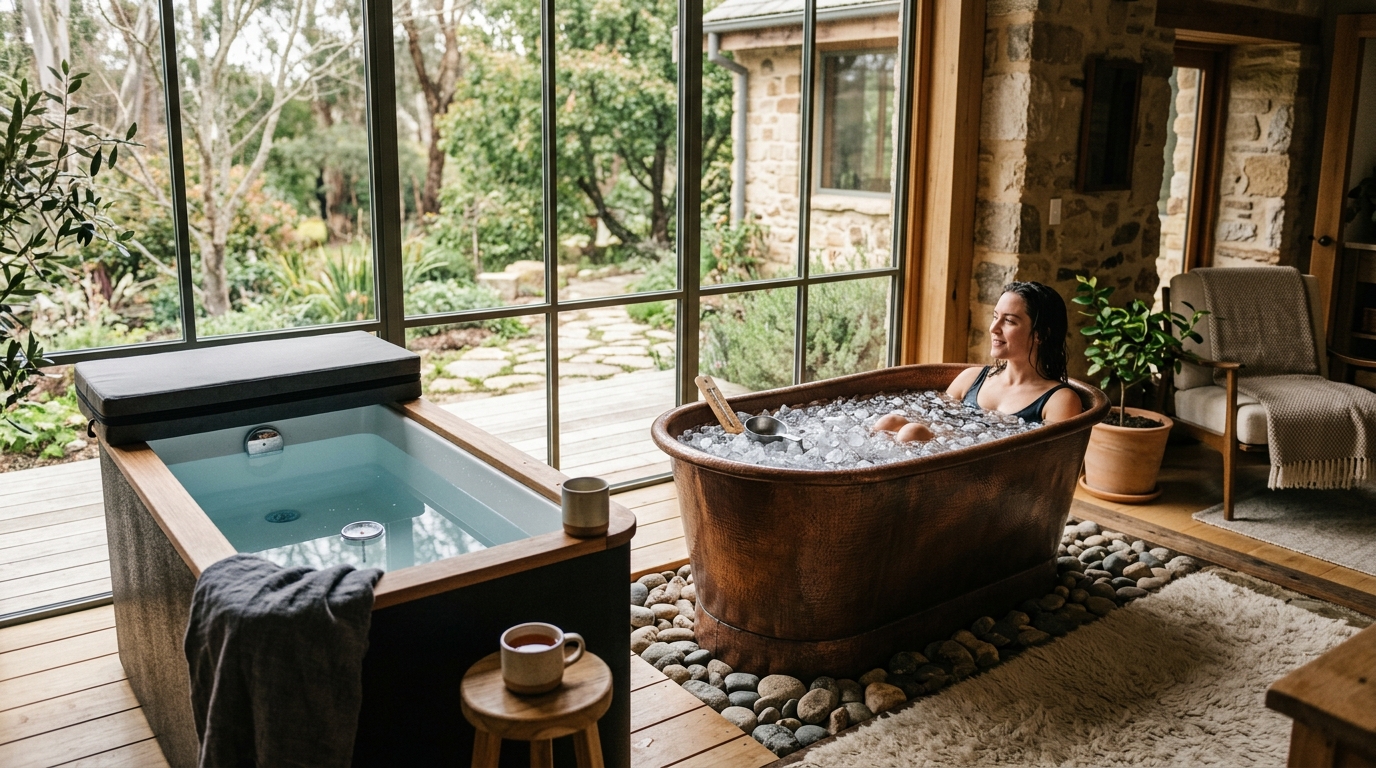
Quick answer: Both deliver the same cold-water immersion therapy — the physiological benefits are nearly identical at the target of 50–59°F. A dedicated cold plunge tub with a chiller holds temperature automatically and costs $500–5,000+; an ice bath uses a stock tank or tub filled with bags of ice for under $200. Start with ice to test your routine, then upgrade to a chiller if you plunge three or more times per week.
What is the difference between a cold plunge and an ice bath?
A cold plunge tub is a purpose-built vessel — ranging from an inflatable barrel to a stainless-steel spa unit — connected to an electric chiller that cools and circulates the water automatically. You set a target temperature, and the chiller maintains it indefinitely. No ice required. Built-in filtration (and often ozone or UV sanitation) keeps the water genuinely clean session after session.
An ice bath is exactly what it sounds like: a container of water cooled by adding bags of ice before each session. The vessel can be your bathtub, a chest freezer conversion, a livestock stock tank, or a purpose-made inflatable cold plunge vessel. Once the ice melts, the water warms — there is no mechanical temperature maintenance. The upfront cost is minimal, but per-session ice cost adds up fast at higher frequencies.
The therapeutic mechanism is identical. Cold water immersion triggers vasoconstriction, a norepinephrine and dopamine surge, reduced systemic inflammation, and faster perceived muscle recovery. Those effects depend almost entirely on water temperature and immersion duration — not the vessel type. At the same temperature, a $50 stock tank and a $4,000 chilled plunge tub produce essentially the same physiological response.
Cold plunge vs ice bath: direct comparison
| Product | Best for | Rating | Notes | |
|---|---|---|---|---|
| Upfront cost | Ice bath: $30-200 for stock tank or inflatable vessel. Cold plunge tub: $500-5,000+. | — | A used chest freezer plus a GFCI outlet is the cheapest functional cold plunge setup. | — |
| Per-session cost | Cold plunge tub: ~$0.10-0.25 in electricity. Ice bath: $4-12 in ice bags per session. | — | Ice costs add up fast. Five sessions per week runs $1,000-3,000 per year in ice alone. | — |
| Temperature control | Cold plunge tub: precise and automatic. Ice bath: variable and manual. | — | Chillers hold within 1-2 degrees. Ice baths start cold and warm as ice melts through the session. | — |
| Water maintenance | Cold plunge tub: filtration keeps water clean for weeks. Ice bath: drain required every 1-2 weeks. | — | Without filtration, standing cold water develops bacteria within days of regular use. | — |
| Setup time per session | Ice bath: 10-15 min to add and distribute ice. Cold plunge tub: always ready instantly. | — | Chiller tubs sit ready to use at all times; ice baths require prep before every session. | — |
| Portability | Ice bath: inflatable vessels fold flat and travel well. Cold plunge tub: mostly semi-permanent. | — | Inflatable ice bath vessels are ideal for travel or temporary setups; chillers are not. | — |
| Space required | Both need similar vessel footprint; cold plunge tub also needs space for chiller unit. | — | Most residential chiller units are roughly microwave-sized and sit beside or behind the vessel. | — |
| Noise | Ice bath: completely silent. Cold plunge tub chiller: similar to a window air conditioner. | — | Chiller noise runs roughly 45-55 dB during active cooling. Worth considering for shared spaces. | — |
| Temperature consistency | Cold plunge tub: holds exact target throughout session. Ice bath: warms as ice melts. | — | On warm days an ice bath may struggle to hit 50°F without very large quantities of ice. | — |
| Long-term cost | Cold plunge tub wins if used 3+ times per week vs ongoing ice purchases. | — | Break-even on a $1,500 chiller vs ice bags at 4 sessions/week is roughly 18-24 months. | — |
When an ice bath is the better choice
Choose an ice bath when:
- You are new to cold therapy and want to validate that it fits your routine before spending $1,000–5,000 on a chiller.
- You plunge once or twice a week — at that frequency, ice cost remains manageable and a dedicated chiller does not pay for itself within a reasonable timeframe.
- Portability matters. Inflatable cold plunge vessels fold flat and pack into a duffel bag. Ice is available at almost any gas station or grocery store.
- You are setting up outdoors in a cool climate. A partially shaded stock tank on a deck in cool weather needs surprisingly little ice to hold 55°F through a 10-minute session.
- Budget is the primary constraint. A 110-quart stock tank costs $30–50. An insulated inflatable ice bath vessel adds shape and better insulation for $40–100.
The honest case for ice baths: nearly all the foundational cold water immersion research was conducted using ice-based protocols. The physiological response is well-established, the cost is very low, and starting with ice gives you real data on how often you will actually plunge before committing significant money to a chiller system.
When a cold plunge tub is the better choice
Choose a cold plunge tub with chiller when:
- You plunge three or more times per week. At that frequency, ice costs and per-session prep time make a chiller the rational economic choice, typically reaching break-even within one to two years.
- You want the experience to be frictionless. A chiller tub is always ready: walk up, get in. No ice to haul, no prep time, no waiting for temperature.
- Protocol consistency matters. If you are using cold therapy for a specific training or recovery protocol, dialing in and holding an exact temperature every session produces more reliable and trackable results.
- You already use a home sauna and want to build a daily contrast therapy routine. Instant-on sauna plus instant-on cold plunge removes all friction from the hot-cold cycle.
- Water hygiene is important to you. Chiller filtration (often combined with ozone or bromine) keeps water genuinely clean across many sessions. Ice baths without filtration require vigilant maintenance.
The consistent finding among regular cold plunge users is that chiller tubs get used far more frequently than ice setups, simply because setup friction is so low. If the friction of buying ice and waiting for temperature is the thing that causes you to skip sessions, the chiller pays for itself in actually-delivered health benefits.
What temperature should a cold plunge or ice bath be?
The target range for effective cold water immersion is 50–59°F (10–15°C). Most of the well-cited protocols — including those referenced by Andrew Huberman, Susanna Søberg, and sports medicine researchers — use water at or below 60°F. The key physiological responses (norepinephrine surge, cold shock adaptation, vasoconstriction) activate reliably across this range.
Going colder than 45°F increases the risk of cold shock and hyperventilation without meaningfully increasing the recovery benefit for most users. Most experienced practitioners find 50–55°F the sweet spot: cold enough to produce a genuine challenge and full hormonal response, tolerable enough to stay in for 3–5 minutes without involuntary gasping.
For ice baths: expect to use 1.5–2 lbs of ice per gallon of water to reach 55°F starting from room-temperature water on a warm day. A 100-gallon stock tank requires roughly 150–200 lbs of ice for initial cool-down. Maintaining temperature through a 15-minute session requires topping off with 30–50 lbs of additional ice as the first load melts.
For chiller tubs: set your target temperature and let the unit run. Most residential chillers take 2–4 hours to cool a 100-gallon vessel from room temperature on first use. Between daily sessions, re-cooling takes under an hour once the water is already cold.
How long should you stay in a cold plunge or ice bath?
Step-by-step protocol for beginners
- Enter calmly. Lower yourself slowly into the water. Take slow, controlled breaths to manage the cold shock response — fight the urge to gasp and hyperventilate.
- Hold for 2 minutes minimum. Two minutes is enough time for meaningful vasoconstriction and the initial norepinephrine release.
- Work up to 3–5 minutes over several sessions. The first week, target 2 minutes. Add 30–60 seconds per week until you reach 5 minutes comfortably.
- Exit and rewarm naturally. Shivering after you exit is beneficial — it drives an additional dopamine and norepinephrine rebound. Do not immediately jump into a hot shower; sit with the cold for a few minutes.
- Track your sessions. Consistent weekly totals matter more than individual session length.
Target weekly volume: Evidence-based protocols generally suggest 11–15 minutes of total cold immersion per week, spread across 2–4 sessions. Daily plunges are practiced safely by many enthusiasts, but building up gradually is strongly recommended.
Cold plunge vs ice bath: which produces better recovery results?
The direct answer: the research does not distinguish between vessel type. It distinguishes between temperature and duration. A 2022 meta-analysis in Sports Medicine found that cold-water immersion at 50–59°F for 10–15 minutes per week produced consistent reductions in delayed-onset muscle soreness and accelerated perceived recovery in recreational athletes. The method of chilling the water was not a variable in any reviewed study.
Where a chiller wins on outcomes is protocol adherence. People plunge more consistently when the experience requires zero prep. Consistency is where cold therapy actually delivers — not a single dramatic ice bath, but repeated cold exposures accumulated over weeks and months. If a chiller results in five sessions per week instead of two, the chiller produces better real-world results regardless of the identical per-session physiology.
Safety precautions for cold water immersion
Cold water immersion carries real risks. Key precautions before you start:
- Never plunge alone when new to cold therapy. Cold shock can cause involuntary gasping and hyperventilation that leads to disorientation in the water.
- Avoid if you have cardiovascular disease, Raynaud syndrome, or are pregnant without explicit medical clearance. The sudden vasoconstriction and heart rate spike are contraindicated in several conditions.
- Do not combine with alcohol. Impaired judgment combined with cold shock is genuinely dangerous.
- Use a GFCI outlet for any electrically powered cold plunge chiller or chest freezer conversion. Water and electricity require a ground fault circuit interrupter without exception.
- Exit if you experience chest pain, severe dizziness, or numbness in your extremities that does not resolve within 30 seconds of entering.
For comprehensive contrast therapy safety and when to skip a session, see our sauna safety tips guide.
Product picks
Best budget ice bath vessel
Best for beginners and occasional plungers who want a dedicated vessel without committing to a chiller
Polar Recovery Cold Plunge Inflatable Ice Bath
An insulated inflatable vessel beats a stock tank in two ways: it holds temperature longer (reducing ice needed) and it gives you a comfortable seated position rather than crouching in a tank. Most setups in under five minutes, hold 80-105 gallons, and fold flat for storage. Add 40-50 lbs of ice and you reach 55°F in about 20 minutes. The right low-cost starting point.
★★★★☆ 4.3 · 1,840 reviews
Check current price on Amazon→Best entry-level cold plunge tub with chiller
Best for daily plungers who want automatic temperature control under 1,500 dollars
Ice Barrel 400 Cold Plunge Tub with Chiller
The vertical barrel design minimizes water volume to around 105 gallons, so a compact chiller cools it fast and keeps it cold economically. The upright seated position is natural for solo use and takes less floor space than a traditional horizontal tub. Pair with a compatible portable chiller and the full system runs $800-1,200. Always ready, always at your target temperature.
★★★★★ 4.5 · 2,300 reviews
Check current price on Amazon→Best premium cold plunge tub
Best for serious athletes and daily contrast therapy practitioners who want a spa-quality no-maintenance setup
The Plunge Cold Plunge Tub with Integrated Chiller
The Plunge sets the benchmark for residential cold plunge: built-in filtration, ozone sanitation, a powerful chiller that holds as low as 39°F, and a full-length spa tub form factor. The chiller unit sits beside or behind the vessel. At $3,000-5,000 it is a genuine commitment, but the always-on, zero-prep experience is a real quality-of-life upgrade that drives daily-use consistency.
★★★★★ 4.7 · 910 reviews
Check current price on Amazon→What about chest freezer cold plunge conversions?
A chest freezer conversion is one of the most popular DIY cold plunge setups and worth knowing about. A 7-cubic-foot chest freezer holds roughly 55–65 gallons of water, cools it to 39°F automatically, and costs $200–400 used on Craigslist or Facebook Marketplace. The freezer thermostat holds temperature as precisely as any dedicated chiller.
The key requirements: use a GFCI outlet without exception, add a pool sanitizer (bromine tabs or an ozone generator) to control bacteria, and plan to do a full water change every 4–6 weeks. The main downside is size — a chest freezer requires you to climb in and crouch or sit in an awkward position. If you are under 6 feet tall and have a garage or basement, it works very well. Search online for chest freezer cold plunge conversion to find detailed step-by-step build guides from experienced users.
FAQ
Frequently asked questions
Is a cold plunge or ice bath better for muscle recovery?
How much ice do I need for an ice bath?
Can I use a chest freezer as a cold plunge tub?
How often should you do a cold plunge?
Do cold plunge tubs require a lot of maintenance?
Can you do contrast therapy with an ice bath instead of a cold plunge tub?
Bottom line
Ice bath first, chiller when you are ready. Start with an inflatable vessel or stock tank to confirm that cold water immersion fits your lifestyle before spending $1,500–5,000. If you consistently plunge more than twice a week and find yourself wishing the setup were faster and the temperature more precise, a dedicated cold plunge tub with a chiller pays for itself in avoided ice costs and reclaimed prep time within one to two years of regular use.
For top-rated cold plunge options including dedicated tubs and portable setups, see our best cold plunge roundup. To combine cold therapy with heat for maximum recovery, read our how to use a sauna guide and browse our best indoor saunas for compatible home sauna options.