guides
Sauna Temperature Guide: Ideal Ranges by Type and Goal
The right sauna temperature depends on your sauna type and goal. Exact ranges for traditional, infrared, and steam, plus how to build heat tolerance.
 Marcus Reade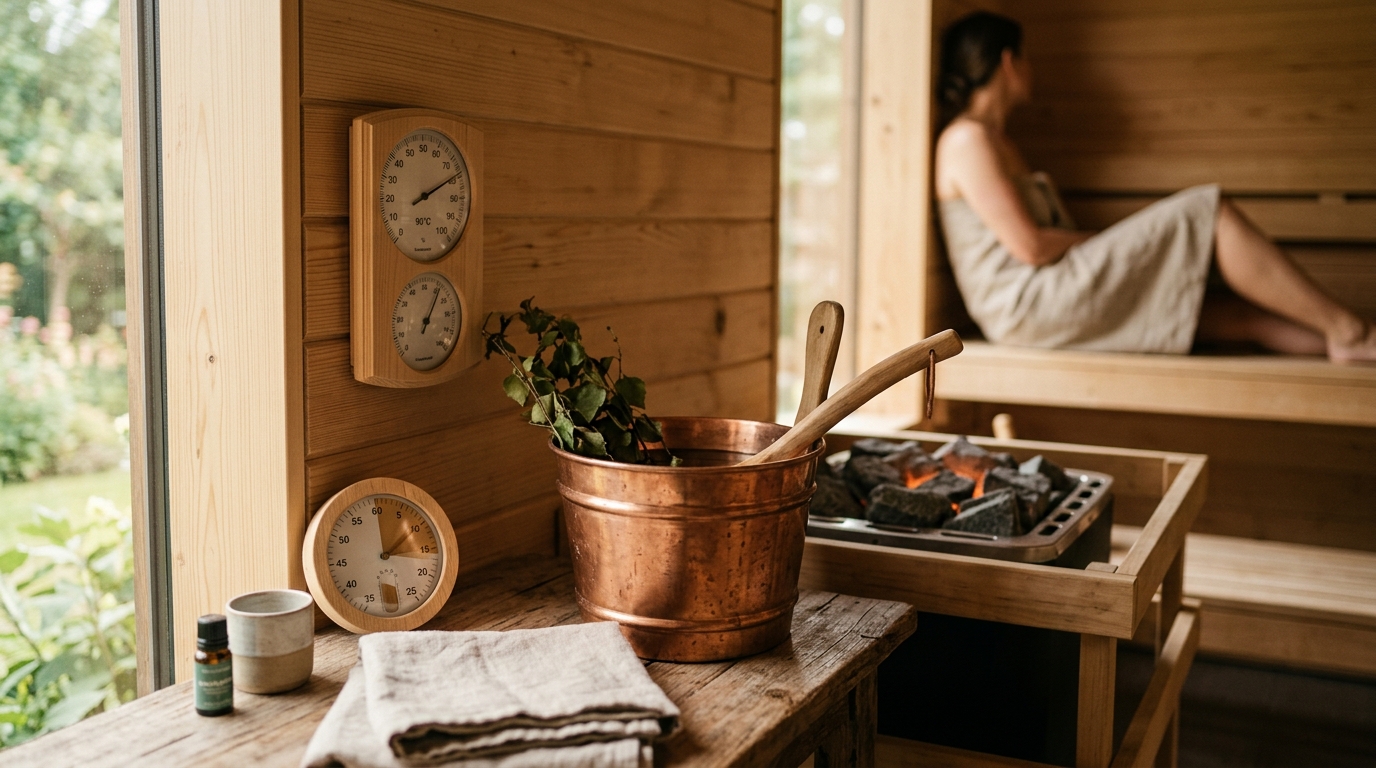
Traditional Finnish saunas run at 150–195°F (65–90°C); infrared saunas run at 120–140°F (49–60°C); steam rooms at 110–120°F (43–49°C). The lower air temperature in infrared and steam is not a downgrade — radiant penetration and 100% humidity compensate fully. For a first-time Finnish sauna session, 170°F on the upper bench is the ideal starting target.
What temperature should a sauna be?
The honest answer depends on the type of sauna, your experience level, and what you are trying to achieve. Here are the core ranges in a single table, with each type broken down in detail below.
| Product | Best for | Rating | Notes | |
|---|---|---|---|---|
| Traditional Finnish sauna | deep heat, authentic steam (loyly), cardiovascular benefits | ★★★★★ | 150-195°F (65-90°C). Pour water on stones for steam. Bench-level temp is typically 160-185°F. | — |
| Infrared sauna (far-infrared) | beginners, joint comfort, longer comfortable sessions | ★★★★★ | 120-140°F (49-60°C). No steam. Radiant heat penetrates 1-2 inches into tissue. | — |
| Infrared sauna (near-infrared) | skin exposure, photobiomodulation protocols | ★★★★★ | 100-130°F (38-54°C). Shorter wavelength, focused surface and shallow-tissue penetration. | — |
| Steam room | respiratory benefits, high perceived heat at lower air temp | ★★★★★ | 110-120°F (43-49°C) at 100% humidity. Perceived intensity equals a dry sauna at 140-150°F. | — |
| Outdoor barrel sauna | traditional experience outdoors, compact footprint | ★★★★★ | Same targets as Finnish sauna: 150-195°F. Wood-fired heats faster but is less stable than electric. | — |
Traditional Finnish sauna temperature
The target range: 150–195°F (65–90°C)
A Finnish sauna is designed to operate at high dry heat. The standard range covers a wide band because the experience is intentionally adjustable by both heater setting and bench position:
- 150–165°F (65–74°C): The lower end. Comfortable for long sessions, well-suited for beginners or users with cardiovascular sensitivities. You will sweat freely at this range, but perceived intensity stays moderate.
- 165–185°F (74–85°C): The functional sweet spot for most experienced users. Deep sweating, thorough muscle relaxation, meaningful cardiovascular stimulus. This is where the physical benefits peak for regular bathers.
- 185–195°F (85–90°C): The high end. Achievable in a well-insulated cabin with a properly sized heater. Used by experienced Finnish bathers. Sessions at this temperature typically run shorter — 8–12 minutes per round rather than 15–20.
The Finnish Sauna Society recommends 80–100°C (176–212°F) as the classic range. Most sauna owners target the middle of that band, around 85–90°C (185–194°F), for a traditional session.
The bench effect
This is the most commonly misunderstood aspect of Finnish sauna temperature. The thermometer reading does not tell you what your body experiences unless you know where the thermometer is mounted.
In a Finnish sauna, hot air rises. The temperature gradient from floor to ceiling can span 40–60°F in the same room:
| Bench position | Approximate temperature |
|---|---|
| Floor level | 100–120°F |
| Lower bench (seated) | 140–165°F |
| Upper bench (seated) | 165–195°F |
| Ceiling | 190–220°F |
If your sauna thermometer is mounted near the ceiling — as most saunas ship them by default — it may read 210°F while the actual bench-level temperature where you are sitting is 185°F. Remount the thermometer at seated height, or add a second one, so you are reading the temperature your body is actually in.
Löyly and perceived temperature
Ladling water onto sauna stones does not significantly raise the thermometer reading, but it sharply increases perceived intensity. The steam adds humidity to a naturally dry environment (typically 5–20% relative humidity), creating a surge in how hot the air feels on your skin and inside your lungs.
One ladle on stones at 185°F produces a wave of steam that lasts 30–60 seconds. During that wave, the perceived sensation jumps by what most users describe as the equivalent of 15–25°F. This is the löyly experience — and it is why Finns treat the hygrometer reading as the other half of the temperature story, not an optional add-on.
Infrared sauna temperature
The target range: 120–140°F (49–60°C)
Infrared saunas operate at dramatically lower air temperatures than Finnish saunas because the heating mechanism is fundamentally different. A traditional sauna heats the air, which heats your body. An infrared sauna radiates electromagnetic energy that is absorbed directly by your skin and subcutaneous tissue, generating heat from the inside out.
The result: at 130°F in an infrared sauna, your body is doing roughly the same physiological work as at 170–180°F in a Finnish sauna. The air feels mild, but your core temperature rises at a comparable rate over a 30–40 minute session.
- 120–125°F (49–52°C): Good starting point for new infrared sauna users or users with heat sensitivity. Sessions can run 30–45 minutes comfortably at this range.
- 125–135°F (52–57°C): The typical operating range for daily users. Deep sweating, cardiovascular response, full tissue penetration.
- 135–145°F (57–63°C): Upper end for most infrared cabins. Some units are limited to 140°F by their control boards. Sessions at this range are shorter — 20–30 minutes.
Near-infrared vs far-infrared temperature
Near-infrared (NIR) saunas use shorter-wavelength light that penetrates the skin more shallowly and targets surface tissue and mitochondrial function. These are sometimes marketed as red-light therapy panels rather than saunas. Operating temperatures are lower — often 100–130°F — and sessions emphasize light exposure duration as much as heat duration.
Far-infrared (FIR) saunas use longer wavelengths that penetrate 1–2 inches into muscle and joint tissue, generating the internal heat that most users associate with the infrared sauna category. The vast majority of consumer infrared sauna cabins are far-infrared units.
Steam room temperature
The target range: 110–120°F (43–49°C)
Steam rooms run at the lowest air temperature of any sauna category, but 100% relative humidity means perceived intensity is dramatically higher than the number suggests. Sweat cannot evaporate from your skin into already-saturated air, so the body’s primary cooling mechanism stops working. The same physiological stress that occurs at 140°F dry happens at 110–115°F in a steam room.
Steam rooms are particularly effective for respiratory benefits — the moist air reaches the sinuses, bronchial passages, and lungs in a way dry saunas cannot replicate. They are also the most accessible format for users who find dry heat uncomfortable or irritating to the airways.
The risks are also amplified: hyperthermia develops faster in a steam room than in a dry sauna because evaporative cooling is blocked. Most experienced steam room users recommend 10–15 minute maximum sessions, even for regular users, and pay closer attention to exit signals like lightheadedness.
How temperature affects sauna benefits
Getting the temperature right is not purely about comfort — it determines which physiological adaptations actually occur.
Cardiovascular stimulus
Meaningful cardiovascular response — elevated heart rate, increased cardiac output, peripheral vasodilation — begins at about 150°F in a dry Finnish sauna and about 120°F in an infrared sauna. Below those thresholds, you will be warm and may sweat lightly, but the cardiovascular load is minimal. The Finnish cohort studies linking regular sauna use to reduced cardiovascular mortality measured sessions at 80°C (176°F), confirming that the relevant research takes place at the upper end of the range.
Heat shock proteins
Heat shock protein (HSP) upregulation, associated with cellular repair and stress resilience, is temperature-dependent. Meaningful HSP activation requires sustained core temperature elevation, which generally requires at least 20 minutes at the standard Finnish sauna range or comparable infrared exposure at 130°F or above.
Growth hormone response
Post-sauna growth hormone elevation is documented in multiple studies. The stimulus appears to be core temperature increase plus duration rather than air temperature alone — which is why infrared saunas can produce comparable hormonal response to Finnish saunas despite operating at lower air temperatures, provided session length is adequate.
Mental and relaxation benefits
These are less temperature-dependent than the physical benefits. The heat, the ritual, and the quiet produce parasympathetic nervous system activation across a wide range of temperatures. A 145°F Finnish sauna still delivers the relaxation, the mental quiet, and the sleep improvement that regular sauna users report — just with a longer window before the heat becomes taxing.
How to adjust temperature in your sauna
Finnish and traditional sauna
- Control via the heater thermostat. Most electric sauna heaters have a dial or digital control that sets the target temperature. Set it before entering and allow 30–60 minutes for the room to pre-heat fully.
- Manage heat via bench position. Moving from the lower bench to the upper bench increases perceived heat by 10–30°F without changing the heater setting — the single most useful adjustment for first-time users.
- Control steam intensity via water application. Löyly adds perceived heat immediately. If the thermometer reads high but the air feels dry, one ladle on the stones intensifies the session without raising the heater output.
- Open the sauna door briefly. Cracking the door for 30 seconds drops the room temperature 5–10°F and refreshes the air. Useful at the high end of the range or between löyly rounds.
Infrared sauna
- Pre-heat 15–20 minutes before entering. Infrared panels need time to warm up and the air temperature needs to reach the target for the full experience.
- Enter during pre-heat if the unit allows. Some users enter at 100–110°F and let the heat climb to 130–135°F while inside, which extends the session and allows a gentler ramp-up.
- Adjust session length rather than temperature. For infrared, duration is a more direct way to control total heat load than small setting changes within the 120–140°F range. An extra 10 minutes at 130°F is more effective than pushing to 145°F for less time.
When to use lower vs higher temperatures
| Scenario | Recommended temperature |
|---|---|
| First-time user | 150-165°F Finnish, or 120-125°F infrared |
| Post-exercise recovery | 160-175°F Finnish, or 125-135°F infrared |
| Pre-sleep wind-down | 150-165°F Finnish, or 120-130°F infrared |
| Cardiovascular focus session | 175-185°F Finnish |
| With elderly guests or new users | 150-160°F Finnish, or 115-125°F infrared |
| Physician-cleared medical use | Follow physician guidance; begin at the low end |
Tracking temperature with a good thermometer
The single most useful sauna accessory is an accurate thermometer mounted at the right height. A ceiling-mounted spirit-tube thermometer — the kind most saunas ship with — reads the temperature near the ceiling rather than where your body is, and it drifts out of calibration within a year of regular use.
Best for accurate bench-level temperature and humidity readings
Harvia Wood Sauna Thermometer and Hygrometer
The Harvia wood-frame combo is the standard Finnish accessory for a reason. Kiln-dried pine frame stays cool to the touch at 190°F, the bimetallic dial holds calibration through years of thermal cycling, and the mechanical hygrometer adds the humidity reading that tells the other half of the temperature story. Mount it at seated bench height, not at ceiling level, for accurate session data.
★★★★★ 4.7 · 980 reviews
Check current price on Amazon→For a full comparison across every thermometer type and price point, see the best sauna thermometers guide.
FAQ
Frequently asked questions
How hot should a sauna be for the first time?
Is 200°F too hot for a sauna?
Why does my infrared sauna feel less intense than a traditional sauna at the same temperature setting?
Where should I mount the sauna thermometer?
Does adding water (loyly) raise the temperature reading?
How long should I stay in a sauna at each temperature?
Bottom line
Temperature targets by sauna type:
- Traditional Finnish sauna: 150–195°F, with 170–185°F as the sweet spot for regular adult users
- Infrared sauna: 120–140°F, with 125–135°F as the standard daily-use range
- Steam room: 110–120°F at 100% humidity — lower than it looks, more intense than it sounds
The temperature range matters less than where you measure it. A thermometer at ceiling height overstates what your body is actually experiencing by 20–40°F. Mount yours at seated bench height, pair it with a hygrometer if you have a Finnish sauna, and use perceived comfort — not pure time — as your exit signal.
Read how to use a sauna for a complete beginner protocol, see the infrared vs traditional sauna comparison if you are choosing a format, or browse the best sauna thermometers guide to find an accurate one for your setup.