guides
Cold Plunge Temperature Guide: Optimal Ranges Explained
What temperature should your cold plunge be? This guide covers the optimal 50-59°F range, temperature tiers by goal, and how to maintain your target.
 Marcus Reade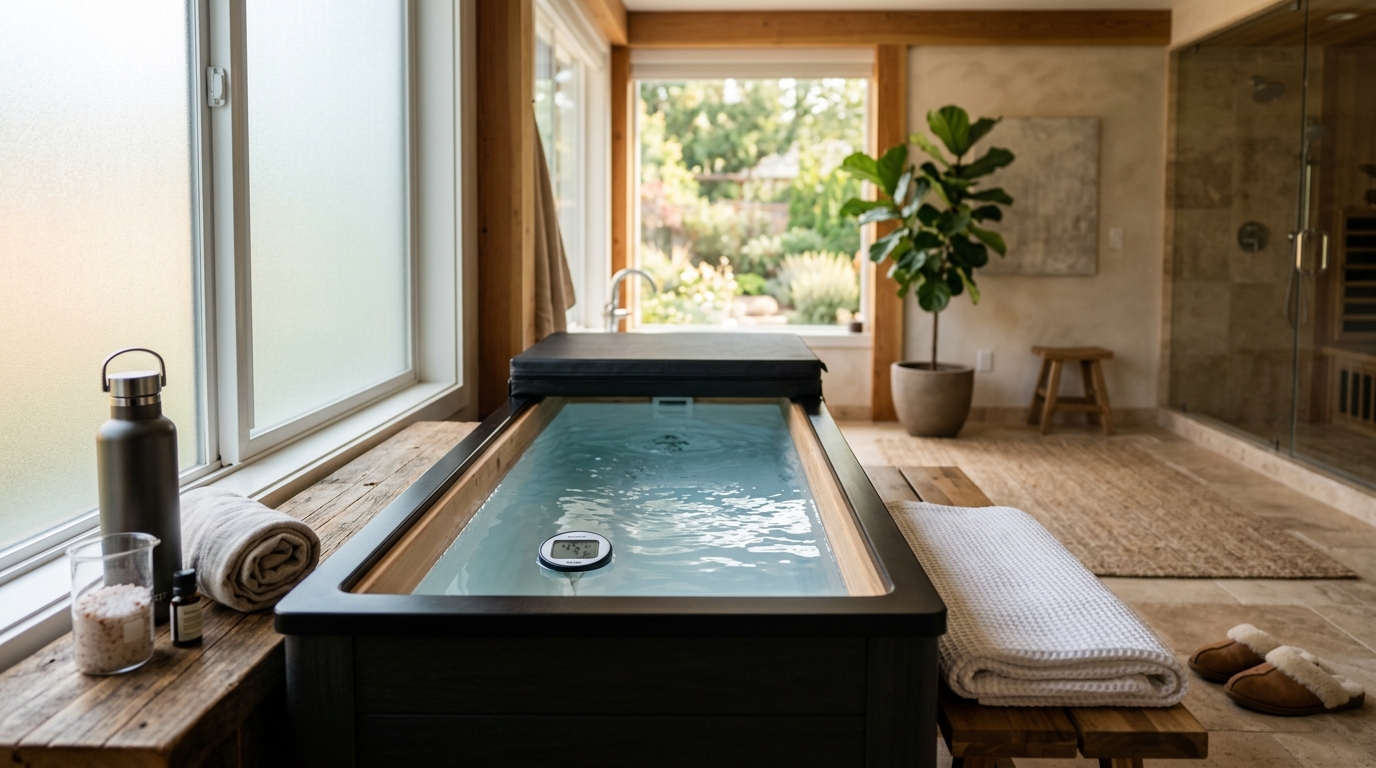
Quick answer: The optimal cold plunge temperature is 50 to 59°F (10 to 15°C). This range reliably triggers the norepinephrine and dopamine surge, vasoconstriction, and cold adaptation that make cold immersion worthwhile. Experienced plungers often work at 45 to 55°F; beginners should start at 57 to 60°F and acclimate over two to four weeks before going colder.
What temperature should a cold plunge be?
The ideal cold plunge temperature for most people is 50 to 59°F (10 to 15°C). At this range, the core physiological response is both substantial and consistent:
- Blood vessels constrict rapidly, routing blood away from the limbs toward the core
- Norepinephrine surges 200 to 300% above baseline within seconds of immersion
- Dopamine rises approximately 250% and remains elevated for two to three hours post-session
- The acute cold shock response activates on entry, then subsides within 30 to 90 seconds with controlled breathing
This 10-degree window is the range most cited in cold immersion research, including work by Dr. Susanna Søberg — whose protocols identified 11 total minutes per week at sub-60°F as the minimum effective dose — and the protocols popularized by Dr. Andrew Huberman. Going colder than 50°F intensifies the initial shock without producing proportionally larger benefits for most people. Going warmer than 60°F produces a weaker and less reliable physiological stimulus.
For contrast therapy combining sauna and cold plunge, this 50 to 59°F range is the standard recommendation. See our contrast therapy guide for full cycling protocols.
Cold plunge temperature tiers: what each range does
| Product | Best for | Rating | Notes | |
|---|---|---|---|---|
| 68°F and above (20°C+) | Total beginners and people with Raynaud syndrome or cold sensitivity | — | Cool but not clinically cold. Minor circulatory benefit and useful for psychological introduction to immersion. Does not reliably trigger the norepinephrine surge most people are seeking from a cold plunge. | Check price |
| 60 to 68°F (15 to 20°C) | Beginners building cold tolerance in the first 2 to 4 weeks | — | Noticeably cold. Produces mild vasoconstriction and a low-level stress adaptation. A solid starting point for people who find sub-60 temperature overwhelming. Benefits accumulate with daily practice at this tier. | Check price |
| 50 to 59°F (10 to 15°C) | Most users seeking recovery, mood, and cold adaptation benefits | — | The evidence-backed optimal range. Reliably drives the norepinephrine surge, dopamine elevation, and vascular response. The 2 to 4 minute duration at this temperature matches most published research protocols. | Check price |
| 40 to 50°F (4 to 10°C) | Experienced plungers seeking the maximum acute stimulus | — | Intense cold shock on entry. Marginal additional benefit over 50 to 59°F for most users. At 45°F and below, hyperventilation risk and loss of limb control increase meaningfully. Keep duration to 1 to 3 minutes at this range. | Check price |
| Below 40°F (below 4°C) | Not recommended for regular home use | — | Ice water at 32 to 38°F produces extreme cold shock. Involuntary gasping and loss of fine motor control can occur within seconds of immersion. Used in specific research protocols — not appropriate for unsupervised home practice. | Check price |
How temperature affects specific cold plunge goals
Recovery and inflammation reduction
For muscle soreness and post-workout recovery, temperatures between 50 and 59°F for 10 to 20 total minutes per week show the most consistent research support. A 2022 meta-analysis in the British Journal of Sports Medicine found cold water immersion at 50 to 59°F reduced perceived muscle soreness by 20 to 40% compared to passive rest. Going colder produced similar results — the key driver is cumulative time in range, not sheer water temperature.
For recovery-focused plunging, immerse within 30 to 60 minutes post-training to capture the greatest anti-inflammatory effect. If you are also trying to maximize muscle hypertrophy, some evidence suggests limiting cold immersion in the 48 hours following heavy strength work — the anti-inflammatory action can slightly blunt hypertrophic signaling — though for general health users this tradeoff is considered acceptable.
Dopamine and mood elevation
The dopamine response to cold immersion is one of its most valuable and underappreciated effects. Research documents a 250% increase in plasma dopamine following cold immersion at approximately 57°F, and crucially, this elevation persists for two to three hours after the session ends. Unlike the brief dopamine spike from caffeine or sugar, cold-induced dopamine rises in a controlled curve that supports sustained focus, drive, and mood through a morning work block or afternoon recovery window.
Temperature matters here, but not dramatically once you are below 59°F. The response at 55°F and 45°F appears comparable in magnitude. What matters more for dopamine benefit is immersion depth (to the neck, not just legs), controlled breathing during the session, and regular practice of at least two to three sessions per week for neuroadaptation to accumulate.
Cold adaptation and stress resilience
Cold adaptation — the physiological and psychological changes that come from repeated cold exposure — occurs most efficiently when you consistently stress your system without overwhelming it. The 50 to 59°F range is ideal for this because:
- It triggers a genuine cold shock response on entry that demands a response
- The shock subsides within 30 to 90 seconds with controlled breathing, allowing you to practice calm under acute physical stress
- It is intense but manageable, enabling consistent daily or near-daily practice
Practitioners who progress gradually — starting at 60°F and dropping 2 to 3 degrees per week over four to six weeks — typically report better long-term adherence and stronger adaptation outcomes than those who jump immediately to ice baths. The psychological skill of managing the cold is inseparable from the physiological benefit.
Sleep quality
Morning cold plunges at 50 to 59°F support sleep quality that same night through two mechanisms: the dopamine-to-serotonin conversion pathway that activates in the hours following cold exposure, and the body temperature regulation reset that acute cold produces. Evening sessions can also support sleep if completed more than two hours before bed, though some users find the norepinephrine elevation from evening plunges overstimulating for sleep onset.
How to reach and maintain your target temperature
Ice bath method
An ice bath — using a chest freezer conversion, galvanized stock tank, or inflatable tub loaded with ice — is the most affordable entry point to cold plunging. To bring a 100-gallon vessel to the 50 to 59°F target range:
- Fill with cold tap water (typically 60 to 70°F depending on season and region)
- Add 15 to 25 lbs of ice, stir to distribute temperature evenly
- Verify temperature with a probe thermometer at mid-depth before entering
- Expect water to warm 5 to 8 degrees over a 15-minute session
The main drawbacks are prep time and ongoing ice cost. Daily plungers spending $6 to $8 per bag of ice can pay $50 to $80 per month on ice alone. The water also warms continuously from the moment you add ice, so temperature consistency session to session requires attentive management.
Chiller system
A cold plunge tub with an integrated chiller holds your target temperature automatically around the clock. Set it to 55°F and it maintains exactly 55°F whether you plunge at 6 AM or 9 PM. For anyone plunging three or more times per week, a chiller typically pays for itself in 12 to 24 months compared to ongoing ice costs, and eliminates all prep friction — you simply get in.
Most residential chillers use 800 to 1,500 watts and run on a standard 120V outlet. Expect 6 to 12 hours of initial chill time to bring a full tub from room temperature down to 50°F. Ongoing maintenance involves periodic water changes every two to four weeks and cleaning the filter or ozone unit as specified by the manufacturer.
Seasonal outdoor use
Natural water — a river, lake, or outdoor plunge barrel — can deliver ideal cold plunge temperatures seasonally without any equipment. In many regions, early spring water temperatures land at 45 to 58°F, providing a naturally perfect cold plunge environment. Cold-water swimming outdoors follows the same temperature guidelines: 50 to 59°F is the productive zone, and below 45°F warrants a spotter, experience, and a planned exit strategy.
Recommended gear for hitting your target temperature
Best for anyone plunging 3 or more times per week who wants automatic temperature control at 50 to 59°F
Cold Plunge Tub with Integrated Chiller
A chiller eliminates the biggest friction point in regular cold plunging: prep time. Set your target temperature once and the unit holds it within 1 to 2 degrees indefinitely. Most residential units reach 50°F within 8 to 12 hours of initial chill and maintain that temperature year-round regardless of ambient conditions. For daily plungers, the per-session cost drops well below ice bath costs within the first year.
★★★★★ 4.5 · 1,840 reviews
Check current price on Amazon→Best for ice bath users who need to verify actual water temperature before each session
Waterproof Digital Probe Thermometer
Cold perception is not accurate enough to confirm you are in the therapeutic 50 to 59°F window. A waterproof probe thermometer gives a precise reading in under 10 seconds. Take one reading at the surface and one at mid-depth — stratification is common in ice baths and the difference can be 5 to 8 degrees. Knowing your exact temperature lets you calibrate ice quantity, session duration, and weekly cold exposure minutes accurately.
★★★★★ 4.6 · 3,280 reviews
Check current price on Amazon→Best for budget-focused plungers who want a rugged vessel for ice-based cold plunging at home
Galvanized Stock Tank Cold Plunge Tub
A 100 to 150-gallon galvanized stock tank is the most durable low-cost cold plunge vessel available. Built for outdoor year-round use, large enough for full-body immersion, and available widely. Pair with an insulated lid to slow warming between sessions, add your ice, and verify with a probe thermometer — and you have a fully functional cold plunge setup for under $200. A realistic starting point before committing to a chiller system.
★★★★☆ 4.4 · 2,950 reviews
Check current price on Amazon→How long to stay in at each temperature
Duration and temperature work together as a combined stimulus. You can achieve comparable physiological responses by staying longer at a warmer temperature or shorter at a colder one. Research suggests these combinations produce roughly equivalent exposure:
- 59°F for 3 to 4 minutes
- 54°F for 2 to 3 minutes
- 50°F for 1.5 to 2.5 minutes
Dr. Søberg’s research identified 11 total minutes per week of sub-60°F cold immersion across multiple sessions as the minimum effective dose for measurable metabolic and recovery benefits. Most practitioners hit this target as two to three sessions of 3 to 4 minutes each. The exact temperature within this weekly total matters less than consistently staying below 60°F across sessions.
A practical beginner progression:
- Weeks 1 to 2: 60°F for 2 minutes, three times per week
- Weeks 3 to 4: 57°F for 2.5 minutes, three times per week
- Weeks 5 to 6: 54°F for 3 minutes, three times per week
- Month 2 and beyond: 50 to 55°F for 3 to 4 minutes, three to five times per week
Beginner versus experienced plunger guidelines
Pros
- Start at 60 to 65°F if you are new — showing up consistently matters far more than hitting the exact optimal temperature in the first month
- Control breathing immediately on entry — lead with a slow exhale, then establish steady nasal breathing within 30 to 60 seconds
- Immerse to the neck for maximum benefit — keeping only legs submerged dramatically reduces the norepinephrine response
- Verify your water temperature with a thermometer every session for the first month before trusting your perception
- Progress colder gradually — 2 to 3 degrees per week — to allow both physiological and psychological adaptation to build
Cons
- Do not start with ice water below 45°F — the cold shock risk before your system has adapted is disproportionate to the marginal benefit
- Do not estimate time in the water without a visible timer — you will exit too early in the first weeks or overstay in distress without clear feedback
- Do not plunge alone in the first few weeks — acute cold shock disorientation is real and having someone nearby is a meaningful safety measure
- Do not plunge immediately after strength-focused training if maximizing muscle growth is a priority — anti-inflammatory effects can blunt hypertrophy signaling
- Do not begin cold plunging without medical clearance if you have cardiovascular conditions, are pregnant, or have Raynaud syndrome
FAQ
Frequently asked questions
What is the best temperature for a cold plunge?
Is 60°F cold enough for a cold plunge?
Is 50°F too cold for a cold plunge?
How much ice do you need for a cold plunge?
Does colder mean better for cold plunging?
How long should you stay in a cold plunge at 55°F?
How do I maintain cold plunge temperature without a chiller?
Bottom line
The optimal cold plunge temperature is 50 to 59°F (10 to 15°C) — the range consistently associated with the norepinephrine surge, dopamine elevation, vasoconstriction, and cold adaptation that make cold immersion worth doing. Beginners should start closer to 57 to 60°F and work colder over several weeks. Going below 45°F adds risk without meaningfully greater benefit for most people.
Temperature is one variable among several. Duration, immersion depth to the neck, and weekly session frequency all determine your total cold stimulus. Accumulate 11 minutes of sub-60°F exposure per week across two to three sessions and you will feel measurable improvements in recovery, mood, and stress resilience within two to four weeks of consistent practice.
To compare plunge tub options, read our best cold plunge guide. For chiller-specific picks, see our best cold plunge chillers roundup. For pairing cold plunge with sauna, see our contrast therapy guide. For a direct comparison of ice baths versus dedicated tubs, read our cold plunge vs ice bath breakdown.