roundups
Best Sauna Rocks for Steam 2026
Best sauna rocks for steam: olivine, peridotite, and vulcanite picks, how many pounds you need, and which stone types crack or explode.
 Marcus Reade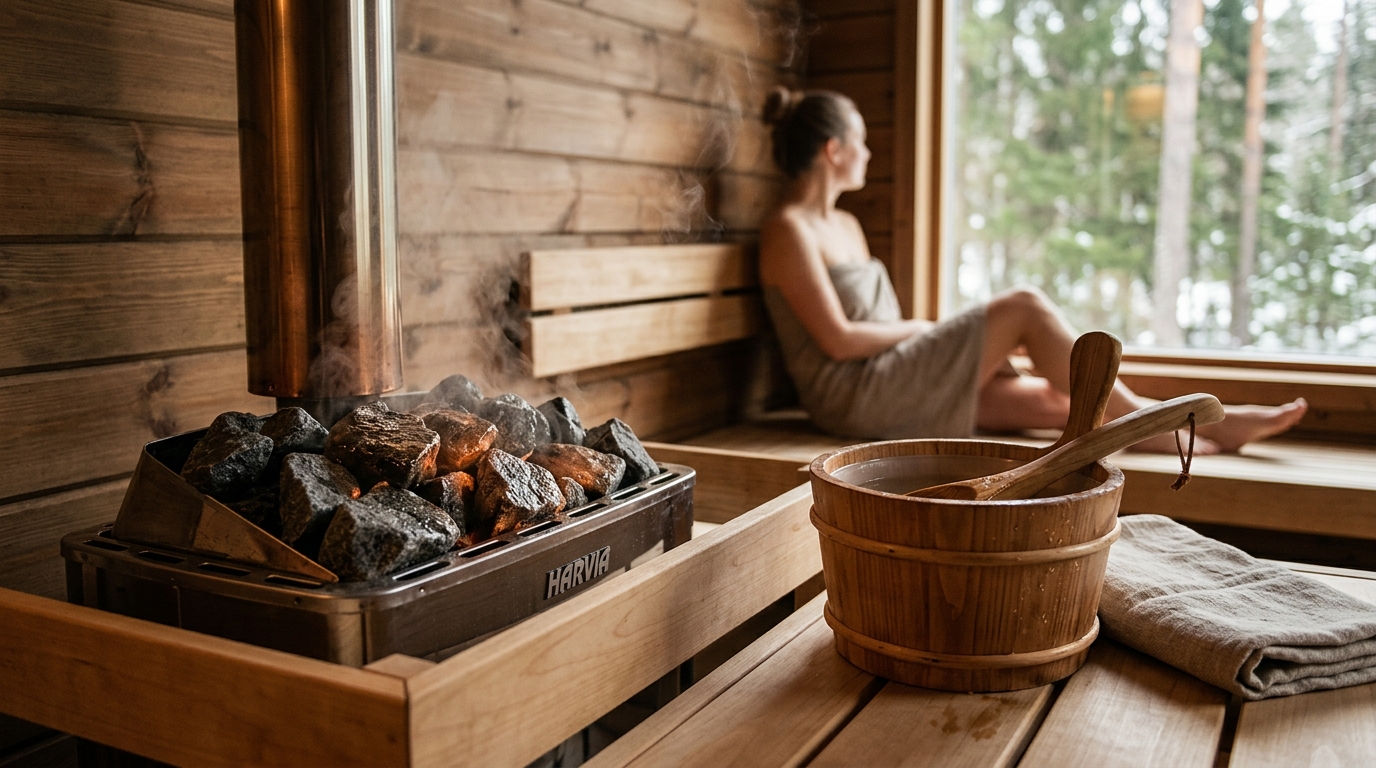
The best sauna rocks for steam are Finnish olivine or peridotite — dense igneous stones that store heat, release it slowly when water hits them, and survive thousands of thermal cycles without cracking. For most home saunas, a 40-50 lb bag runs $80-130 and lasts 5-7 years. Vulcanite (volcanic basalt) is a strong budget alternative at roughly half the price.
Why rock type matters for steam saunas
Not every rock belongs in a sauna heater. Use the wrong type and you risk cracked stones, damaged heating elements, or a rock that fractures explosively when cold water hits a 200°F surface. Two rules define what works:
1. Igneous rocks only. These formed from cooled magma at extreme temperatures, giving them a dense, crystalline structure that handles repeated heating and cooling without stress fractures. Sedimentary rocks (sandstone, limestone, quartzite, most river rocks) are porous and layered — moisture trapped in microscopic pockets vaporizes under heat, blowing the rock apart from the inside.
2. Rounded, uniform shapes. Jagged or irregular stones leave air gaps in the heater basket, reduce heat distribution, and concentrate thermal stress on specific heating elements. Commercially bagged sauna stones are pre-sorted for round, uniform pieces — this is not just aesthetics.
The three igneous types used in saunas are olivine/peridotite, vulcanite (volcanic basalt), and dunite. All three are safe. The differences are density, heat retention, price, and warmup time.
Finnish olivine and peridotite — the gold standard
Olivine and peridotite are the traditional Finnish sauna stones and the benchmark everything else is measured against. They are extremely dense (3.2–3.5 g/cm³), handle thousands of heat cycles without fracturing, and retain enough thermal energy for multiple rounds of steam without cooling significantly between ladles.
Finnish-quarried olivine (sometimes labeled Karelia stones or Made in Finland) has been the sauna industry standard for decades. Domestically quarried US Pacific Northwest olivine is functionally equivalent and typically priced lower.
Best for any traditional or barrel sauna; the most durable long-term choice
Finnish Olivine Sauna Stones — 40-50 lb bag
Finnish-quarried olivine and peridotite are the canonical home sauna stones. Dense enough to stay hot through 3-4 rounds of steam, they last 5-7 years with normal home use (3-5 sessions per week). Look for bags labeled with Finnish or Karelian origin. A 40-50 lb bag covers most home heaters (6-9 kW). Expect to pay \$80-130 — the premium over budget stones pays back in longevity and performance.
★★★★★ 4.8 · 1,650 reviews
Check current price on Amazon→Pros
- Highest heat retention of any sauna stone type
- Lasts 5-7 years under regular home use
- Traditional Finnish standard; widely available as replacements
- Handles hundreds of thermal cycles without fracturing or dusting
Cons
- More expensive than vulcanite ($80-130 vs $40-70)
- Longer warmup — requires 35-45 minutes to full temperature
Vulcanite and volcanic basalt — best budget option
Vulcanite (also sold as lava stone or volcanic basalt) is a lighter igneous rock that heats up faster than olivine and costs roughly half as much. The tradeoff is lower thermal mass — it holds heat for a shorter window, so you want the heater fully up to temperature before ladling water rather than relying on residual heat between rounds.
For a once-daily 20-minute session, the performance gap is barely noticeable. For marathon sauna sessions with multiple steam rounds, olivine holds the advantage.
Best for budget-conscious buyers and users who prefer shorter, single-session saunas
Volcanic Basalt Sauna Stones — 44-50 lb bag
Volcanic basalt (vulcanite) delivers solid steam performance at \$40-70 for a 44-50 lb bag — roughly half the cost of Finnish olivine. It heats up in 20-30 minutes vs 35-45 for olivine, and handles thermal cycling reliably for 4-6 years. The main limitation is lower thermal mass: fewer rounds of intense steam at the same heat setting. For most casual sauna users, this distinction is minimal.
★★★★★ 4.5 · 870 reviews
Check current price on Amazon→Pros
- Roughly half the cost of olivine ($40-70 vs $80-130)
- Heats up faster — ready in 20-30 minutes
- Good durability for home use at 4-6 years
- Widely available and easy to find as a replacement
Cons
- Lower thermal mass than olivine — less retained heat between ladles
- Quality varies by supplier; inspect for uniform rounded shape on arrival
Dunite — olivine-quality at a lower price
Dunite is an olivine-dominant igneous rock quarried in Norway and the Pacific Northwest US. It performs nearly identically to Finnish peridotite — same density range, same heat retention characteristics — at a price that typically lands $20-30 below imported Finnish stone.
If your heater shipped with cracked or inferior stones and you want an olivine-tier replacement without paying the Finnish import premium, dunite is the smart call.
Best for buyers who want olivine-level performance without the Finnish import markup
Dunite Sauna Stones — 44 lb bag (Pacific Northwest)
Pacific Northwest dunite matches Finnish peridotite on heat retention and thermal durability. A 44 lb bag runs \$60-90 — typically \$20-30 less than equivalent Finnish olivine. The stones are dense, consistently rounded, and safe for all traditional and barrel sauna heaters. An excellent choice if you want to upgrade from the inferior stones that ship with budget heaters.
★★★★★ 4.6 · 410 reviews
Check current price on Amazon→How many pounds does your heater need?
Your heater manual specifies the stone weight it is designed for — always match that spec. Overfilling reduces airflow through the elements, increases heat-up time, and can void the heater warranty. Underfilling leaves elements exposed and degrades steam production.
General guidelines by heater size:
- 3-6 kW (compact 1-2 person saunas): 22-40 lbs
- 6-9 kW (standard home saunas): 40-55 lbs
- 9-12 kW (large home or cabin saunas): 55-70 lbs
- 12+ kW (large commercial or group saunas): 70-100 lbs
If you are replacing an existing batch, weigh the old stones before ordering. A postal or luggage scale works fine. Do not estimate by visual volume — olivine is significantly denser than basalt at the same bag size, so visual comparisons mislead.
What to skip
Granite. Many assume granite is tough enough for saunas. It is not. Granite contains quartz and feldspar minerals with different thermal expansion rates that create internal stress fractures under repeated heating and cooling. Some pieces hold up for a while; many do not. The risk is not worth it when safe alternatives cost the same.
River rocks and decorative pebbles. Smooth river rocks look durable but are typically quartzite, sandstone, or limestone — sedimentary rocks that trap moisture and fracture under sauna heat. Do not use them regardless of how solid they look.
Pumice and porous lava rock. This is different from dense volcanic basalt. Pumice-type lava rock is full of air pockets that absorb water and fail from internal steam pressure. If you are buying “lava stone” make sure it is dense, heavy volcanic basalt — not the lightweight porous variety sold for landscaping.
Cheap stones bundled with discount heaters. Budget heaters often include mislabeled or unidentified stone types. Before the first session, verify the rock type or replace the bundled stones with a confirmed bag of olivine or dunite.
Crushed or jagged stone aggregate. Some suppliers sell angular crushed stone labeled as sauna-grade. Irregular shapes reduce airflow, create hot spots, and degrade faster than round stones. Rounded, sorted stones only.
Quick comparison
| Product | Best for | Rating | Notes | |
|---|---|---|---|---|
| Finnish olivine/peridotite (40-50 lb) | best long-term performance | ★★★★★ | $80-130. Lasts 5-7 yrs. Top heat retention. | Check price |
| Dunite sauna stones (44 lb, Pacific NW) | olivine quality at lower price | ★★★★★ | $60-90. US-sourced. Near-equivalent to Finnish olivine. | Check price |
| Volcanic basalt (44-50 lb) | budget buyers; quick warmup | ★★★★★ | $40-70. Heats fast. Solid for 4-6 years. | Check price |
| Granite / river rocks | skip — cracking risk | ★★☆☆☆ | Not safe. Sedimentary or mixed-mineral types fracture under heat. | Check price |
How to maintain your sauna stones
Stones require minimal care, but skipping maintenance shortens their lifespan and degrades steam quality over time.
Inspect annually. Remove all stones and check for visible cracks, chips, or a chalky-dusty surface (a sign of internal breakdown). Discard any cracked or degraded pieces — a fractured stone on a hot element is a safety problem, not just a maintenance issue.
Rinse with clean water. Mineral deposits and residue from essential oils build up on the stone surface after hundreds of steam sessions. An annual rinse with clean water removes most buildup and restores steam performance. Do not use soap — residue burns and produces unpleasant fumes.
Rotate every 6-12 months. Stones in direct contact with heating elements experience more thermal stress than stones in the upper layers. Rotating the full batch distributes wear evenly and extends the service life of the entire set.
Replace the full batch, not individual stones. When a few stones degrade, it is tempting to swap in fresh ones. Mixing old and new stones creates uneven heat distribution — the new stones run hotter than the degraded old ones at the same heater input, creating hot spots. When stones need replacing, replace the entire batch.
FAQ
Frequently asked questions
Can I use rocks I find outside in my sauna?
How long do sauna rocks last?
Why do sauna rocks crack or explode?
Can I use more stones than my heater specifies?
Do sauna rocks need to be rounded?
Should I wash new sauna stones before first use?
Bottom line
For most home saunas, Finnish olivine or peridotite is the right choice — $80-130 for a 40-50 lb bag that lasts 5-7 years. If budget is the primary constraint, volcanic basalt delivers solid steam performance for $40-70 and is a legitimate step down rather than a dangerous compromise. Dunite splits the difference at $60-90 with near-olivine performance. Never use granite, river rocks, pumice, or unidentified outdoor stones.
Related reading: sauna accessories guide, best sauna heaters, how to use a sauna, how to maintain a sauna.