roundups
Best Sauna Heaters 2026
Top sauna heater picks for every room size and budget: electric wall-mount, floor-mount, and wood-burning models with sizing guidance.
 Marcus Reade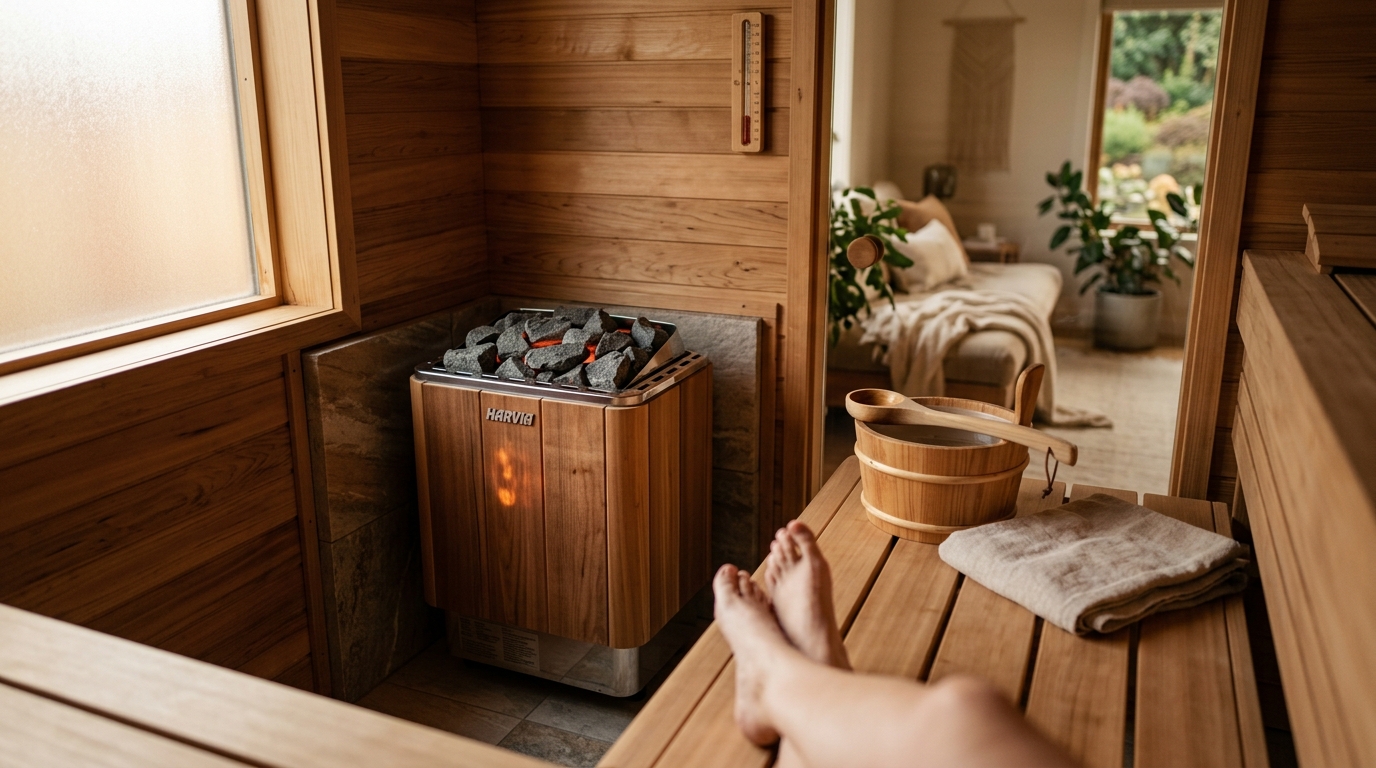
The sauna heater is the one piece of equipment that cannot be compromised. An undersized heater means a room that peaks at 150°F instead of 190°F, never produces the dense löyly you’re after, and takes 90 minutes to warm up instead of 30. An oversized heater in a small room overheats it instantly and burns electricity for no benefit. The sizing math is simple; the challenge is finding a heater that’s correctly sized, properly stoned, and backed by a manufacturer that still supports it in year eight. This guide covers that selection — electric wall-mounts, floor-mounts, and wood-burning options — across every room size from a 4×4 personal sauna to a 10×12 family cabin.
How sauna heaters actually differ
Three axes determine which heater fits your room:
-
Kilowatt rating. The formula: cubic feet of sauna volume ÷ 45 = minimum kW. A 6×6×7-foot room = 252 cubic feet ÷ 45 = 5.6 kW — round up to a 6kW unit. Add 1-2 kW for exterior walls, a concrete floor slab, or glass panels. Undersizing is the most common installation mistake — an underpowered heater runs continuously without reaching target temperature.
-
Stone capacity. Igneous stones absorb heat from the elements, then release it as steam when you ladle water onto them (löyly). Heaters rated for 22-40+ lbs of stones produce noticeably denser steam and more stable ambient temperature than heaters with 12-15 lb stone loads. If löyly quality matters to you, stone capacity matters as much as kW rating.
-
Voltage and circuit. Nearly all residential sauna heaters above 3kW require 240V. A 6kW heater draws ~25A and needs a dedicated 30A 240V circuit. An 8kW heater draws ~33A and needs a 40A circuit. Confirm your panel has an open slot before ordering.
Quick comparison
| Product | Best for | Rating | Notes | |
|---|---|---|---|---|
| VEVOR 4.5kW Wall-Mount Electric | small rooms up to 200 cu ft; budget entry | ★★★★☆ | $160-200. 240V/20A. ~15 lbs stones included. | Check price |
| Harvia KIP 6kW Wall-Mount Electric | best overall; mid-size rooms up to 270 cu ft | ★★★★★ | $380-450. 240V/25A. 22 lbs stone capacity. | Check price |
| Harvia 8kW Floor-Mount Electric | larger rooms 270-360 cu ft; multi-person saunas | ★★★★★ | $520-620. 240V/40A. 33 lbs stone capacity. | Check price |
| HUUM DROP Electric Sauna Heater | premium build; maximum stone mass for richest löyly | ★★★★★ | $700-900. 9kW or 12kW. 110+ lbs stones. | Check price |
| Harvia M3 Wood-Burning Sauna Stove | off-grid or cabin saunas; no electricity required | ★★★★★ | $450-550. Requires flue. 33 lbs stone capacity. | Check price |
The picks
Best budget: VEVOR 4.5kW wall-mount electric
Best for small personal saunas up to 200 cubic feet; first heater for a DIY sauna build
VEVOR 4.5kW Wall-Mount Electric Sauna Heater with Rocks
The VEVOR 4.5kW is the lowest-cost path to a real electric sauna with stones. It includes an integrated 60-minute timer, adjustable thermostat, 240V wiring with a standard terminal block, and a steel guard that keeps you from touching the hot elements. The included stones are not olivine-grade — order a 15-lb bag of Finnish igneous stones and swap them before first use. For a 4×4×7 or 4×6×7 personal sauna, this heater reaches 190°F in 35-45 minutes and holds it. The 15-lb stone load produces functional but thin löyly. At $160-200, it's a real heater for a small room, not a toy.
★★★★☆ 4.3 · 1,840 reviews
Check current price on Amazon→Pros
- Lowest cost for a real 240V sauna heater with integrated controls
- Wall-mount keeps the floor clear in a small room
- Terminal block included — wiring is straightforward for a licensed electrician
- Adjustable thermostat (140-194°F) and integrated 60-minute timer
Cons
- Included stones are not igneous grade — replace with olivine before first use
- 15-lb stone capacity produces functional but noticeably thin löyly
- Not appropriate for rooms above 200 cubic feet
- Integrated timer only — no external control or app preheat option
Best overall: Harvia KIP 6kW wall-mount electric
Best for the most common home sauna room size (200-270 cubic feet); the heater most owners wish they bought first
Harvia KIP 6kW Electric Sauna Heater
Harvia is the Finnish heater brand with the deepest U.S. parts and service network. The KIP series is their mid-range residential line — commercial-grade steel elements, 22 lbs of stone capacity on the 6kW unit, and an analog timer and thermostat that's proven reliable in rental sauna cabins for 15+ years. Heat-up time in a properly insulated 6×6×7 room: 25-35 minutes. Stone temperature at steady state is hot enough for immediate, dense steam release with each ladle. At $380-450, it's not a budget heater, but it's the unit most owners buy after outgrowing a cheap electric.
★★★★★ 4.7 · 3,200 reviews
Check current price on Amazon→Pros
- 22-lb stone capacity produces notably richer löyly than budget heaters
- Harvia parts network — elements and controls are available and replaceable
- Stable temperature regulation; holds ±5°F once at target temp
- Compact enough for rooms as small as 180 cubic feet
- Compatible with Harvia external digital controller (sold separately)
Cons
- Integrated analog timer is not remote-capable without an upgrade controller ($80-150 extra)
- 240V/25A dedicated circuit required
- Stones not included — budget $60-90 extra for Finnish olivine stones
- Wall-mount stone basket is less accessible for top-loading than a floor-mount design
Best for large rooms: Harvia 8kW floor-mount electric
Best for rooms 270-360 cubic feet (6×8×7 to 8×8×7 footprints); multi-person family saunas
Harvia 8kW Floor-Mount Electric Sauna Heater with External Control
The 8kW floor-mount is the right call for a family-sized sauna room where you want a large stone load and the convenience of an external controller. Floor-mounts allow significantly more stones than wall-mounts because the unit doesn't cantilever off a wall — at 33 lbs, this heater produces the kind of löyly density you find in commercial saunas. An external digital controller is included: set temperature and timer from outside the room or use the delay-start function to preheat before you arrive. Heat-up for a 300 cubic foot room: 35-45 minutes. The stone mass holds heat through 8-10 ladles without noticeably dropping temperature.
★★★★★ 4.6 · 1,150 reviews
Check current price on Amazon→Pros
- 33-lb stone capacity — dense, sustained steam release on every ladle
- External digital controller ships included; app upgrade available separately
- Floor footprint allows a larger stone load and easier stone access than wall-mounts
- Sized correctly for rooms from 270 to 360 cubic feet
Cons
- 240V/40A dedicated circuit required — most residential panels need a dedicated breaker install
- Floor footprint (~16×16 inches) reduces usable room space in small saunas
- More expensive than wall-mount models at equivalent kW ($520-620)
- Requires 4-inch clearance from combustibles on all sides per code
Best premium: HUUM DROP electric sauna heater
Best for owners who prioritize löyly quality above all else; premium custom sauna builds
HUUM DROP Electric Sauna Heater (9kW or 12kW)
HUUM is an Estonian brand built around stone-dominant heater design. The DROP holds 110+ lbs of stones — closer to a commercial Finnish sauna than a typical residential unit. The difference is immediately felt: when you ladle water onto 110 lbs of stones at 220°F, the steam release is instant, dense, and long-lasting rather than the brief hiss of a 15-22 lb heater. Available in 9kW (rooms to 390 cu ft) and 12kW (rooms to 530 cu ft). The UKU digital controller ships with the unit and supports app-based remote start. At $700-900, this is a serious purchase for a serious build.
★★★★★ 4.8 · 620 reviews
Check current price on Amazon→Pros
- 110+ lbs of stones — commercial-level löyly density in a residential heater
- UKU digital controller with app remote start ships included
- Open stone-stack design allows custom stone arrangement
- Best stone-to-kW ratio of any residential heater currently available
Cons
- $700-900 entry price — a significant step up from mid-range options
- Requires a 240V/40-50A circuit for 9-12kW models
- Weight exceeds 60 lbs before stones are added; strict wall clearance requirements
- Availability varies; often sold through specialty sauna retailers rather than Amazon
Best wood-burning: Harvia M3 sauna stove
Best for off-grid saunas, cabin builds, and anyone who wants the traditional wood-fired experience
Harvia M3 Wood-Burning Sauna Stove with Stone Tray
Wood-burning heaters produce a qualitatively different heat — convective, with a slight wood-smoke aroma and a warmth that many veteran sauna users describe as softer than electric. The Harvia M3 is the benchmark residential wood-burning stove: a steel firebox rated for continuous operation, a 33-lb stone tray on top, and a 5-inch flue outlet compatible with standard class-A chimney components. Heat-up time with dry hardwood (birch, oak, or hickory): 30-45 minutes. Temperature ceiling: 200-220°F without effort. No electrical hookup required — just a properly installed flue through the wall or roof and a supply of seasoned hardwood.
★★★★★ 4.6 · 890 reviews
Check current price on Amazon→Pros
- No electricity required — works anywhere a flue can be installed
- Fastest heat-up in the category; dry hardwood outpaces equivalent electric kW
- 33-lb stone capacity for dense, traditional löyly
- Firebox aesthetics and experience are irreplaceable for traditional sauna purists
Cons
- Requires a through-wall or through-roof chimney flue — adds $400-800 to installation cost
- Ongoing fuel cost and storage; firewood requires planning that electricity does not
- Ash removal after every session adds 10 minutes to post-sauna cleanup
- Permit requirements for wood-burning installs vary by jurisdiction — check local codes first
What to skip
Infrared panels marketed as “sauna heaters.” Infrared panels are a different product — they warm your body via radiant heat rather than heating the air and stones. Infrared saunas are a legitimate category (see infrared vs traditional sauna comparison), but they don’t produce löyly, don’t bring the room to 190°F, and are not interchangeable with a conventional sauna heater. If you want a traditional sauna experience, buy a traditional sauna heater.
Under-3kW “portable” electric heaters. Tabletop or portable units rated at 1.5-2kW cannot heat an actual sauna room. They’re designed for single-person tent saunas or small personal pods — not permanent sauna rooms where the real experience happens.
Heaters with no stone tray or a stone capacity under 10 lbs. The stones are what produce löyly. A heater designed with no stone load produces dry convective heat — indistinguishable from a high-output electric baseboard heater. Twenty-two or more pounds of stones is the bar for a genuine löyly experience.
No-name import heaters without UL or CE listing. A 240V sauna heater carries real fire risk if the element, thermostat, and overheat protection are not independently rated. UL listing (or CE for European brands) is a baseline requirement. VEVOR carries UL ratings; many no-name imports on marketplace sites do not — check the listing carefully before ordering.
FAQ
Frequently asked questions
How do I size a sauna heater for my room?
What electrical circuit does a sauna heater need?
Electric vs wood-burning: which is better?
How much stone should I put in my heater?
Can I add a remote or app control to my sauna heater?
How long should a quality sauna heater last?
How to choose
- Calculate your room volume first, then match the kW rating. Nothing else in this guide matters if the heater is undersized.
- Verify your electrical panel has an open slot for a dedicated 240V circuit before ordering any electric heater.
- Prioritize stone capacity if löyly quality matters — 22+ lbs is the floor; 40+ lbs is meaningfully better for traditional sauna users.
- Wood-burning only makes sense if you have a viable flue path and either lack 240V service or specifically want the traditional experience.
- Buy from a brand with a parts network. Harvia parts are stocked across the U.S.; HUUM through specialty sauna dealers. Budget import parts are not reliably sourced when a component fails in year six.
Bottom line
For most home sauna installations, the Harvia KIP 6kW is the right pick — correctly sized for the most common room dimensions, a 22-lb stone load that produces real löyly, and the deepest parts and support network in the U.S. Larger rooms step up to the 8kW floor-mount. Owners who prioritize löyly quality above all else should look at the HUUM DROP. Off-grid and cabin installs go with the Harvia M3 wood-burning stove.
Pair your heater with the right accessories — stones, bucket, and thermometer — in the sauna accessories guide. For full build cost breakdowns, see the home sauna cost guide. Starting from scratch? The installation guide covers electrical, ventilation, and flue requirements in detail. And for a full overview of home sauna options including pre-built cabins, see best home saunas.