roundups
Best Sauna Backrests 2026
The best sauna backrests for lumbar support and spinal relief — cedar and hemlock slatted designs built to last in daily heat and steam.
 Marcus Reade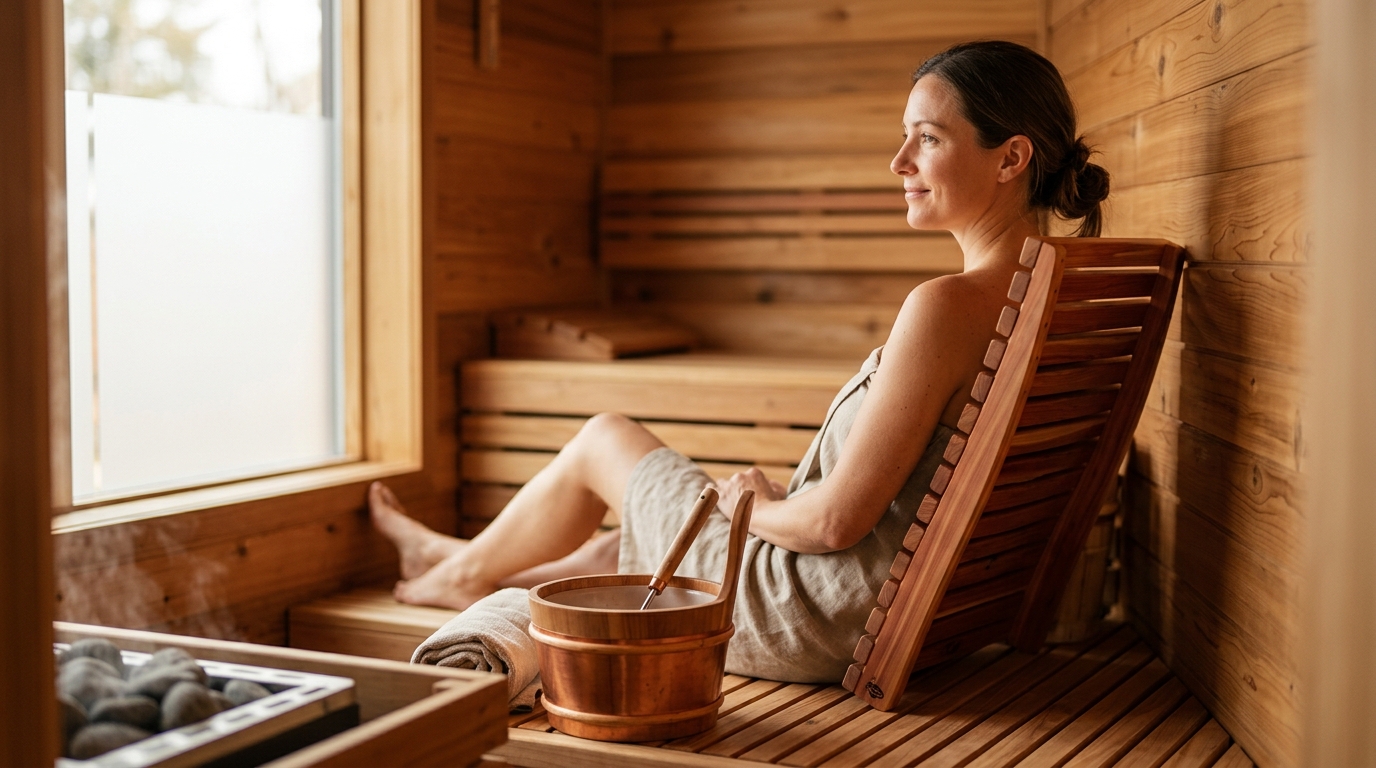
The best sauna backrest overall is a slatted cedar backrest 17–20 inches wide: it supports the lumbar and mid-back without trapping heat against the spine, handles repeated exposure to 180–200°F without warping, and fits any traditional or infrared cabin without tools or hardware. The top runner-up for users who want angle control is a hemlock ergonomic backrest with a stainless steel tilt mechanism.
Sitting upright in a sauna for 15–30 minutes without back support places real load on the lumbar spine and erector muscles — the opposite of what a recovery session should do. A backrest distributes that load across a larger surface area, lets your core release instead of bracing, and meaningfully improves the quality of long sessions. This guide covers four backrests built for sauna environments and explains exactly what materials, construction details, and sizing to look for — and which common options to avoid.
What makes a good sauna backrest?
Sauna backrests face the same material demands as other sauna accessories, but with a stricter contact requirement: you press your bare back against the surface for the full session, so surface comfort and heat management matter as much as raw durability.
Wood species follows the same hierarchy as sauna benches and footrests. Western red cedar is the first choice — its open grain structure accommodates the thermal expansion and contraction of a 180–200°F environment, its natural oils inhibit mold, and it does not absorb body odor readily. Nordic white cedar performs similarly and is common in Scandinavian sauna lines. Hemlock is harder and denser than cedar, which some users prefer for feel against bare skin, and it performs equally well at traditional sauna temperatures.
Spruce and poplar are suitable for infrared saunas at 120–150°F but are prone to checking at traditional high-heat temperatures. Pine is the wood to avoid — it contains resins that release sharp-smelling compounds when repeatedly heated above 150°F, which matters more for a backrest than any other sauna accessory because you hold your back against it for the entire session.
Slatted vs. solid construction is a meaningful distinction for a backrest. A slatted surface with quarter-inch to half-inch gaps allows air and steam to move through rather than being trapped between your back and the wood. Trapped heat creates uncomfortable hot spots and accelerates mold growth on the wood face. Solid-panel backrests feel more substantial but hold heat and moisture directly against the skin — most sauna users who switch from solid to slatted do not go back.
Width and height determine whether the backrest supports the body or merely contacts it. A 16-inch-wide backrest is adequate for a medium-framed adult; larger users benefit from 19 to 21 inches. Height from seat to top should be 14 to 18 inches to cover the lumbar and lower thoracic spine without forcing the head forward. Full-height models at 20–22 inches extend coverage to the mid-shoulder blades — the right choice for users over six feet.
Mounting and stability vary by design. Freestanding backrests hook over the bench top and lean against the wall — these work in any cabin configuration without tools. Clamp-mounted models attach to the bench edge and are more stable but may not fit all bench thicknesses. Wall-bracket models provide the most secure attachment but require drilling into the cabin wall.
Quick comparison
| Product | Best for | Rating | Notes | |
|---|---|---|---|---|
| Cedar Slatted Sauna Backrest | Traditional Finnish and wood-burning saunas at 170-200 degrees Fahrenheit | ★★★★★ | $40-70. Classic 17-20 inch wide slatted design. Hook-over-bench mounting. Non-slip base. Natural cedar aroma. | Check price |
| Hemlock Ergonomic Adjustable Backrest | Shared saunas and users who prefer a reclined rather than upright seated position | ★★★★★ | $65-100. Three recline angles. Hemlock construction. Stainless steel hinge. Fits any bench width. | Check price |
| Compact Basswood Infrared Backrest | One-person and two-person infrared cabins where bench space is limited | ★★★★☆ | $30-50. Narrower 14-16 inch profile. Weighs 3-4 pounds. Smooth grain. Best at infrared temperatures below 160 degrees. | Check price |
| Full-Height Nordic Cedar Backrest | Taller users and anyone who wants mid-back to shoulder support during long sessions | ★★★★★ | $60-95. Extended 20-22 inch height. Covers lumbar and thoracic spine. Cedar or hemlock. Contoured slatted surface. | Check price |
The picks
Best overall — cedar slatted sauna backrest
Best for traditional Finnish saunas, wood-burning cabinets, and any sauna reaching 170-200 degrees Fahrenheit
Cedar Slatted Sauna Backrest
A slatted cedar backrest in the 17-20 inch wide range is the right call for most home sauna users. Western red cedar handles repeated heat and steam cycles without checking or warping, and the slatted construction lets air move through the surface so heat does not build against your spine during a session. The hook-over-bench design installs in any cabin without tools or hardware modifications. At $40-70, a quality cedar backrest will outlast a decade of daily sessions with only basic annual care.
★★★★★ 4.7 · 1,320 reviews
Check current price on Amazon→Pros
- Cedar grain structure handles repeated 180-200 degree Fahrenheit cycles without checking or splitting over years of daily use
- Slatted design allows air circulation between the back and wood surface, preventing hot spots from trapped heat and steam
- Hook-over-bench or lean-against-wall design installs in any sauna cabin without tools or hardware modifications
- Natural cedar aroma complements the sauna environment without added fragrance or chemical treatment
Cons
- Cedar is softer than hemlock — the surface will show pressure impressions from prolonged contact after years of heavy use
- Fixed upright angle does not suit users who prefer a reclined or semi-reclined seated position
- Cedar aroma fades after 12-18 months of daily heat exposure; the wood remains functional but loses its scent character
- Requires light sanding and food-grade mineral oil once per year to keep the surface smooth and prevent splinters
Best adjustable — hemlock ergonomic backrest
Best for households where multiple users share the sauna and each prefers a different recline angle for seated or semi-reclined sessions
Hemlock Ergonomic Adjustable Sauna Backrest
An adjustable hemlock backrest folds to three recline positions — upright at 90 degrees, moderate recline at 110 degrees, and full lounging at 130 degrees — so different users can configure their preferred posture without removing the accessory. The stainless steel hinge is the critical quality point: confirm stainless steel specifically, not zinc or chrome-plated hardware, which corrodes visibly within months of steam exposure. Hemlock is harder than cedar, so the surface holds up to repositioning without marking. Prices run $65-100.
★★★★★ 4.6 · 750 reviews
Check current price on Amazon→Pros
- Three recline angles at 90, 110, and 130 degrees accommodate upright, moderate, and full lounging sauna postures in one accessory
- Stainless steel hinge hardware resists the corrosion that destroys zinc or plated hinges within months of sauna steam exposure
- Hemlock is harder than cedar and holds up better to the repositioning that comes with multi-user shared sauna setups
- Works in both traditional saunas at 200 degrees Fahrenheit and infrared cabins at 130-150 degrees without modification
Cons
- The hinge mechanism adds wood joints that can loosen after prolonged heat and humidity exposure — check the tension monthly
- At $65-100, it costs 60-80 percent more than a fixed cedar backrest for the angle adjustment feature alone
- Hemlock lacks the aromatic oils of cedar — the surface is odor-neutral, which some users find less satisfying in a traditional cabin
- More surfaces around the hinge points where steam and sweat accumulate — requires more thorough cleaning between sessions
Best for small cabins — compact basswood backrest
Best for one-person and two-person infrared sauna cabins where bench depth is limited and temperatures stay under 160 degrees Fahrenheit
Compact Basswood Sauna Backrest
Basswood is a light, smooth-grained hardwood that sands to a comfortable surface and weighs 3-4 pounds in backrest form — roughly half the weight of a full cedar backrest. In infrared cabins where bench space is measured in inches, a 14-16 inch basswood backrest fits where a standard 19-inch cedar model will not. Basswood handles infrared temperatures of 120-150 degrees Fahrenheit without issue but shows more surface checking above 180 degrees, so it is best reserved for infrared-only setups. At $30-50, it is the most affordable option on this list.
★★★★☆ 4.4 · 530 reviews
Check current price on Amazon→Pros
- Compact 14-16 inch width fits in narrow infrared cabin bench configurations where a standard backrest will not sit flush
- At 3-4 pounds, it is the lightest backrest option and easy to move in and out of the cabin between sessions
- Smooth basswood grain is comfortable against bare skin without the annual sanding that cedar surfaces eventually require
- Most affordable option at $30-50 — a practical entry-level choice for infrared sauna owners who want basic lumbar support
Cons
- Basswood is not recommended for traditional saunas above 170 degrees Fahrenheit — the surface checks and can split at sustained high heat
- Narrower footprint at 14-16 inches contacts a smaller portion of the back than a standard 18-20 inch model
- Basswood lacks the natural moisture-resistant oils of cedar, requiring more frequent cleaning to prevent mold in humid environments
- Lighter construction can mean less stability leaning against uneven cabin walls — verify that the model includes a non-slip base
Best full-height — Nordic tall cedar backrest
Best for users taller than 6 feet or anyone who wants continuous spinal support from the lumbar through the mid-back and lower shoulder blades
Full-Height Nordic Cedar Sauna Backrest
A full-height Nordic backrest extends from lumbar support up to the lower shoulder blades — typically 20-22 inches in height — covering the full thoracic spine rather than just the lumbar region alone. For taller users, a standard 14-16 inch backrest leaves the upper back unsupported and pressing against the cabin wall planks. The extended surface eliminates that pressure point and allows the entire spinal column to release during long sessions. Made from cedar or hemlock in smooth-sanded sauna-grade stock, these run $60-95 and are the top choice for users who regularly spend 20-30 minutes in a seated or reclined position.
★★★★★ 4.5 · 420 reviews
Check current price on Amazon→Pros
- Extended 20-22 inch height covers lumbar and thoracic spine together, allowing full spinal relaxation rather than isolated lower back support
- Cedar or hemlock construction at sauna grade handles 200 degree temperatures and repeated steam exposure without warping or checking
- Smooth-sanded surface requires no modifications before use — unlike rougher-finish imports that need pre-session sanding
- Accommodates users over 6 feet tall who cannot achieve full back support from a standard-height 14-16 inch backrest model
Cons
- Extended height at 20-22 inches can press against ceiling rails or upper bench boards in compact or low-ceiling sauna cabins
- At $60-95, it is priced similarly to the adjustable hemlock backrest but without angle adjustment capability
- Heavier at 6-8 pounds than other options — less convenient to reposition during a session or move between uses
- May be more coverage than necessary for users under 5 feet 10 inches who achieve adequate support from a standard model
What to skip
Pine backrests. Pine is the most common wood in budget imported sauna accessories because it is cheap and broadly available. Pine contains resins that release volatile compounds when repeatedly heated above 150°F. For a backrest — which contacts your skin directly for the full session — the effect is more noticeable than it would be on a bench or footrest. The smell is sharp and turpentine-adjacent and intensifies at higher temperatures. If a product listing does not specify the wood species, assume pine and look elsewhere.
Varnished, lacquered, or painted backrests. Any synthetic surface coating will soften, bubble, or release fumes at 160–200°F in an enclosed cabin. Varnish and lacquer may look attractive in product photos but peel within months of sauna use and leave debris on the wood. The correct treatment for sauna accessories is no finish at all, or a single application of food-grade mineral oil once per year. Look specifically for “unfinished” or “raw wood” in product descriptions.
Metal hardware at sauna temperatures. Standard steel screws, hinges, and brackets become extremely hot in a traditional sauna — reaching the same temperature as the surrounding cabin air — and can cause burns on contact with bare skin. Avoid backrests with zinc-plated or standard steel hardware. For adjustable models that require a hinge, confirm specifically that the hardware is stainless steel. The best fixed-angle backrests use wooden dowel joinery with no metal hardware at all.
Solid-panel backrests. A solid back surface traps heat and steam against the spine rather than letting it dissipate through the wood surface. Slatted construction with quarter-inch to half-inch gaps between slats is the correct standard for sauna back contact surfaces. Solid panels also tend to warp more readily because one face is exposed to the sauna air while the other is insulated by contact with the user.
Adjustable backrests with zinc or plated hinges. Adjustable backrests are the most useful accessories for shared saunas, but many budget versions use zinc or chrome-plated hinges that corrode visibly within weeks of exposure to steam. Once a hinge corrodes, the angle no longer holds and rust stains leach into the wood. Verify stainless steel hardware in the product description or specifications before purchasing any adjustable model.
How to use and care for a sauna backrest
Position the backrest on the bench against the cabin wall so the bottom of the backrest sits flush with the bench surface. In a standard Finnish sauna, this places the lumbar contact zone at the correct height for most adult users. A flat cabin wall holds a fixed backrest at a near-vertical 90 degrees; a slightly sloped or recessed wall creates a comfortable passive recline without an adjustable mechanism.
For a more reclined posture, use an adjustable backrest set to 110 or 130 degrees, or pair a fixed backrest with a sauna footrest so your legs extend forward while your spine remains supported. The reclined position is traditional in Finnish sauna culture and particularly effective during longer sessions above 20 minutes.
After each session, remove the backrest from the wall, shake off surface condensation, and lean it slat-side-out in the cabin or a ventilated space so air circulates through both faces. Allow it to dry fully before storing or returning it to the cabin — moist wood in a closed space promotes mold formation even in cedar. Every few months, run your hand across the slatted surface and sand any rough spots lightly with 220-grit sandpaper. Once per year, apply a thin coat of food-grade or sauna-specific mineral oil to all surfaces to prevent the wood from drying out and developing splinters.
FAQ
Frequently asked questions
Do I need a backrest in a sauna?
What wood is best for a sauna backrest?
Can I use a sauna backrest in an infrared sauna?
How do I keep a sauna backrest from sliding?
How do I clean a sauna backrest?
Bottom line
The best sauna backrest for most users is a slatted cedar model at 17–20 inches wide — it handles daily heat and steam cycles without warping, lets air move through the slats against your back, and fits any cabin configuration without modifications. If you share your sauna or prefer a reclined posture, the hemlock adjustable backrest is worth the price premium — confirm stainless steel hinge hardware before purchasing. For compact infrared cabins with limited bench space, the basswood model fits where a standard backrest will not.
For more ways to set up your cabin, see the best sauna accessories guide. If you want to pair a backrest with proper leg elevation, the best sauna footrests guide covers the right dimensions and materials for circulation and comfort. For complete session protocols that take full advantage of back support and a reclined position, the how to use a sauna guide covers timing, posture, and heat management from start to finish.