roundups
Best Sauna Footrests 2026
The best sauna footrests for bench elevation and circulation support — cedar and hemlock slatted designs that hold up to daily heat and steam.
 Marcus Reade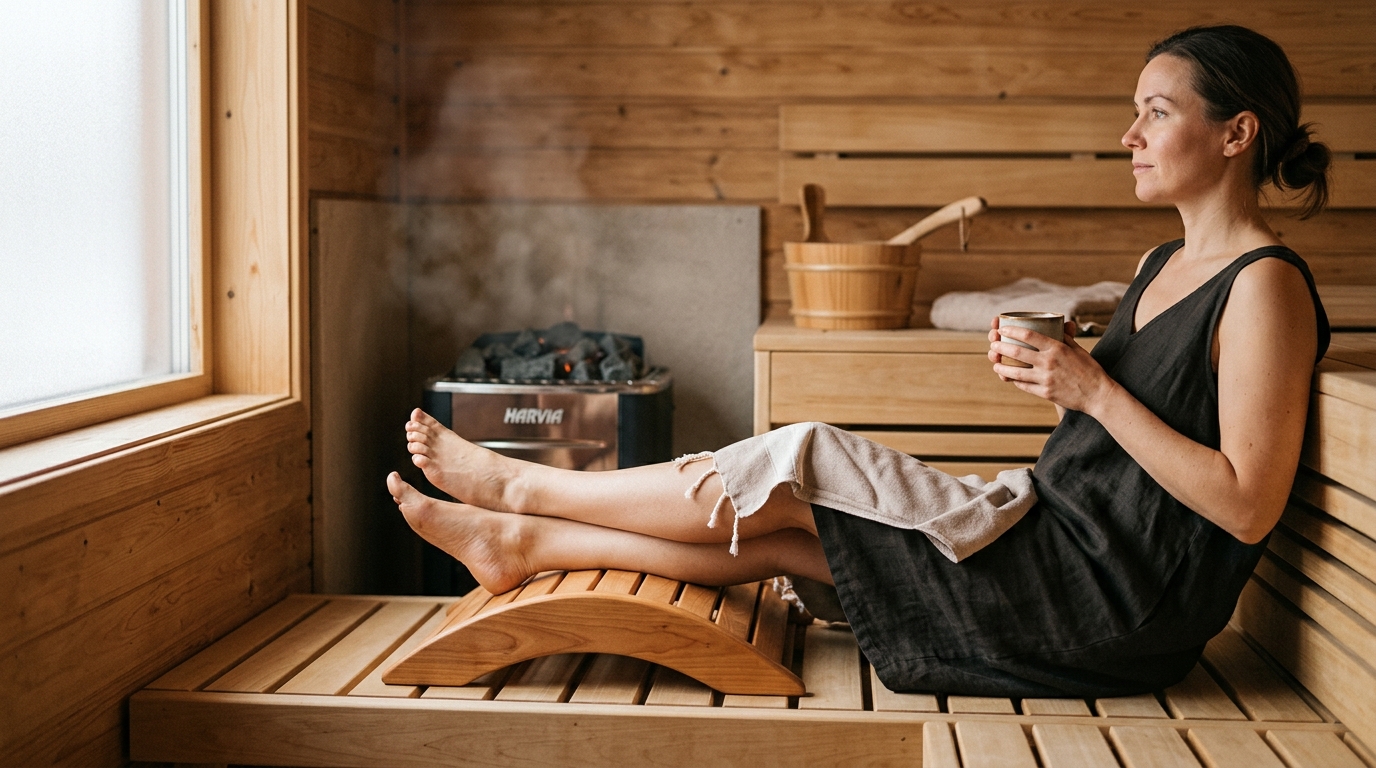
The best sauna footrest overall is a slatted cedar footrest at 16–18 inches wide: it elevates your legs to bench height so blood circulates freely during long sessions, stays stable on flat sauna floors, and handles repeated heat and steam cycles without warping. For users who want height adjustability, a two-position hemlock footrest is the top runner-up.
Elevating your feet during a sauna session is not a luxury accessory — it changes the biomechanics of the session. When your feet hang off the bench below body level, blood pools in the lower legs, limiting circulation benefits and increasing leg fatigue. A footrest brings your feet level with the torso, creating a reclined position that takes pressure off the spine and improves full-body relaxation. This guide covers four footrest designs that genuinely work in sauna environments and explains what materials and construction to avoid.
What makes a good sauna footrest?
Sauna environments impose specific requirements on wood accessories that kitchen or outdoor furniture does not share. Temperatures of 160–200°F in traditional saunas and repeated steam contact from löyly cycles expose wood to thermal stress and humidity changes that cause cheaper footrests to crack, warp, or shed splinters within a season.
Wood species is the primary variable. Cedar — western red cedar or Nordic white cedar — is the preferred choice for sauna accessories because its open grain structure allows it to expand and contract with heat and humidity without checking. Cedar also naturally resists mold and does not absorb moisture odors as readily as denser woods. Hemlock is a close second: harder than cedar, slightly less aromatic, and widely available as pre-built sauna accessory stock.
Spruce and poplar are acceptable in lower-temperature infrared saunas (120–150°F) but both species show more checking and warping in traditional Finnish saunas at 180–200°F. Pine is common in budget footrests but contains resins that can release volatile compounds when repeatedly heated above 150°F.
Slatted construction matters for both air circulation and drainage. A footrest with closely spaced slats rather than a solid top surface allows water from steam cycles and foot sweat to drain away, keeping the surface drier and reducing bacterial load on the wood. Gaps of 0.25 to 0.5 inches between slats are the functional range — wider gaps become uncomfortable underfoot.
Stability on sauna floors is underrated. A footrest that slides on smooth hemlock or cedar flooring is a slip hazard in a hot, humid environment. Look for models with non-slip rubber feet or a cross-brace bottom frame that spreads the contact footprint. For sloped sauna floors, an adjustable footrest with independent leg height adjustment is worth the price premium.
Size should match the user. For most adults, a footrest 16 to 18 inches wide and 10 to 12 inches deep fits two feet side by side on a standard bench. Taller users who prefer a more reclined position may want a longer surface of 18 to 24 inches front-to-back.
Quick comparison
| Product | Best for | Rating | Notes | |
|---|---|---|---|---|
| Cedar Slatted Sauna Footrest | Traditional Finnish and wood-burning saunas at 170-200 degrees Fahrenheit | ★★★★★ | $35-65. Classic 16-18 inch wide slatted design. Natural cedar aroma. Non-slip rubber feet. Stable on flat floors. | Check price |
| Hemlock Adjustable Footrest | Shared saunas where users have different leg lengths or height preferences | ★★★★★ | $50-85. Two height settings at 5 and 8 inches. Hemlock construction. Folds flat for storage between sessions. | Check price |
| Compact Basswood Sauna Footrest | One-person and two-person infrared sauna cabins with limited floor space | ★★★★☆ | $25-45. Narrower 12-14 inch profile. Weighs 2-3 pounds. Smooth grain. Best for infrared use under 160 degrees. | Check price |
| Nordic Sauna Bench Leg Rest | Taller users and anyone who prefers a fully reclined position with calves and feet supported | ★★★★★ | $45-80. Extended 20-24 inch depth. Supports calves and feet together. Cedar or hemlock. Smooth sanded finish. | Check price |
The picks
Best overall — cedar slatted sauna footrest
Best for traditional Finnish saunas, wood-burning cabinets, and any sauna reaching 170-200 degrees Fahrenheit
Cedar Slatted Sauna Footrest
A slatted cedar footrest in the 16-18 inch range is the right tool for most home sauna users. Western red cedar open grain allows the wood to flex with repeated heating and steam cycles without splitting, while the natural oils in cedar resist the mold and bacterial buildup that afflict denser woods. The slatted top drains water from löyly steam immediately, and non-slip rubber feet keep the footrest stable on smooth cedar or hemlock sauna floors. At $35-65, a quality cedar footrest will outlast a decade of daily sessions.
★★★★★ 4.7 · 1,140 reviews
Check current price on Amazon→Pros
- Cedar grain structure flexes with heat and humidity cycles without checking or warping over years of daily use
- Natural cedar aroma enhances the sauna experience without any applied fragrance or chemical treatment
- Slatted top drains steam condensation and foot sweat immediately, keeping the surface dry between sessions
- Non-slip rubber feet keep the footrest stable on smooth sauna floors at any cabin temperature
Cons
- Cedar is softer than hemlock — the surface will show wear marks and small impressions after years of heavy use
- Cedar aroma fades after 12-18 months of daily heat exposure; the wood remains functional but loses its scent
- Fixed height at 6-8 inches does not suit all body proportions or bench heights
- Requires sanding and light oiling once per year to maintain surface smoothness and prevent splinter formation
Best adjustable — hemlock two-position footrest
Best for households where more than one person uses the sauna and users have different leg lengths or sitting preferences
Hemlock Adjustable Sauna Footrest (Two Heights)
A two-position hemlock footrest adds practical flexibility for shared saunas. At the lower setting (5 inches), it suits users who want partial elevation without full leg extension. At the upper setting (8 inches), it brings feet level with a standard-height sauna bench for full recline. Hemlock is harder than cedar, which means the surface holds up better to repositioning during sessions. The fold-flat design reduces storage footprint between uses. Prices run $50-85 — reasonable for a footrest that accommodates multiple users without requiring a second accessory.
★★★★★ 4.6 · 620 reviews
Check current price on Amazon→Pros
- Two height positions at 5 and 8 inches accommodate different user heights and bench configurations without separate footrests
- Hemlock is harder than cedar and resists surface wear marks from repeated repositioning during a session
- Fold-flat design reduces floor footprint to under 2 inches thick when stored between sauna sessions
- Works in both traditional saunas at 200 degrees Fahrenheit and infrared cabins at 130-150 degrees
Cons
- The two-position adjustment mechanism adds wood joints that can loosen after prolonged heat and humidity exposure
- Hemlock lacks the natural aromatic oils of cedar — it is odor-neutral, which some users find less satisfying in a sauna cabin
- At $50-85, it costs 40-60 percent more than a fixed-height cedar footrest for the height adjustment feature alone
- The fold-flat latch can loosen over time; check it every 3-4 months to keep the footrest rigid at the correct height
Best for small cabins — compact basswood footrest
Best for one-person and two-person infrared sauna cabins where floor space is limited and the temperature stays under 160 degrees Fahrenheit
Compact Basswood Sauna Footrest
Basswood is a light, smooth-grained hardwood that sands to a comfortable surface and weighs 2-3 pounds in footrest form — roughly half the weight of a standard cedar footrest. In infrared cabins where floor space is measured in inches, a 12-14 inch wide basswood footrest occupies a meaningfully smaller footprint than a standard 16-18 inch cedar model. Basswood is safe at infrared temperatures of 120-150 degrees Fahrenheit but shows more checking than cedar at traditional sauna temperatures above 180 degrees, so it is best reserved for infrared-only setups. At $25-45, it is the most affordable option on this list.
★★★★☆ 4.4 · 480 reviews
Check current price on Amazon→Pros
- Compact 12-14 inch width fits in narrow infrared cabin floor spaces where a standard footrest will not sit flat
- At 2-3 pounds, it is the lightest footrest option and easy to move in and out of the cabin between sessions
- Smooth basswood grain is comfortable underfoot without requiring the same annual sanding that cedar surfaces need
- The most affordable option on this list at $25-45 — a practical entry-level choice for infrared sauna users
Cons
- Basswood is not recommended for traditional saunas above 170 degrees Fahrenheit — it checks and splits at high heat
- Narrower footprint at 12-14 inches means two feet must be positioned closer together than on a standard 16-inch model
- Lighter construction means less stability on wet sauna floors — verify that rubber non-slip feet are included before purchasing
- Basswood lacks the natural moisture-resistant oils of cedar, requiring more frequent cleaning to prevent mold in humid saunas
Best extended surface — Nordic sauna bench leg rest
Best for users taller than 6 feet or anyone who prefers a fully reclined position with both calves and feet supported during long sessions
Nordic Sauna Bench Leg Rest
A Nordic-style leg rest extends support from the heel through the calf — typically 20-24 inches in depth — rather than supporting only the feet. For taller users, a standard footrest leaves the lower leg unsupported and pressing against the bench edge. The extended surface eliminates that pressure point and allows a genuinely reclined position during long sessions. Made from cedar or hemlock in smooth-sanded stock at sauna grade, these run $45-80 and are the top choice for users who spend 20-30 minute sessions lying down rather than seated upright.
★★★★★ 4.5 · 390 reviews
Check current price on Amazon→Pros
- Extended 20-24 inch depth supports calves and feet together, allowing a fully reclined position without bench edge pressure
- Cedar or hemlock construction at sauna grade handles 200 degree temperatures and repeated steam exposure
- Smooth-sanded surface requires no modifications before use — unlike some rougher-finish accessories that need sanding first
- Accommodates users over 6 feet tall who cannot get full leg extension on a standard-depth footrest
Cons
- The extended depth at 20-24 inches takes up significantly more floor space — not suitable for small infrared cabins
- At $45-80, it is priced similarly to the adjustable footrest but offers no height adjustment capability
- Heavier than other options at 5-7 pounds — less convenient to move in and out of the cabin between sessions
- May be longer than necessary for users under 5 feet 10 inches who can achieve full leg extension on a standard model
What to skip
Pine footrests and imported accessory sets. Pine is the most common budget wood in imported sauna accessories because it is cheap and readily available. Pine contains resins that release volatile compounds when heated repeatedly above 150°F — not acutely dangerous in small doses, but unpleasant and contrary to the clean-environment goal of a sauna session. The smell is distinct: a sharp, turpentine-adjacent odor that intensifies at higher temperatures. If a product listing does not specify the wood species, assume pine and look elsewhere.
Footrests with varnish, lacquer, or polyurethane finishes. A finish that looks attractive in a product photo will off-gas in a sauna. Any synthetic coating — varnish, lacquer, water-based polyurethane, or paint — will bubble, peel, or release fumes in an enclosed space above 160°F. Look for “unfinished,” “raw wood,” or “heat-treated only” in product descriptions. The correct treatment for sauna wood accessories is either no treatment at all or a single application of food-grade mineral oil.
Footrests with metal hardware. Screws, bolts, and brackets made from standard steel or zinc will become extremely hot in a traditional sauna — reaching the same temperature as the surrounding air — and can cause burns on contact. If hardware is required for assembly, look for stainless steel or wooden dowel joinery. The best footrests use wooden tenon joints with no metal hardware at all.
Plastic or composite footrests. Some importers sell sauna “footrests” made from polypropylene or composite wood materials. These may be acceptable in a shower or poolside, but have no place in a sauna cabin. Plastic at 160–200°F softens, warps, and releases chemical odors. The same applies to composite “wood-look” materials that contain binding agents or plastic filler.
How to use a sauna footrest correctly
Position the footrest on the floor of the sauna cabin directly in front of or beneath the bench, depending on how reclined you want to sit. For an upright seated position, place it so your feet rest flat at approximately hip height — matching your seated bench height — and keeping your knees at roughly a 90-degree angle.
For a more reclined position, move the footrest outward so your heels are at or above bench seat height. This requires either a taller footrest or positioning the footrest on the bench itself if bench depth allows. The reclined position is most comfortable for long sessions and is the traditional Finnish approach to sauna relaxation.
Clean the footrest with warm water and a small amount of mild unscented soap after every few sessions. Pat dry and allow it to air out completely before storing or returning it to the cabin — moist wood in a closed cabinet is the primary cause of mold formation on sauna accessories. Once per year, apply a thin coat of food-grade mineral oil or a sauna-specific wood conditioner to prevent the surface from drying out and developing splinters.
FAQ
Frequently asked questions
What is a sauna footrest used for?
What wood is best for a sauna footrest?
How tall should a sauna footrest be?
Can I use a sauna footrest in an infrared sauna?
How do I care for a sauna footrest?
Bottom line
The best sauna footrest for most users is a slatted cedar model at 16–18 inches wide — it handles daily heat and steam cycles without warping, drains condensation through the slats, and stays stable on sauna floors. If you share your sauna with other users at different heights, the hemlock two-position adjustable footrest is worth the price premium. For small infrared cabins, the compact basswood footrest fits where a standard model will not.
For more ways to improve your sauna setup, see the best sauna accessories guide. If you are considering adding a full bench to a larger cabin, the best sauna benches guide covers complete bench specifications and installation considerations. For session protocols that take full advantage of a footrest and reclined position, the how to use a sauna guide covers timing, positioning, and heat management from start to finish.