comparisons
Sauna Blanket vs Infrared Sauna: Which Is Worth It?
Sauna blanket vs infrared sauna compared on cost, benefits, EMF safety, and real-world use — so you can choose the right format for your home.
 Marcus Reade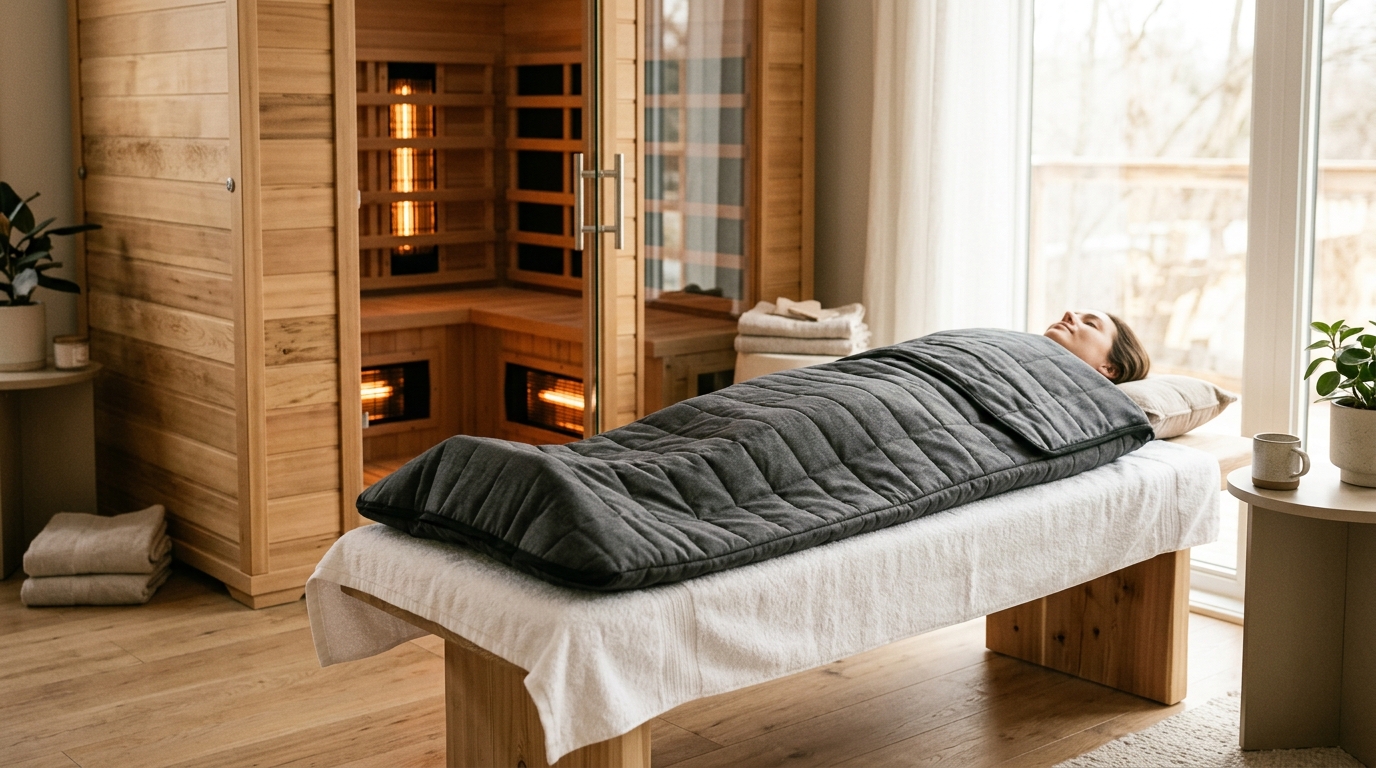
Quick answer: A sauna blanket costs $150–500, rolls up for storage, and delivers real far-infrared heat — but you lie flat with your head outside the heat zone. A full infrared cabin costs $1,500–4,500, permanently occupies a 4x4-foot corner, and delivers the complete immersive experience that builds lasting daily habits. If you rent, travel, or are testing the practice: blanket. If you have the space and a long-term plan: cabin.
What separates a sauna blanket from an infrared cabin?
The underlying technology in both formats is identical: far-infrared radiant panels raise your core body temperature directly, without heating the surrounding air to the extreme levels of a traditional Finnish sauna. Both formats plug into a standard 110V outlet and require no special installation, plumbing, or electrical work. The difference is not in the wavelength — it is in the form factor, and that form factor determines how comfortable the sessions are, how often you actually do them, and what results you get over time.
A sauna blanket is a sleeping-bag-style wrap with far-infrared heating panels embedded in the inner surface. You lie inside it, tucked in to the neck, with your head resting outside on a pillow. The heated panels press directly against your body. Most quality models reach 130–140°F at the highest setting. Session prep involves unrolling the blanket on a bed or yoga mat, waiting 10–15 minutes for it to reach temperature, lying inside for 20–45 minutes, then wiping the inner surface and rolling it back up. Store in its included bag when done.
An infrared sauna cabin is a wood enclosure — typically Canadian hemlock, cedar, or basswood — with far-infrared carbon fiber or ceramic panels mounted on each interior wall. You sit upright inside it, fully enclosed including your head. The cabin heats to 130–165°F and holds that temperature evenly across your entire body surface. Prep time is 15–20 minutes. The session feels close to a traditional sauna: warm, aromatic wood, easy reading or audio, 30 minutes that go by without fidgeting. After use, a quick bench wipe is all the maintenance needed.
The practical gap between formats is how each one affects your daily behavior.
Sauna blanket vs infrared sauna: direct comparison
| Product | Best for | Rating | Notes | |
|---|---|---|---|---|
| Price | Blanket: $150-500. Infrared cabin: $1,500-4,500. | — | Cabins cost 5-10x more upfront; per-session electricity costs are similar for both formats. | — |
| Session posture | Blanket: lying flat. Cabin: seated upright, fully enclosed. | — | Cabin posture is more comfortable for 30+ minute sessions and allows reading or screen use naturally. | — |
| Body immersion | Blanket: body wrapped in heat, head outside. Cabin: full body and head sealed inside. | — | Head-in immersion enables higher perceived heat intensity and matches the conditions used in cardiovascular research. | — |
| Storage footprint | Blanket: rolls into a tote bag; stores under a bed. Cabin: permanent 4x4 to 5x4-foot floor area. | — | Blankets are the only viable option for renters and studio apartments without a dedicated permanent space. | — |
| Heat-up time | Blanket: 10-15 min. Cabin: 15-20 min. | — | Both are practical for daily use; the cabin needs no unrolling or prep surface. | — |
| Temperature ceiling | Blanket: 130-140F. Cabin: 130-165F. | — | Cabins hold higher sustained temperatures and distribute heat more evenly across the full body surface. | — |
| EMF exposure | Blanket: heating panels press against bare skin. Cabin: panels mounted 6-18 inches away on walls. | — | Distance matters for EMF reduction — blankets require verified low-EMF certification; cabins have inherent separation. | — |
| Material contact | Blanket: inner liner (PU leather or PVC) against skin. Cabin: cedar or hemlock wood only. | — | PVC blankets off-gas more volatile compounds when heated; PU leather is meaningfully safer for skin contact. | — |
| Durability | Blanket: 2-5 year lifespan typical. Cabin: 10-20 years with basic care. | — | Rolling and unrolling fatigues heating elements over time; cabins are structurally simple and long-lasting. | — |
| Sharing sessions | Blanket: one person at a time only. Cabin: 1-4 persons depending on model. | — | Two-person cabins ($2,000-3,500) make sauna use a shared habit, which strongly increases long-term adherence. | — |
When a sauna blanket makes sense
Buy a sauna blanket if one or more of the following applies to your situation:
You rent or move frequently. An infrared cabin requires floor space you may not control and assumes you will be in the same home for two or more years. A sauna blanket rolls into a tote bag and moves with you to any apartment or rental. For renters, it is often the only realistic format regardless of how the two compare on experience.
You are testing the sauna habit. Many cabin owners bought a blanket first. A $200 blanket lets you verify that you will actually use a sauna four or five days a week before investing $2,500 in a cabinet. If the habit does not stick with a blanket, it almost certainly would not stick with a cabin either. If it does stick, you have real data to justify the upgrade.
Space is genuinely impossible. A studio apartment, a shared bedroom, or a tiny house often cannot accommodate a permanent 5x4-foot enclosure. A blanket stores on a shelf, under the bed, or in a closet. No other sauna format has this footprint advantage.
Targeted posterior-chain heat is the goal. Blankets concentrate heat along the back side of your body because you lie on them. For people managing lower back pain or recovering from posterior-chain injuries, this positioning delivers more direct, sustained heat to the target tissue than sitting in a cabin would.
Budget is the primary constraint. The $150–350 range of entry-level blankets from established brands produces genuine far-infrared heat and genuine sweating. The experience is not the same as a cabin, but the therapeutic heat output is real. If the cabin budget is simply not there this year, a quality blanket is the right call — not a compromise.
When an infrared cabin is the better choice
Buy an infrared cabin when you have a dedicated space, a long-term plan, and a real intention to use it most days. The experience gap between formats is large enough that it directly determines whether you maintain the habit — which is the actual mechanism behind the cardiovascular and recovery benefits sauna is known for.
The pattern among home sauna owners is consistent: cabin owners use their sauna. Blanket owners often drop to two or three sessions a week after the first month, and sometimes stop entirely within six months. The reason is not motivation — it is friction and comfort. Unrolling a blanket, waiting for it to heat, lying in a horizontal position for 30 minutes, then wiping it down and rolling it back up is more work than sitting in a warm cedar room you powered on 15 minutes ago. That friction gap compounds over hundreds of sessions.
Buy a cabin when:
- You plan to maintain a near-daily sauna practice for three to five or more years. At that usage rate, a $2,500 cabin costs less per session over time than a $350 blanket replaced every three years.
- You want the full immersive experience: head enclosed, seated upright, warm aromatic wood, 30-minute sessions that feel restorative rather than awkward.
- You are targeting cardiovascular improvement, deep sleep, or chronic stress relief. The outcomes documented in research were built on full-immersion seated sessions — consistent daily use over months.
- You have a basement corner, garage wall, or spare room with at least 4x4 feet of floor space and a standard outlet within 6 feet.
- You want to share sessions with a partner. Two-person cabins make sauna a shared evening ritual, which is the strongest predictor of long-term adherence in any wellness practice.
EMF and material safety: the blanket question
The most common concern specific to sauna blankets — not cabins — is EMF exposure at the skin contact point. In a cabin, far-infrared panels are mounted on walls 6–18 inches from your body. Distance drops EMF intensity dramatically; by the time infrared radiation reaches you across that gap, the EMF component is negligible. In a blanket, the panels press directly against your body surface for 30–45 minutes per session. That proximity matters.
What this means practically: brand selection matters more for blankets than for any other sauna format.
Low-EMF certification: Look for independent third-party EMF testing results — not just a brand claim. HigherDOSE publishes independent lab testing for the V3. Many budget blankets under $200 do not.
Inner liner material: The material that contacts your skin for 30–45 minutes per session should not be PVC. PVC (polyvinyl chloride) off-gasses volatile organic compounds when heated to 130–140°F — meaningful because those compounds contact your skin directly over the entire session. PU (polyurethane) leather is the meaningfully safer alternative; it does not off-gas VOCs at typical blanket temperatures.
Layered construction: Premium blankets add amorphous carbon, tourmaline, and charcoal layers that scatter the infrared output. These layers also reduce localized EMF intensity at the contact surface and contribute to more even heat distribution across the body.
In a cabin, none of these concerns arise. The panels are fixed to the walls and your body is separated from them by air. This gives cabins an inherent material safety advantage that no blanket, however well-made, can fully match — though a quality low-EMF blanket with a PU liner is safe for regular use.
Do sauna blankets produce the same health benefits as infrared cabins?
The honest answer is: probably similar per session, but with important caveats.
The research base for infrared sauna benefits — reduced cardiovascular risk, accelerated muscle recovery, cortisol reduction, improved sleep quality — was built almost entirely on full-immersion cabin sessions. No large-scale studies have directly compared blanket sessions to cabin sessions on the same outcomes. The thermal physiology is similar: both formats raise core temperature by 1–2°F, both produce similar sweat volume, and both trigger the same vasodilation response.
Where cabins have a probable functional advantage is in head immersion. Breathing warm air during a sauna session contributes to the respiratory conditioning effect and intensifies the perceived heat experience. The parasympathetic relaxation response often cited in sauna research is also driven partly by the sensory envelopment of being fully enclosed in a warm space — which a blanket approximates but does not replicate.
The more practical advantage of cabins is adherence. A 30-minute daily cabin session produces far more cumulative benefit over six months than a 30-minute blanket session twice a week, even if each individual session is physiologically comparable. Consistency is the variable that separates meaningful outcomes from mild ones.
The picks
Best sauna blanket overall
Best for people who want genuine far-infrared output in a portable format with verified low-EMF safety
HigherDOSE Infrared Sauna Blanket V3
The V3 is the benchmark for the blanket category. Amorphous carbon, tourmaline, and charcoal layers beneath a PU leather inner surface produce far-infrared heat to 140F with third-party-verified low EMF output. Eight temperature zones, a removable PU liner that wipes clean after each session, and an included tote bag for storage. Build quality is noticeably better than blankets in the $150-250 range — the zipper seals without gaps and the outer shell holds heat evenly across the full body length. At $499-599, it is the most expensive blanket in the category and the one most likely to last five or more years of regular use.
★★★★★ 4.6 · 3,100 reviews
Check current price on Amazon→Best budget sauna blanket
Best for people testing the blanket habit before committing to a premium model or upgrading to a cabin
MiHIGH Infrared Sauna Blanket
MiHIGH sits between budget and premium at around $300-350. Far-infrared carbon heating elements, a non-toxic inner lining, and a 4-zone temperature controller distinguish it from generic blankets while keeping cost below the HigherDOSE. Sessions reach 130F comfortably and the outer material holds temperature with fewer cold spots than most competitors in this price range. MiHIGH does not publish independent third-party EMF test results, which is worth knowing — but it is a meaningful upgrade over blankets under $200 and a reasonable entry point for someone testing the format before a larger investment.
★★★★☆ 4.4 · 1,800 reviews
Check current price on Amazon→Best infrared cabin for sauna-to-cabin upgraders
Best for solo users upgrading from a blanket who want full immersion in the smallest possible cabin footprint
JNH Lifestyles 1-Person Far Infrared Sauna
The JNH Lifestyles 1-person cabin is consistently the top-selling entry-level infrared cabin on Amazon. Canadian hemlock construction, six far-infrared carbon fiber panels covering all four walls, dual interior and exterior controls, and a Bluetooth speaker. The footprint is approximately 36 by 36 inches — the smallest a usable single-person cabin gets — which fits basement corners and garage walls where a 2-person model would not. Assembly takes 90-120 minutes solo. At $1,200-1,600, it is the most direct and affordable path from blanket-level heat to full cabin immersion.
★★★★☆ 4.4 · 2,200 reviews
Check current price on Amazon→FAQ
Frequently asked questions
Is a sauna blanket as effective as an infrared sauna cabin?
Are sauna blankets safe to use regularly?
How often should I use a sauna blanket?
Can a sauna blanket replace a full sauna for cardiovascular benefits?
What is the best sauna blanket on the market?
How do I clean a sauna blanket after use?
Bottom line
A sauna blanket is real infrared heat in a format that actually works for renters, travelers, and anyone testing the practice before committing to a permanent installation. At $150–500, it is a legitimate entry point — the HigherDOSE V3 is the one to buy if you want verified low-EMF output and a liner that holds up over years of use.
For anyone with a dedicated corner and a long-term plan to sauna most days, the infrared cabin is the better investment. The session is more comfortable, the setup friction is lower, the adherence rate is higher, and that adherence rate is the actual mechanism behind every cardiovascular and recovery outcome infrared sauna is credited with producing.
For a detailed look at cabin options at every price, see our best infrared saunas and best 1-person saunas roundups. For the full breakdown of every major blanket side by side, read our best infrared sauna blankets guide. And if you are still choosing between portable formats, our portable sauna vs infrared cabin comparison covers tent-style portables and cabins in depth.