comparisons
Portable Sauna vs Infrared Cabin: Which to Buy?
Portable sauna vs infrared cabin compared on heat, cost, setup, and results so you can pick the right home sauna format.
 Marcus Reade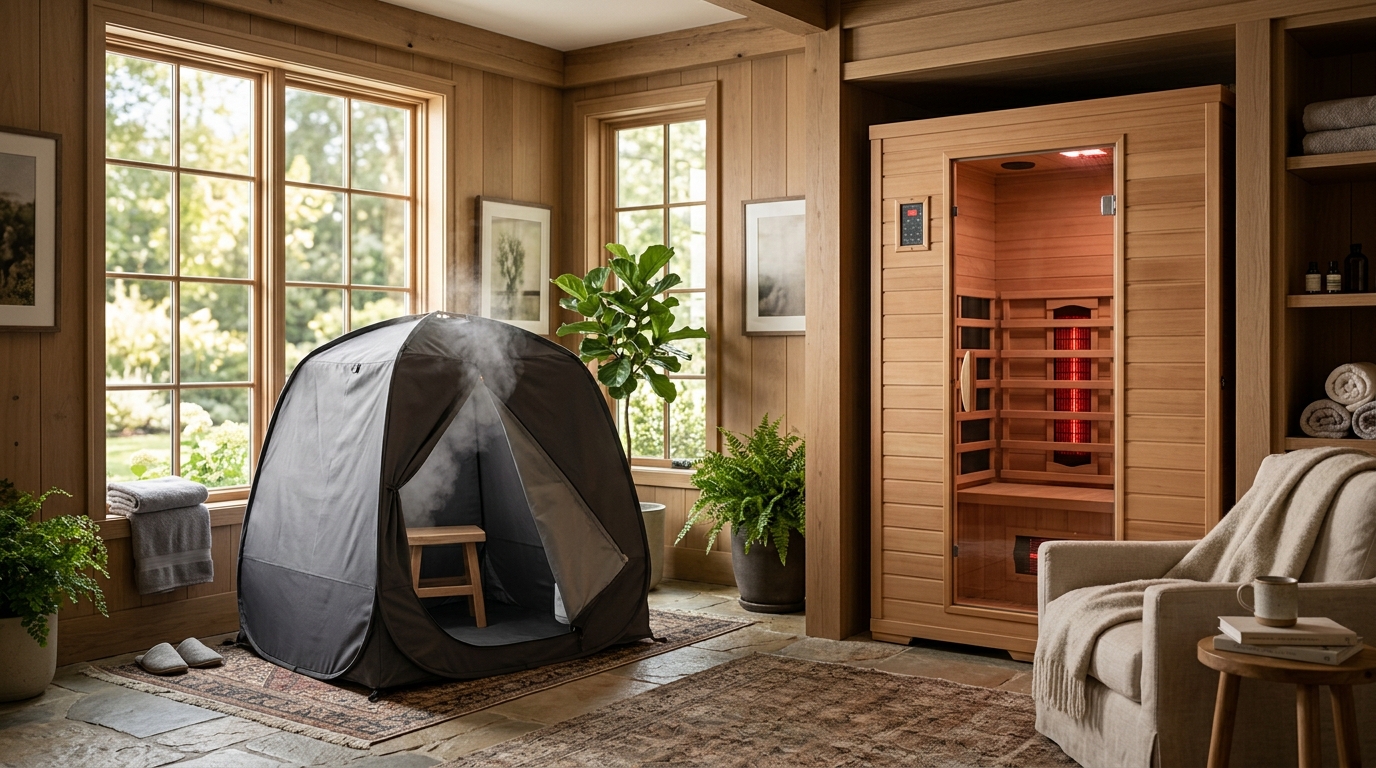
Quick answer: A portable sauna — either a blanket or pop-up tent — costs $100–400, stores in a closet, and works for renters, travelers, and beginners testing the habit. A permanent infrared cabin costs $1,500–4,500 but delivers full-body immersion, better panel coverage, and a session experience comfortable enough to build a lasting daily routine. Budget or space constraints: go portable. Otherwise, the cabin is the better long-term investment.
What is the difference between a portable sauna and an infrared cabin?
The core difference is immersion. An infrared cabin is a permanent wood enclosure — typically cedar, basswood, or hemlock — fitted with carbon or ceramic far-infrared panels on the walls, floor, and ceiling. You sit inside a sealed cabin; your entire body, including your head, is surrounded by radiant heat. The result is the classic sauna experience: sustained heat, sweating from head to toe, and an enveloping warmth that is easy to maintain for a full 30-minute session.
A portable sauna comes in two forms. The first is an infrared sauna blanket: a sleeping-bag-style wrap with embedded heating elements. You lie inside the blanket with your head resting on a pillow outside. The second is a pop-up sauna tent: a collapsible fabric enclosure you sit inside with your head poking out through a neck opening. Both reach meaningful infrared temperatures, plug into a standard outlet, and produce genuine sweating.
The gap is not in the technology — both use far-infrared radiant heat — but in the experience, the session comfort, and ultimately how often you actually use the thing.
Portable sauna vs infrared cabin: direct comparison
| Product | Best for | Rating | Notes | |
|---|---|---|---|---|
| Price | Portable blanket or tent: $100-400. Infrared cabin: $1,500-4,500. | — | Cabins cost 4-10x more upfront; per-session running costs are similar for both. | — |
| Space needed | Portable: zero permanent footprint, stores in a bag or box. Cabin: dedicated 4x4 to 5x5-foot floor area permanently. | — | Portables are the only option for renters and small apartments. | — |
| Heat-up time | Portable blanket: 10-15 min. Pop-up tent: 10-15 min. Cabin: 15-20 min. | — | All are practical for daily use; the cabin is always ready — no unrolling or prep. | — |
| Temperature ceiling | Portable blanket: 120-140F. Pop-up tent: 110-130F. Cabin: 130-155F. | — | Cabin panels reach higher sustained temps and hold them more evenly across the body. | — |
| Body immersion | Blanket: body inside, head out. Pop-up tent: body inside, head through neck hole. Cabin: full body and head sealed inside. | — | Head-inside immersion changes the experience — breathing warm air is part of the traditional sauna effect. | — |
| Session friction | Portable: unroll or unfold, preheat, clean after each session. Cabin: power on and sit down. | — | Lower friction is why cabin owners use theirs 4-5 days a week vs 1-2 for portable users. | — |
| Cleaning | Portable blanket: wipe inner surface after each use. Cabin: monthly cedar wipe-down. | — | Sweat contacts blanket material directly; regular wipe-downs prevent odor buildup. | — |
| Durability | Portable: 2-5 year lifespan typical. Cabin: 10-20 years with basic care. | — | A quality cabin is a one-time purchase; blankets and tents wear out faster from repeated rolling and washing. | — |
When a portable sauna is the right choice
Buy a portable sauna when one or more of these applies to your situation:
You rent or move frequently. An infrared cabin requires permanent floor space and the reasonable expectation you will still be in the same home in two or more years. A sauna blanket rolls up into a tote bag and fits in any car trunk or closet. For renters, it is often the only viable format.
Budget is the primary constraint. The $100–300 price point of most sauna blankets is genuinely hard to argue with if you are curious about infrared therapy but not ready to commit $2,000–4,000 to a cabin. The blanket lets you test whether you will actually maintain a daily sauna habit before making a larger purchase — and if the habit sticks, you can upgrade later.
You want travel portability. Some dedicated sauna users pack a blanket when staying at vacation rentals or hotels for extended trips. A pop-up tent is too bulky for travel, but a quality blanket folds into checked luggage. The HigherDOSE V3 comes with its own tote for this reason.
You have very limited space. Studio apartments, small bedrooms, and shared homes often simply do not have a spare 4x4-foot corner. A blanket you store under the bed or in a closet shelf is genuinely more practical in these settings.
You are testing infrared for a specific recovery purpose. Blankets allow you to target heat toward specific body areas — lower back, hips, legs — in a way that a standard cabin does not. This is a narrow use case, but relevant for people treating specific injury sites rather than seeking a full-body session.
When an infrared cabin is the right choice
Buy an infrared cabin when you have the space and budget, because the experience gap is significant enough to determine whether you actually use it.
The most consistent pattern among home-sauna owners is straightforward: cabin owners use their sauna. Portable users often stop within two to three months. The experience of sitting upright in a warm cedar cabin, head immersed in radiant heat, reading or listening to a podcast for 30 minutes is genuinely comfortable and relaxing. The experience of lying zipped into a heated blanket is more awkward and claustrophobic — and that difference in comfort directly affects how often you repeat the session.
Buy a cabin when:
- You want a sauna session that actually feels like a sauna: immersive, calming, and easy to sustain for a full 30 minutes without fidgeting.
- You are targeting cardiovascular benefits, post-workout recovery, or chronic stress relief as a regular practice. The research supporting these outcomes was built on consistent near-daily sessions.
- You have a garage corner, basement nook, or spare bedroom with at least 4x4 feet of clear floor space and a standard wall outlet within reach.
- You plan to own the unit for five or more years. At that horizon, a $2,000 cabin bought once is comparable in total cost to three blankets replaced over the same period — and it delivers a better experience at every session.
- You want to share sessions with a partner. Two-person cabins ($2,000–3,500) make the sauna a social habit rather than a solo errand, which dramatically increases long-term adherence.
Does the session experience really matter?
It sounds like a soft argument, but it is actually the central variable. Health outcomes from infrared sauna depend on consistent, sustained use — typically 30 minutes, four to five times per week. The cardiovascular and recovery benefits documented in research accumulate over months, not sessions.
A portable sauna that you use 20 times over six months delivers less benefit than a cabin you use 120 times over the same period, even if both units produce identical heat output per session. The comfortable, low-friction quality of the cabin experience is what enables that usage rate. This is not a peripheral consideration; it is the main reason to spend more on the cabin format if your budget allows it.
Sauna blankets vs pop-up tents: which portable type is better?
Between the two portable formats, blankets generally outperform pop-up tents for most buyers.
Pop-up tents are the older design and their weaknesses become obvious from first use: the folding chair inside is uncomfortable, the neck hole pulls at your shoulders, and the fabric structure does not seal tightly around your body. Tents typically cap out at 110–125°F ambient air temperature, which is lower than what quality blanket panels produce.
Sauna blankets heat your body more directly because the panels are pressed against your skin. Despite the lying-down position and the head-out limitation, a quality blanket produces sweat volume comparable to many pop-up tent sessions. The HigherDOSE Infrared Sauna Blanket V3 has become the category benchmark, with far-infrared output up to 140°F and a washable inner liner.
The tent does have one meaningful advantage: you can sit upright and use your hands during the session. If lying flat is genuinely uncomfortable for your back or neck, the tent format may work better for you despite the lower heat ceiling.
How much does each option cost to run?
Both formats are inexpensive to operate and the running cost difference is not a meaningful decision factor:
- A sauna blanket draws 200–400 watts. A 45-minute session at average US electricity rates (~$0.16/kWh) costs roughly $0.05–0.10.
- A pop-up tent with an 800–1,000-watt heater costs about $0.10–0.13 per 45-minute session.
- A 2-person infrared cabin draws 1,500–2,000 watts. A 45-minute session costs about $0.18–0.24.
Daily cabin use costs roughly $65–90 per year in electricity. The purchase price is the real financial variable between formats — not the running cost.
The picks
Best infrared sauna blanket
Best for people who want a portable infrared option with genuine heat output and easy cleaning
HigherDOSE Infrared Sauna Blanket V3
The V3 reaches 140°F across its far-infrared layers, ships with a removable and machine-washable inner liner, and folds into an included tote bag. Build quality is noticeably better than budget blankets — the outer layer holds heat without gap leaks at the zipper, and the eight temperature settings cover everything from a gentle warm-up to a full 30-minute deep-sweat session. HigherDOSE publishes third-party EMF testing results. Price typically runs $350-500, which is steep for a blanket but justified by durability and cleaning convenience.
★★★★★ 4.5 · 3,100 reviews
Check current price on Amazon→Best portable pop-up sauna tent
Best for people who prefer sitting upright and want the lowest-cost entry to infrared sauna
SereneLife AZSLSPA10 Portable Infrared Home Spa
At $90-140, the SereneLife tent is the most widely owned pop-up sauna category on Amazon. The folding chair seats one person, carbon fiber heating panels run on 800 watts, and the folded package stores in a carry bag roughly the size of a camping tent. You will not mistake it for a cabin session, but it produces real sweating at 110-130F and serves well for 20-minute recovery sessions. Comes with a remote control and a foot heating pad.
★★★★☆ 4.2 · 2,800 reviews
Check current price on Amazon→Best infrared cabin for daily home use
Best for people upgrading from portable to a permanent daily-use cabin with full-body immersion
JNH Lifestyles Joyous 1-2 Person Far Infrared Sauna
Consistently the top-selling cabin in the $1,500-2,000 price range. Canadian hemlock construction, seven carbon fiber far-infrared heating panels covering all four walls and the floor, dual control panels (interior and exterior), Bluetooth speaker, and chromotherapy lighting. The 2-person model needs 47 by 39 inches of floor space. Assembly takes 2-3 hours with a second person and standard tools. If you are graduating from a blanket or tent and want a real sauna habit, this is the right first cabin.
★★★★★ 4.5 · 1,200 reviews
Check current price on Amazon→FAQ
Frequently asked questions
Is a portable sauna as effective as an infrared cabin?
Can I use a sauna blanket every day?
Do portable saunas help with weight loss?
What do I wear in a sauna blanket or infrared cabin?
How do I clean a sauna blanket?
Can a portable sauna fit in a small apartment?
Bottom line
If price or space is the deciding factor, a sauna blanket delivers real infrared heat at a fraction of the cost and stores anywhere. The HigherDOSE V3 is the benchmark in that category, and it is a legitimate tool for building an infrared habit. But if you can dedicate a permanent corner and a larger budget, the infrared cabin is the better long-term investment — the experience is more immersive, the sessions are easier to sustain, and that consistency is what actually produces lasting cardiovascular and recovery benefits over time.
For cabin options at every price point, see our best indoor saunas and best portable saunas roundups. For a deeper look at what the cabin format delivers, read our sauna benefits for recovery guide and our infrared vs steam sauna comparison.