roundups
Best Dry Saunas for Home 2026
Top traditional electric and wood-fired dry heat saunas for home — indoor and outdoor picks ranked by heat output, build quality, and install ease.
 Marcus Reade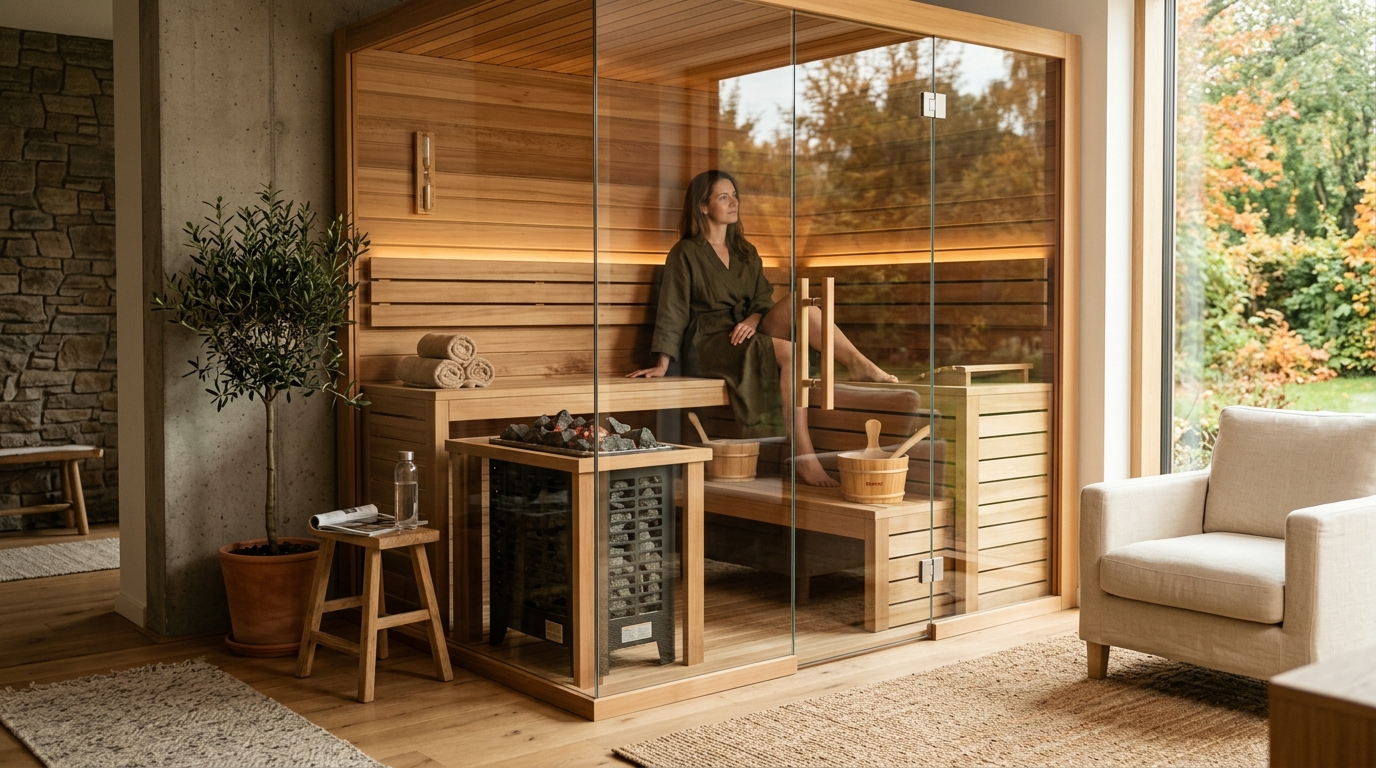
The best dry sauna for most homes is the ALEKO SERENITY 2-Person for indoor installs and the Almost Heaven Grandview for outdoor cabin use — both deliver authentic 180–195°F dry heat with löyly. For wood-fired authenticity without any electrical work, the Dundalk LeisureCraft Luna barrel with a Harvia M3 stove is the category standard.
What sets a dry sauna apart from infrared
Understanding the distinction matters before choosing hardware — the two formats deliver different experiences, not just different temperatures.
Dry heat vs. radiant heat. A traditional dry sauna heats the air and a pile of stones to 170–200°F using an electric resistance heater or a wood stove. The stones store thermal mass — enough that when you ladle 50–100 ml of water onto them, the surface temperature drops locally and releases a burst of steam (löyly, Finnish for “steam spirit”) that floods the room and then re-evaporates within seconds. This brief humidity spike — from 5% to 20–30% and back — is the defining feature of a Finnish sauna session. An infrared sauna heats the body directly through radiant panels at 120–150°F and cannot produce löyly by design.
Why temperature matters. At 185°F with 10–15% relative humidity, your body’s thermoregulatory response is categorically different from a 140°F infrared session. Core temperature rises faster, sweat response is more pronounced, and the heat is felt as an enveloping physical presence rather than a directional warmth. The traditional dry sauna session — rounds of heat alternating with cool-downs, shared with others, with löyly as the centrepiece — is a ritual that infrared can approximate but not replicate.
Who this guide is for. This roundup is written for buyers who have decided they want a genuine dry heat sauna. If you are still choosing between infrared and traditional, the best home saunas guide covers both categories and helps you decide.
Electric vs. wood-fired: the practical trade-offs
Both formats deliver dry heat and löyly. The choice depends on installation context and how you prefer to use the sauna.
Electric heaters are the default for most home installations: precise temperature control (dial to within a few degrees), preheat timers that have the sauna ready when you walk in, and heat-up in 20–40 minutes from cold. The requirement is a dedicated 240V circuit — 20A for heaters up to 4.5 kW (1-person and small 2-person saunas), 30–40A for 6–9 kW heaters in larger cabins. That circuit typically adds $200–600 in licensed electrician costs if one is not already near the install location.
Wood-fired stoves require no electrical infrastructure beyond optional lighting. The tradeoff is control and convenience: heat-up takes 60–90 minutes, peak temperature is weather-dependent, and you need a reliable supply of dry hardwood. The wood-fired ritual — building the fire 60–90 minutes ahead, managing the heat through stoking — is part of the experience for most buyers who choose it. The Harvia M3 cast-iron stove, standard on most quality wood-fired kits, carries 90 kg of stones and delivers löyly intensity that electric units with smaller stone loads cannot match.
For a detailed heater comparison with wattage sizing charts, see electric vs. wood sauna heater.
Quick comparison
| Product | Best for | Rating | Notes | |
|---|---|---|---|---|
| ALEKO SERENITY 2-Person Indoor Electric | best value indoor traditional dry sauna; 240V required | ★★★★☆ | $1,000-1,400. 240V/20A. 4.5 kW heater. ~47x47 in. Hemlock. | Check price |
| Almost Heaven Pinnacle 1-Person Barrel | best 1-person dry sauna; indoor or covered outdoor | ★★★★★ | $1,799-2,199. 240V/20A. Western red cedar. Electric w/stones. | Check price |
| Almost Heaven Grandview 4-Person Cabin | best outdoor traditional cabin; family dry heat sauna | ★★★★★ | $5,800-7,200. 240V/40A. Cedar cabin. 6 kW Harvia heater. | Check price |
| Dundalk LeisureCraft Luna 4-Person Barrel | best wood-fired outdoor dry sauna; no electrical needed | ★★★★★ | $5,200-6,500. Wood-fired. W. red cedar. Harvia M3 stove. | Check price |
| ALEKO 6-Person Outdoor Barrel Electric | best value 6-person; family outdoor barrel at lower cost | ★★★★☆ | $4,800-6,000. 240V/40A. 8 kW heater. Western red cedar. | Check price |
The picks
Best value indoor dry sauna: ALEKO SERENITY 2-Person
Best for buyers who want authentic dry heat with löyly in an indoor pre-built format at the lowest credible all-in price
ALEKO SERENITY 2-Person Indoor Electric Sauna with Heater
The ALEKO SERENITY is the clearest value entry into pre-built traditional electric dry saunas under $1,500. Canadian hemlock walls with double-panel construction provide real heat retention — a meaningful step above single-panel budget builds where you can feel the walls warming on the outside during a session. The included 4.5 kW heater has genuine stone capacity: load it with quality kiln-dried stones and the first ladle of water produces a full löyly burst that fills the 47×47-inch interior within seconds. Heat-up to 175°F takes 30–35 minutes from cold. The 240V/20A circuit is the main planning hurdle — if you do not already have 240V capacity near the install location, budget $200–500 for a licensed electrician to run a dedicated circuit. Add that cost and you are still under $2,000 all-in for a cabin that will run reliably for a decade of regular use.
★★★★☆ 4.3 · 1,420 reviews
Check current price on Amazon→Pros
- Authentic 175°F dry heat with genuine löyly capability — not an approximation
- Double-wall Canadian hemlock construction insulates better than single-panel import cabins
- 4.5 kW heater is correctly sized for the interior volume; heat-up performance meets spec
- Lowest all-in price for a legitimate pre-built traditional indoor dry sauna
- Sand timer and wall thermometer included; two-person assembly in 2–3 hours
Cons
- 240V/20A dedicated circuit required — adds $200-500 electrician cost in most installs
- 30–35-minute cold-start heat-up is standard for the category but 3x longer than infrared
- Bench layout is functional for two adults but not generous; no room to fully recline
- ALEKO parts availability can be slower than premium brands; confirm before purchasing if long-term serviceability matters
Best 1-person dry sauna: Almost Heaven Pinnacle Barrel
Best for solo buyers who want authentic dry heat in a compact format that works indoors or on a covered outdoor surface
Almost Heaven Pinnacle 1-Person Barrel Sauna (Electric)
Almost Heaven is among the most consistently well-reviewed North American sauna brands, and the Pinnacle is their 1-person barrel — a format that works indoors with a minimal footprint or on a covered patio without requiring a poured concrete slab. Western red cedar barrel staves, a true electric heater with stone tray included, and authentic 180–190°F heat capability. Interior dimensions are generous for one person: full-length recline on the lower bench or upright seating on the upper bench. At $1,799–2,199, you are paying a real premium over the ALEKO SERENITY for the cedar quality, the better-reviewed assembly experience, and Almost Heaven documented U.S. support. For solo buyers planning daily use, that premium pays back over years of reliable operation.
★★★★★ 4.5 · 680 reviews
Check current price on Amazon→Pros
- Western red cedar barrel — materially better than hemlock for long-term heat cycling and outdoor durability
- Compact footprint works in finished basements, spare rooms, or covered patios without a concrete foundation
- Almost Heaven has accessible U.S.-based parts and support — documented multi-year ownership feedback is consistently positive
- Full löyly capability with the included stone tray; dual bench positions for varying heat intensity
- Round barrel format heats faster than equivalent square volume due to reduced dead-air corners
Cons
- 240V/20A circuit required for the electric heater; wood-fired version is the no-electrical alternative
- $1,799-2,199 is a meaningful premium over the ALEKO for solo use
- Round interior ergonomics differ from flat-wall rectangular cabins; try before committing if possible
- Requires a covered outdoor location; direct rain exposure on the barrel joints accelerates wear
Best outdoor traditional cabin: Almost Heaven Grandview
Best for outdoor installs where you want a traditional cabin aesthetic, 4-person capacity, and a kit you can assemble without a contractor
Almost Heaven Grandview 4-Person Outdoor Sauna Cabin
The Almost Heaven Grandview is a pre-built outdoor sauna cabin in traditional square format — the format that reads as a small Finnish outbuilding rather than a barrel. Western red cedar exterior, a Harvia electric heater at 6 kW (sized correctly for the 4-person interior), and pre-cut interlocking log construction that two people can assemble over a long weekend. Bench layout seats 4 adults or allows 2–3 to recline fully. Heat-up to 185°F takes 40–50 minutes from cold. The pitched cedar roof handles snow load and rain without the maintenance issues that flat-roofed imports develop at corner seams. Almost Heaven sells replacement parts directly, has U.S.-based support, and owners report 10+ years of daily-use operation without structural issues — which justifies the $5,800–7,200 price tag over bargain imports.
★★★★★ 4.6 · 390 reviews
Check current price on Amazon→Pros
- Pre-cut interlocking log construction — no contractor required; two-person assembly over a weekend
- Harvia 6 kW heater included — one of the most trusted heater brands in the traditional sauna category
- Pitched cedar roof handles precipitation without flat-roof maintenance problems
- Almost Heaven replacement parts are accessible; documented 10+ year durability on sauna forums
- Traditional cabin aesthetic integrates naturally with backyard landscaping
Cons
- $5,800-7,200 plus a level concrete or compacted gravel pad — total project cost typically reaches $7,000-9,000
- 240V/40A dedicated circuit required — plan for $400-700 in electrician costs from the service panel
- 40–50-minute cold-start heat-up is expected for this cabin size
- Large pre-cut log panels require a level assembly site; uneven ground creates visible gaps at base joins
Best wood-fired dry sauna: Dundalk LeisureCraft Luna Barrel
Best for outdoor installs without 240V electrical access, or buyers who want the wood-fired ritual and the most intense löyly
Dundalk LeisureCraft Luna Barrel Sauna (Harvia M3 Wood Stove)
Dundalk LeisureCraft manufactures saunas in Ontario, Canada and ships across North America with a reputation for precision cedar joinery that holds through freeze-thaw cycling. The Luna 4-person barrel pairs western red cedar staves with a Harvia M3 cast-iron wood stove — a stove that reaches 220°F in a loaded barrel and holds heat for two or more hours between stokings. Setup requires no electrical work: level the barrel on the provided cradles, install the stovepipe with a spark arrestor, and you are operational. The wood-fired ritual — building the fire 60–90 minutes ahead, managing the stoke during the session — is part of the appeal for buyers who choose this format. The Harvia M3 carries 90 kg of stones; the löyly quality from that stone mass is categorically more intense than most electric heater equivalents. At $5,200–6,500, pricing is competitive with electric barrel kits once you subtract the $400–700 electrician cost those require.
★★★★★ 4.7 · 520 reviews
Check current price on Amazon→Pros
- No 240V circuit required — fully operational in locations without electrical infrastructure
- Harvia M3 cast-iron stove with 90 kg stone capacity delivers the most intense löyly in this roundup
- Dundalk cedar joinery manufactured in Canada; precision tolerances hold through years of freeze-thaw exposure
- Wood-fired radiant heat from a massive heated stone pile has a quality different from electric convection
- Competitive net cost once you exclude the electrician cost that electric barrel kits require
Cons
- Heat-up requires 60–90 minutes — plan ahead, wood stoves do not sprint
- Requires a dry firewood supply within practical distance and storage space
- Stovepipe requires annual creosote cleaning; neglect creates a fire risk
- Temperature is less precise than electric; peak output depends on fire management and ambient conditions
Best value 6-person: ALEKO 6-Person Outdoor Barrel
Best for families who want a 6-person outdoor dry sauna at the lowest credible price for genuine western red cedar construction
ALEKO 6-Person Outdoor Electric Barrel Sauna
ALEKO manufactures high-volume sauna kits in western red cedar at prices below the Almost Heaven and Dundalk tier. The 6-person barrel comes with an 8 kW electric heater — correctly sized for the 6x8-foot interior — pre-cut tongue-and-groove staves, two-height cedar benches, and a window end panel that adds useful natural light. Assembly requires two people and 4–6 hours; instructions are workable if not exceptional. Heat-up to 180°F takes 35–45 minutes from cold. The cedar quality is genuine western red cedar, not a substitute, though join precision is a step below Dundalk or Almost Heaven. ALEKO support is slower than premium brands but functional. At $4,800–6,000, this is the correct choice when budget is the primary constraint and you are comfortable with a longer service-response time.
★★★★☆ 4.4 · 760 reviews
Check current price on Amazon→Pros
- 8 kW heater is correctly sized for the 6-person interior — genuine heat-up and löyly performance
- Western red cedar barrel staves — the correct material for long-term outdoor weathering
- Two-height bench design maximizes seated positions for different heat preferences
- Most affordable 6-person outdoor electric barrel with authentic cedar construction
- Window end panel included; adds natural light and visual depth
Cons
- Stave join precision is a step below premium brands; minor gaps may appear during assembly
- ALEKO customer support response times are slower; parts sourcing can take longer than Almost Heaven or Dundalk
- 240V/40A dedicated circuit required — budget $400-700 for a licensed electrician
- Assembly instructions are adequate but inconsistently clear; plan to cross-reference forum guides
What to skip
Budget traditional sauna kits under $600. Pre-built sauna kits in this price range that claim traditional/Finnish heating are uniformly built to a margin spec, not a performance spec. The heater stones are too light to hold meaningful thermal mass — you ladle water and get a brief hiss, not a löyly burst — and the walls are single-panel imports that lose heat within 20 minutes after the heater cycles off. The wood is typically imported paulownia or poplar that splits along grain lines within two years of daily heat cycling. The bottom of the legitimate traditional sauna tier is the ALEKO SERENITY at around $1,000.
Undersized heaters. The most common spec error in this category is shipping a heater too small for the sauna interior. The correct sizing is approximately 1 kW per 50 cubic feet of interior volume. A 2-person cabin with a 47×47×84-inch interior has roughly 107 cubic feet and needs a minimum 2 kW heater — most legitimate kits ship with 4.5 kW, which is the comfortable spec for reaching 180°F and recovering after door openings. Anything below 1 kW per 50 cubic feet will struggle to reach authentic sauna temperatures. See the electric sauna heater sizing guide for volume calculations.
Sauna tents and personal pods. Collapsible nylon tent saunas with a single heating element are not dry saunas. They operate at 100–130°F and cannot reach the temperatures that define traditional Finnish dry heat. They are a different product category with different outcomes.
FAQ
Frequently asked questions
What temperature does a dry sauna reach?
Do I need a building permit for a home dry sauna?
How long does a dry sauna take to heat up?
Can a dry sauna go in a basement?
How often should dry sauna heater stones be replaced?
What is the difference between a dry sauna and a steam room?
How to choose
-
Settle on indoor or outdoor first. Indoor traditional electric saunas are accessible — a pre-built kit, 2–4 hour assembly, no pad needed — but require a 240V circuit and basement or room ventilation. Outdoor saunas offer more format options (barrel, cabin, wood-fired) at the cost of a level pad and a longer project timeline.
-
Size the heater correctly. Calculate your sauna interior volume in cubic feet (length × width × height) and target 1 kW of heater power per 50 cubic feet. A 47×47×84-inch 2-person sauna is approximately 107 cubic feet — a 4.5 kW heater is the correct minimum. See the best sauna heaters guide for brand comparisons.
-
Plan electrical before ordering. Every electric traditional sauna requires a dedicated 240V circuit that shares no loads. Get an electrician quote before finalizing your total budget — the sauna purchase price is typically 60–80% of the total all-in cost once electrical, pad, and assembly are included.
-
Match wood type to install location. Western red cedar weathers outdoor freeze-thaw exposure without staining or rot. Canadian hemlock and Nordic spruce perform well indoors where they remain dry between sessions. Imported paulownia and basswood are the budget-cabin woods — they work initially but degrade within years of daily heat cycling.
Bottom line
For most buyers, the ALEKO SERENITY 2-Person is the clearest path to an authentic indoor dry sauna — real löyly, 175°F temperatures, and the lowest all-in price in the legitimate traditional category. Solo buyers who prioritize cedar quality and U.S. support should step up to the Almost Heaven Pinnacle barrel. For outdoor family use, the Almost Heaven Grandview cabin is the best-built ready-to-assemble option; the ALEKO 6-Person Barrel is the budget alternative if price is the primary constraint. For wood-fired traditionalists or off-grid installs, the Dundalk LeisureCraft Luna with the Harvia M3 stove delivers the most intense löyly in the category.
For a full comparison across all sauna formats, see best home saunas. For indoor options that include infrared, see best indoor saunas. For heater selection and sizing, see best sauna heaters and electric vs. wood sauna heater.