roundups
Best Sauna Sound Systems 2026
The best speakers for infrared and traditional saunas — waterproof, heat-tolerant picks for clear audio during your sweat session.
 Marcus Reade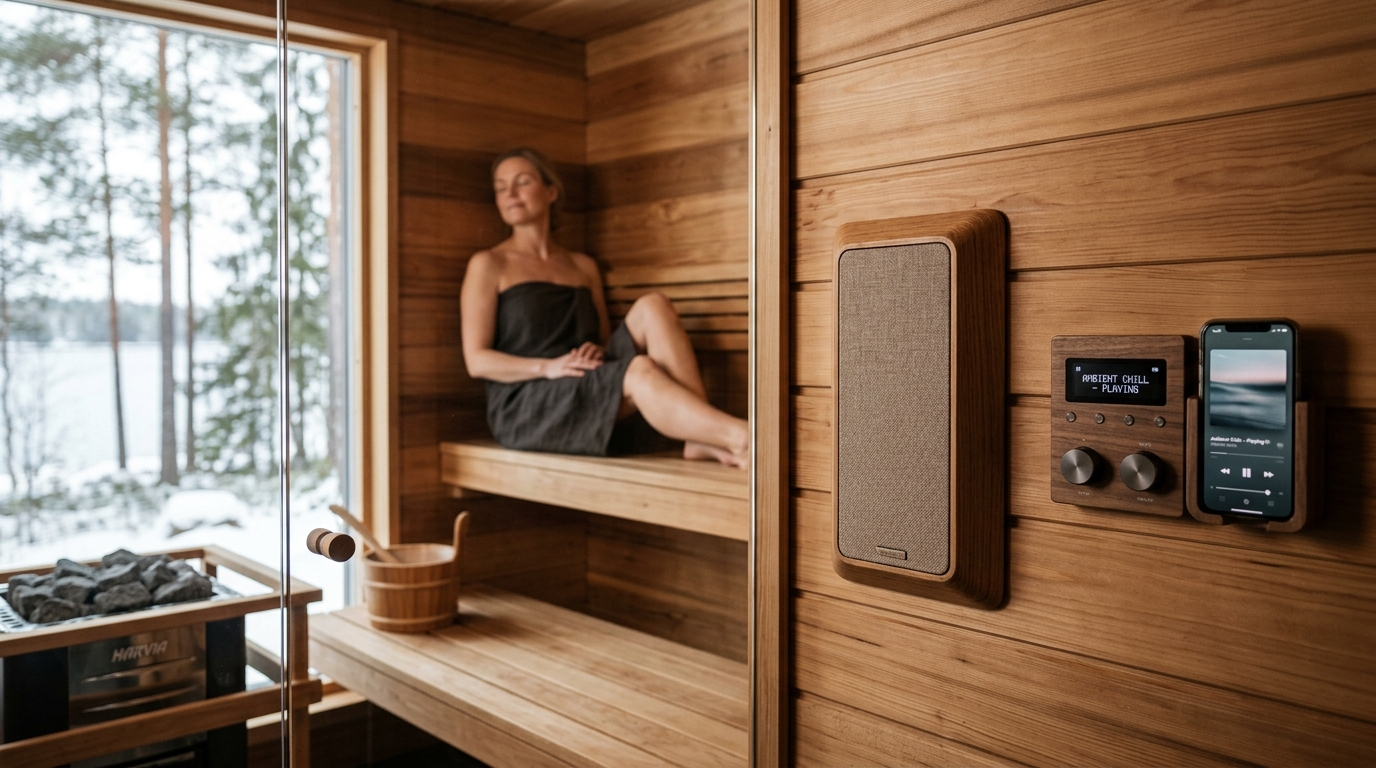
The best sauna sound system depends entirely on the type of sauna you own. For infrared saunas (120–140°F), the Bose SoundLink Flex is the top pick — IP67-rated with excellent room-filling audio in a compact package. For traditional Finnish saunas at 180–200°F, no portable speaker belongs inside the cabin; a permanent in-wall speaker setup with components mounted outside is the only reliable solution.
Most buyers focus on waterproofing and skip the more critical specification: maximum operating temperature. Standard Bluetooth speakers are rated to 104–122°F, and traditional sauna interiors exceed that within 15 minutes of heating. This guide covers which solutions actually work at each sauna temperature, and which products will fail or off-gas before the session ends.
Why sauna temperature rules out most speakers
The single most important specification for a sauna speaker is maximum operating temperature. Every major Bluetooth speaker brand — JBL, Bose, Sony, Anker — lists an operating temperature ceiling in the spec sheet. That ceiling is almost universally 104°F or 122°F.
An infrared sauna at its warmest (typically 125–140°F for a standard session) puts a portable Bluetooth speaker right at its thermal limit. Placing the speaker at floor level, away from the heating elements and the hottest upper-cabin air, keeps it within its rated range for most sessions.
A traditional Finnish sauna, wood-burning sauna, or electric sauna running a standard 180–195°F session exceeds every commercial speaker’s operating ceiling within the first 15 minutes. The risk is not just malfunction — sustained exposure above 140°F damages lithium batteries, and some enclosure plastics release compounds into the enclosed breathing environment.
The rule is clear: portable Bluetooth speakers work in infrared saunas only, placed strategically. Permanent external mounts with speaker wire run inside are the only safe and reliable choice for traditional saunas.
What to look for
IP rating. IP67 is the minimum for any sauna speaker. IP67 means fully dust-tight and submersible to 1 meter — both matter in a hot, humid enclosed space. IPX5 splash-resistance is not sufficient for repeated sauna exposure over months and years.
Battery life. A 45–60 minute sauna session means a 10-plus-hour battery covers a week of daily sessions without anxiety about dead-battery interruptions mid-session.
Sound dispersion in a small reflective room. Sauna cabins are small with cedar or hemlock walls that reflect sound sharply. Speakers with wide or omnidirectional dispersion fill the space more evenly than directional designs, which create harsh hot spots in a hard-surface room.
Enclosure material. Avoid speakers with rubber gaskets rated below 140°F or polyester fabric grilles — both degrade at elevated temperatures. Speakers with all-plastic or all-silicone exterior construction hold up better under repeated thermal cycling.
Quick comparison
| Product | Best for | Rating | Notes | |
|---|---|---|---|---|
| Bose SoundLink Flex | Infrared saunas; best compact 1-2 person cabin speaker | ★★★★★ | $149. IP67. 12-hr battery. Omnidirectional. PositionIQ auto-EQ adjusts by orientation. | Check price |
| JBL Xtreme 3 | Larger infrared cabins and outdoor barrel saunas below 140 degrees | ★★★★★ | $250-300. IP67. 15-hr battery. High output. Built-in bungee strap for bench anchoring. | Check price |
| Anker Soundcore Motion X600 | Budget infrared sauna audio for solo users | ★★★★★ | $80-100. IPX7. 12-hr battery. Hi-Res audio. Spatial audio processing. | Check price |
| Outdoor In-Wall Speaker Kit | Traditional Finnish saunas and any sauna running above 140 degrees | ★★★★★ | $80-200/pair. Components outside the cabin. Requires speaker wire and amplifier. Permanent install. | Check price |
The picks
Best overall — Bose SoundLink Flex
Best for 1-2 person infrared sauna cabins running 120-140 degrees Fahrenheit
Bose SoundLink Flex Bluetooth Speaker
The SoundLink Flex earns its top pick status for infrared sauna use because of three specific design choices. IP67 waterproofing handles the humidity and occasional steam of an infrared session without degradation over time. The PositionIQ technology adjusts EQ based on orientation so audio quality holds whether the speaker sits on the bench, hangs from a wall hook, or stands upright on the floor. The omnidirectional dispersion fills a small cedar room evenly without the harsh reflections that directional speakers create in hard-surface rooms. Battery lasts 12 hours, covering 12-15 standard sessions between charges. Place the speaker at floor level or on the lowest bench tier, away from the infrared heating panels, to stay within its 104-degree operating ceiling during a typical infrared session.
★★★★★ 4.8 · 15,400 reviews
Check current price on Amazon→Pros
- IP67 waterproofing handles sauna humidity and steam with no degradation over repeated sessions
- PositionIQ automatically adjusts EQ for speaker orientation — sounds good regardless of placement angle
- Omnidirectional dispersion fills small reflective sauna cabins evenly without harsh echo points
- 12-hour battery covers a full week of 45-60 minute daily sessions on a single charge
Cons
- At $149, the most expensive portable option — hard to justify for infrequent sauna users
- Operating temperature ceiling of 104 degrees Fahrenheit rules out use in traditional Finnish saunas
- Bluetooth only with no aux input — requires a phone within 30 feet of the cabin
- The silicone loop attachment limits placement options to a hook or carabiner — no flat base for bench placement
Best for larger infrared cabins — JBL Xtreme 3
Best for 3-4 person infrared cabins, outdoor barrel saunas below 140 degrees, and sessions where volume matters
JBL Xtreme 3 Portable Bluetooth Speaker
The Xtreme 3 moves significantly more air than compact speakers, which is the right specification for a larger infrared cabin or a barrel sauna where the internal volume is two to three times that of a standard 2-person cabinet. Two 40mm drivers and two passive radiators produce bass that registers in a resonant wood room rather than sounding thin against hard surfaces. The IP67 rating and 15-hour battery both outperform competing speakers at this size class. The integrated bungee strap is designed for outdoor adventures but works equally well as a bench anchor that prevents the speaker from sliding when someone shifts position. At $250-300, this is a premium cost for an accessory, but for households with larger cabins and daily use habits, the performance difference over a compact speaker is obvious.
★★★★★ 4.7 · 8,900 reviews
Check current price on Amazon→Pros
- High output fills a larger 3-4 person infrared cabin or barrel sauna without distortion at comfortable listening volumes
- IP67 waterproofing and rugged housing handle sauna humidity reliably in outdoor barrel sauna placements as well
- 15-hour battery handles daily sessions for two full weeks without charging
- Dual passive radiators produce genuine bass in a resonant wood room without cranking the volume
Cons
- At 4.4 pounds, it requires deliberate placement rather than casual drop-and-go setup before a session
- Operating temperature ceiling around 104 degrees limits use to infrared saunas — not suitable for traditional Finnish or steam
- At $250-300, a significant spend for an accessory that cannot be used in every sauna type
- The bungee strap attachment is functional but looks utilitarian against cedar finishes
Best budget — Anker Soundcore Motion X600
Best for solo infrared sauna users who want solid audio quality without spending over $100
Anker Soundcore Motion X600 Bluetooth Speaker
The Motion X600 competes with speakers costing twice its price on the specific strengths that matter in a sauna: IPX7 waterproofing, 12-hour battery, and spatial audio processing that widens the soundstage beyond what a single-point speaker typically produces in a small room. At $80-100, it is the best-value waterproof speaker for infrared sauna use available. The Hi-Res Audio certification means it plays streaming audio without the compression artifacts that make budget speakers sound flat at moderate volumes. For a solo practitioner doing 45-minute morning sessions in a personal infrared cabin, this speaker performs well above its price and survives indefinitely with proper placement near the floor, away from heating elements.
★★★★★ 4.5 · 6,200 reviews
Check current price on Amazon→Pros
- IPX7 waterproofing handles full immersion — sauna humidity and steam are well within its protection rating
- Spatial audio processing widens the perceived soundstage in a small reflective wood room
- At $80-100, the most affordable path to reliable waterproof audio for infrared sauna use
- 12-hour battery performance matches speakers at twice the price point
Cons
- IPX7 offers slightly less dust resistance than IP67 — not meaningful inside a sauna but worth noting
- At high volume, compression artifacts become noticeable earlier than on the Bose or JBL options
- Spatial audio processing can sound artificial in very small cabins — some users prefer disabling it
- The same operating temperature ceiling applies as all Bluetooth speakers — infrared sauna use only
Best for traditional saunas — outdoor in-wall speaker system
Best for traditional Finnish saunas, wood-burning saunas, steam rooms, and any sauna running above 140 degrees Fahrenheit
Outdoor Weatherproof Bookshelf Speakers with In-Wall Kit
This is the correct approach for traditional and steam saunas: mount weatherproof outdoor bookshelf speakers on the exterior wall of the cabin, run speaker wire through the wall, and terminate the interior end at bench height using a small flush-mount grille or a simple conduit opening. The amplifier, Bluetooth receiver, and any electronics stay outside the hot zone entirely. Brands like Polk Audio, Klipsch, and Yamaha make outdoor-rated bookshelf pairs in the $80-200 range that handle humidity and temperature variation across outdoor seasons reliably. The setup requires one afternoon to install — routing wire through the sauna wall is the main task — but once complete it delivers reliable audio at any sauna temperature with no battery to charge and no equipment at risk of heat damage. This is also the solution that hotel spas and commercial sauna facilities use.
★★★★★ 4.5 · 3,200 reviews
Check current price on Amazon→Pros
- The only solution genuinely safe and reliable inside a traditional Finnish or wood-burning sauna at 180-200 degrees
- No battery to charge and no Bluetooth pairing per session — audio is always available from the external amplifier
- Outdoor-rated weatherproof speakers handle sauna exterior conditions in any climate at any season
- One-time installation eliminates recurring speaker replacement costs from heat damage
Cons
- Requires a half-day install: routing speaker wire through the sauna wall and setting up an external amplifier
- Total cost including a Bluetooth receiver and amplifier typically runs $150-350, more than any single portable speaker
- Sound quality depends on speaker placement and wire routing — a careful install matters more than brand
- Permanent once installed — repositioning is difficult if the sauna is relocated or reconfigured
What to skip
Polyester-grille Bluetooth speakers inside a traditional sauna. Most Bluetooth speakers use stretched polyester fabric over the drivers. Polyester softens above 120°F and can shed fibers into the hot, enclosed air. Even in an infrared sauna, polyester grilles placed near heating panels degrade faster than the electronics underneath. In a traditional sauna at 180°F, this rules out every portable speaker regardless of brand or IP rating.
Speakers marketed as sauna-safe with no listed operating temperature. A growing number of third-party listings on Amazon describe their products as sauna-compatible without citing a maximum operating temperature in the specifications. Without a confirmed number, assume the safe ceiling is 104°F — the consumer electronics standard. A claim of sauna compatibility at 180°F without documentation is unverified marketing, not an engineering specification.
Budget speakers under $30 with IPX4 or IPX5 ratings. These are splash-resistant only. The repeated humidity and condensation of a sauna environment at any temperature will compromise the seals in this tier within weeks of regular use. The $80+ threshold filters for speakers that genuinely handle a humid enclosed environment over months and years.
Headphones or earbuds of any kind. Wearing anything on the head that blocks heat dissipation defeats one of the primary physiological benefits of a sauna session — core heat rising to the skin surface for release. A Bluetooth speaker at 60–70 dB fills a small cabin without requiring headwear.
Placement tips for infrared sauna speakers
Floor level is the coolest zone. Temperature stratification in an infrared cabin puts the hottest air at the upper bench level. Placing a portable speaker on or near the floor keeps it 15–30°F cooler than it would be at seated height.
Maintain 18 inches from heating panels. Infrared panels emit radiant heat directly, and the surface temperature near a panel significantly exceeds the ambient cabin air. Keep the speaker on the wall opposite the main heating elements.
Remove the speaker after each session. Residual heat in a closed infrared cabin after a 45-minute session can sit at 120–130°F for 30–60 minutes. Repeated exposure to that temperature during storage — not just active sessions — shortens lithium battery lifespan. Take the speaker out when the session ends.
Angle toward the upper bench. If the speaker has a directional element, point it upward toward the seated position rather than horizontally across the floor. The cedar ceiling and walls reflect sound down into the listening zone more evenly from that starting angle.
How loud should a sauna speaker be?
The correct listening level for a sauna session is 60–70 dB — roughly conversation volume at arm’s length. Sauna practice is a parasympathetic recovery state; high-tempo, high-volume audio works against the physiological purpose of the session.
Research on heat stress environments shows that slow-tempo music at 60–80 BPM reduces perceived exertion and extends the tolerable session duration more effectively than fast-tempo or ambient sounds. For most users, slow instrumental music, natural soundscapes, or guided breathwork audio at moderate volume are the most productive choices for a recovery-focused sauna session.
A small cedar cabin at 125°F amplifies sound noticeably. Volume settings that feel moderate in a living room will feel louder inside the cabin — start at 40–50 percent volume and adjust from there.
FAQ
Frequently asked questions
Can I put a Bluetooth speaker inside a traditional sauna?
What IP rating do I need for a sauna speaker?
How do I add sound to a traditional sauna?
Where should I place a speaker inside an infrared sauna?
Does music in a sauna actually help the session?
Bottom line
For infrared sauna users, the Bose SoundLink Flex is the best starting point — IP67, excellent omnidirectional room coverage, and a 12-hour battery that covers a week of daily sessions. Budget-conscious infrared users should look at the Anker Soundcore Motion X600, which delivers strong performance at roughly half the price. For larger infrared cabins, the JBL Xtreme 3 has the output and battery to fill the space reliably. If you use a traditional Finnish or wood-burning sauna, the only responsible choice is a permanent in-wall speaker system — every portable Bluetooth speaker will fail and potentially off-gas in that temperature environment before the year is out.
For more on accessories that improve a sauna session, see the best sauna accessories guide. If you are still selecting your sauna type, the infrared vs. steam sauna guide explains the temperature and humidity differences in detail. For installation questions, the home sauna installation guide covers the full setup process.