roundups
Best Sauna Chairs 2026
Top sauna chairs, backrests, and stools for traditional and infrared saunas. Five picks with pros, cons, and what to skip.
 Marcus Reade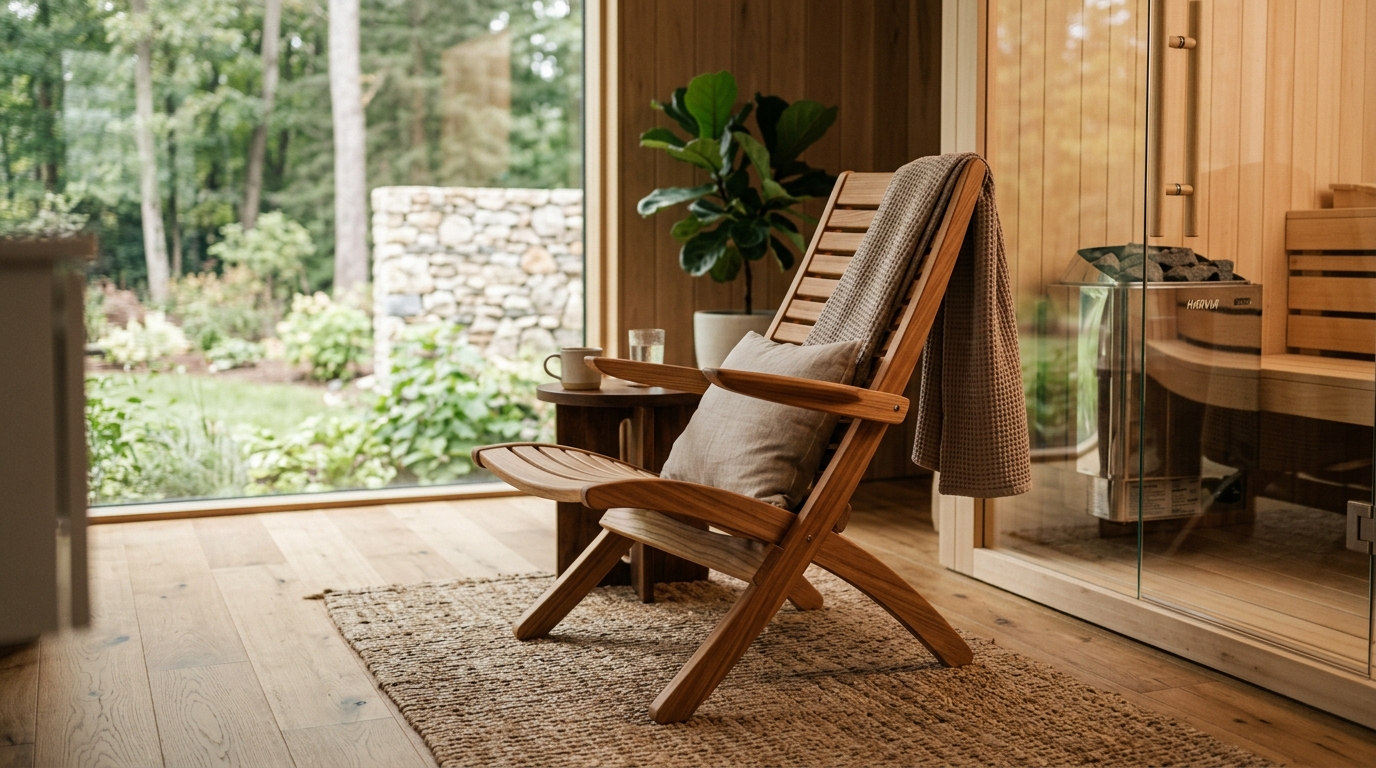
The best sauna chair for most home sauna users is a cedar ergonomic backrest chair — it adds lumbar support for longer sessions without taking up much more floor space than a plain stool. For traditional Scandinavian setups or compact barrel saunas, an aspen stool is the top runner-up: compact, stackable, and maintenance-free.
Sauna seating must survive sustained temperatures above 160°F, heavy humidity swings, and constant skin contact. Standard household chairs warp, delaminate, or leach adhesives within one or two sessions. The five picks here are built specifically for sauna conditions: the right wood species, stainless hardware, and no glues or finishes on skin-contact surfaces.
What makes a sauna chair worth buying?
Wood species matters
The same rules that apply to sauna benches apply to sauna chairs: resin-free, heat-stable wood species only. The three correct choices are cedar, aspen, and hemlock.
Cedar is the most common material for sauna seating in North America. It resists moisture, handles repeated heat-cool cycling without warping, and is widely available. At normal home sauna temperatures (160-190°F), cedar performs without resin bleed. At higher traditional Finnish temperatures (190-210°F), aspen is slightly better for skin-contact surfaces.
Aspen is the traditional Scandinavian choice for skin-contact sauna surfaces. It is resin-free at all sauna temperatures, has lower thermal conductivity than cedar (meaning it feels cooler to the touch at the same air temperature), and stays splinter-free over time. The trade-off is that aspen is softer and shows surface wear faster in high-use environments.
Hemlock is standard in infrared sauna interiors. Smooth grain, pale color, resin-free, and a cooler surface touch than cedar at infrared temperatures (110-140°F). Hemlock chairs work well in both infrared and traditional setups.
Avoid pine, fir, spruce, or any resinous softwood. Never use furniture with paint, stain, polyurethane, or adhesive-joined seat panels. Regular household chairs are not sauna-safe.
Backrest vs. stool: which is right for your setup?
The choice between a backrest chair and a stool comes down to session length and sauna size.
Backrest chairs are better for sessions longer than 20-25 minutes. Lumbar support makes a meaningful difference when seated upright for a full round. The footprint of a backrest chair is 4-6 inches deeper than a stool, which matters in a 4x4 or smaller sauna room.
Stools are the traditional Scandinavian choice and are better for compact saunas. A stool takes up minimal floor space, is easy to reposition or stow when not in use, and stackable models make multi-user sessions simpler. Most sauna stools are also lighter than chairs, which matters if you move them between the sauna and a cold plunge area.
Loungers and recliners are a niche option for large infrared cabins or outdoor saunas — they allow lying or reclining during longer low-heat sessions but require a much larger footprint.
Construction and hardware
- Hardware: Stainless steel (grade 304 or 316) only. Galvanized or zinc hardware corrodes in high-humidity heat, staining both the metal and the wood.
- Joints: Mortise-and-tenon or dowel joints are the strongest for sauna seating. Avoid chairs with staples or cam-lock furniture fittings — both fail under repeated thermal cycling.
- Surface finish: None on skin-contact surfaces. Raw, sanded sauna-grade wood only. The seat, armrests, and any surface that contacts skin must be completely unfinished.
- Weight capacity: Most sauna chairs are rated for 200-300 lbs. Verify this in the specifications if needed.
Quick comparison
| Product | Best for | Rating | Notes | |
|---|---|---|---|---|
| Cedar ergonomic backrest chair | Sessions over 20 minutes; lumbar support for regular sauna users | ★★★★★ | $120-280. Full back support. Stainless hardware. Cedar or aspen available. | Check price |
| Aspen sauna stool (no backrest) | Compact saunas; traditional Scandinavian style; multi-user sessions | ★★★★★ | $45-120. Stackable. Resin-free. Cooler to the touch than cedar. | Check price |
| Cedar sauna lounger recliner | Large infrared cabins or outdoor saunas where reclining is possible | ★★★★☆ | $200-450. Allows full reclining. Requires 18x48 in of floor space or more. | Check price |
| Aspen sauna footstool | Elevating feet while seated on a bench or in a chair | ★★★★☆ | $35-80. Small footprint. Doubles as a step stool for the upper bench. | Check price |
| Portable folding cedar sauna chair | Barrel saunas and outdoor saunas where chairs are stored between uses | ★★★★☆ | $80-180. Folds flat. Stainless hardware. Lightweight for carry-in use. | Check price |
The picks
Best overall — cedar ergonomic backrest chair
Best for regular sauna users who sit for sessions of 20 minutes or longer and want lumbar support
Cedar Ergonomic Sauna Backrest Chair
A cedar backrest chair is the most practical upgrade from plain bench seating. Proper back support makes a real difference during longer sessions — the typical 2-3 round sauna protocol runs 45-75 minutes total, and upright seating without a backrest becomes uncomfortable past the 15-minute mark for most people. Quality cedar backrest chairs are built with mortise-and-tenon joints, stainless hardware, and a fully raw finish on all surfaces. Seat depth runs 16-18 inches; look for at least 1.5-inch-thick seat planks. Price range: $120-280.
★★★★★ 4.6 · 1,580 reviews
Check current price on Amazon→Pros
- Lumbar support makes sessions over 20 minutes significantly more comfortable
- Cedar is durable and widely available in standard ergonomic sauna chair designs
- Stainless hardware on quality models resists corrosion through years of high-humidity use
- Mortise-and-tenon joints hold through thousands of heat-cool cycles without loosening
- Most models weigh 8-12 lbs — easy to reposition within the sauna room
Cons
- Deeper footprint than a stool — adds 4-6 inches of depth to a 16-inch seat profile
- Not ideal for saunas under 4x4 feet where floor space is limited
- Cedar can show resin at temperatures above 200F — choose aspen for extreme-heat traditional setups
- Budget models use square-edged boards and zinc hardware; verify both before purchasing
Best stool — aspen sauna stool
Best for compact saunas, traditional Scandinavian sauna setups, and households with multiple sauna users
Aspen Sauna Stool (stackable, no backrest)
The aspen sauna stool is the classic Finnish and Swedish sauna seating choice. No backrest keeps the footprint small — a standard stool is 12-16 inches across — and stackable designs let you store 3-4 in the same space one fixed chair occupies. Aspen is the preferred wood for skin-contact sauna seating: resin-free at all sauna temperatures and cooler to the touch than cedar at the same air temperature. Most aspen stools have a seat height of 17-19 inches, suitable for floor-level use in front of the bench or in the lower position during a session. Price range: $45-120.
★★★★★ 4.5 · 2,140 reviews
Check current price on Amazon→Pros
- Compact footprint — 12-16 inches across — works in the smallest barrel and infrared saunas
- Aspen is resin-free and cooler to the touch than cedar; ideal wood for skin-contact seating
- Stackable designs store multiple stools in minimal space between sessions
- Lightweight at 4-7 lbs — easy to move between the sauna and cold plunge area
- Traditional Scandinavian design that is durable and low-maintenance
Cons
- No back support — becomes uncomfortable for sessions longer than 20-25 minutes
- Aspen is softer than cedar; shows surface wear more quickly in high-use saunas
- No armrests, which matters for users who need support getting up from a low seat
- Standard height may not suit all users; height-adjustable models are less common
Best lounger — cedar sauna recliner
Best for large infrared sauna cabins or outdoor saunas where reclining or lying position is practical
Cedar Sauna Lounger Chair (adjustable reclining)
Sauna loungers are a niche but genuinely comfortable option for anyone with a large-format sauna (6x8 feet or larger) or an outdoor barrel sauna with room for a longer piece of furniture. A cedar lounger positions the user at a slight to full recline — some models adjust from a seated 90 degrees to a 30-degree reclining position — and is most often used in infrared cabins where lower temperatures make extended reclining comfortable. Solid cedar construction with stainless hardware is standard on quality loungers. The footprint is large: a typical lounger is 18-22 inches wide and 48-60 inches long. Price range: $200-450.
★★★★☆ 4.3 · 680 reviews
Check current price on Amazon→Pros
- Reclining position reduces lower back pressure during longer infrared sessions
- Cedar construction handles the full temperature range of traditional and infrared saunas
- Adjustable angle on quality models accommodates both seated and reclining positions
- Large surface area allows leg stretches and full-body reclining between rounds
- A single lounger replaces both a bench and a chair in a large-format sauna layout
Cons
- Requires at least 18x48 inches of clear floor space — not practical in standard 4x6 or smaller saunas
- Heavier than chairs or stools at 15-25 lbs — difficult to reposition frequently
- Higher price point ($200-450) for a piece of furniture that works in fewer sauna types
- Selection is more limited than chairs or stools; lead times can be longer
Best footrest — aspen sauna footstool
Best for elevating feet while seated on a bench or in a chair, and as a step stool for the upper bench tier
Aspen Sauna Footstool and Step Stool
A sauna footstool is an underrated accessory that most regular sauna users eventually add. It serves two purposes: elevating the feet while seated on the lower bench (which reduces leg pressure and helps maintain a comfortable position during longer sessions) and functioning as a step stool for safely accessing the upper bench tier. Aspen is the right wood choice — lightweight, resin-free, and comfortable to bare feet. Standard dimensions are 10-14 inches square and 8-12 inches tall. Most models are solid, which keeps them stable and allows use as extra seating at a lower height. Price range: $35-80.
★★★★☆ 4.4 · 1,320 reviews
Check current price on Amazon→Pros
- Dual function as footrest and step stool for the upper bench tier
- Small footprint — stores under the bench or in a corner when not in use
- Aspen surface stays comfortable and cool to bare feet during the session
- Light at 2-4 lbs — easy to move around the sauna room as needed
- Budget-friendly at $35-80; a practical add-on to any sauna seating setup
Cons
- Purpose-built footrest only — not a replacement for bench or main seating
- Shorter models at 8 inches are too low for many seated leg elevations; 10-12 inches is the better range
- Bare feet on a small surface can feel unstable if the footstool is not level
- Aspen dents and shows surface wear faster than cedar under heavy foot-contact use
Best portable — folding cedar sauna chair
Best for barrel saunas and outdoor saunas where chairs are carried in and stored between uses
Folding Cedar Sauna Chair (stainless hardware)
A folding sauna chair solves the storage problem for outdoor and barrel saunas that are not in a permanent indoor space. These chairs fold flat to a 2-4 inch profile and can be hung on a wall hook or stored in a shed between sessions. Cedar construction is standard; stainless hardware on the hinge and cross-members is required — galvanized or zinc pivots corrode within one season under the combined stress of heat, humidity, and outdoor storage. Most folding sauna chairs are rated for 200-250 lbs. Weight runs 6-10 lbs folded. Look for a design with a full-length back panel rather than horizontal slats, which is more comfortable for extended seated use. Price range: $80-180.
★★★★☆ 4.2 · 920 reviews
Check current price on Amazon→Pros
- Folds flat for easy storage between sessions in a shed or outdoor space
- Cedar handles outdoor humidity and temperature changes better than other woods
- Stainless hardware on quality models resists corrosion in outdoor storage conditions
- Light enough to carry in one hand for in-and-out barrel sauna use
- No permanent installation required — works in rental or shared sauna spaces
Cons
- Hinge hardware sees more stress than fixed joints — inspect annually and replace if the pivot develops play
- Folding mechanism adds cost compared to fixed chairs at the same quality level
- Some models use horizontal slat backs rather than a full-panel design — less comfortable for longer sessions
- Not as stable as a fixed chair on uneven outdoor ground; check for level placement before sitting
What to skip
Household furniture. Standard wooden chairs, folding camping chairs, and resin outdoor furniture are not rated for sustained sauna temperatures. Adhesives fail, wood warps, and plastic or resin components can off-gas or soften above 140°F.
Painted or stained sauna chairs. Many decorative sauna chairs marketed online have painted or stained surfaces. Paint and most wood stains off-gas volatile organic compounds at sauna temperatures. All skin-contact surfaces of sauna seating must be raw, sanded, and unfinished.
Chairs with galvanized or zinc hardware. Galvanized hardware looks fine at room temperature, but the coating fails within one to two sauna seasons under repeated heat and humidity. The result is orange-brown rust stains on the wood that are very difficult to remove. Only stainless steel hardware — grade 304 or 316 — is correct.
Pine, fir, or spruce furniture. Resinous softwoods bleed sticky, dark resin at sauna temperatures. Even if the chair starts out visually clean, the resin will appear on skin-contact surfaces within the first few sessions. Budget outdoor furniture is almost always made from these species.
Chairs with upholstered or padded seats. Foam, fabric, and vinyl cannot handle sauna temperatures or humidity. Any chair with a cushion or padded seat is not designed for sauna use.
How to maintain sauna chairs and stools
- After each session: Move chairs away from the heater so the sauna ventilates evenly. Leaving furniture directly adjacent to the heater accelerates drying and surface cracking.
- Weekly: Wipe down seat surfaces with a clean damp cloth — water only. No detergents or cleaning sprays on raw wood.
- Monthly: Check all hardware for tightness. Mortise-and-tenon joints occasionally loosen after the first season; snug them with a rubber mallet if needed.
- Annually: Sand seat surfaces lightly with 120-grit sandpaper to restore texture and remove surface greying. Raw sauna wood does not need oiling or sealing on seat surfaces.
- Every few years: Inspect leg bases for soft spots or dark discoloration, which indicates moisture damage. Replace individual legs if available; otherwise replace the full piece.
FAQ
Frequently asked questions
Can you use a regular wooden chair in a sauna?
What is the best wood for sauna chairs?
Do sauna chairs need to be sealed or treated?
Can you put a chair inside an infrared sauna?
How do I clean a sauna chair?
Are sauna stools or chairs better?
Bottom line
A cedar ergonomic backrest chair is the best choice for most home sauna users — it adds meaningful lumbar support for longer sessions and is built in the right wood, hardware, and joint construction. For compact saunas or traditional Scandinavian-style setups, an aspen stool covers all the bases at lower cost and a smaller footprint. Add an aspen footstool to any setup for dual use as a leg rest and a step to the upper bench tier.
Related reading: best sauna benches for the bench your chair will sit alongside, how to use a sauna for session technique and positioning, best sauna accessories for the full kit, and best sauna for small spaces if floor space is a constraint.