roundups
Best Sauna Accessories 2026 (Stones, Buckets, Thermometers)
Sauna accessory picks: igneous rocks, hardwood buckets and ladles, thermometers, sand timers, aromatherapy oils. What to buy and what to skip.
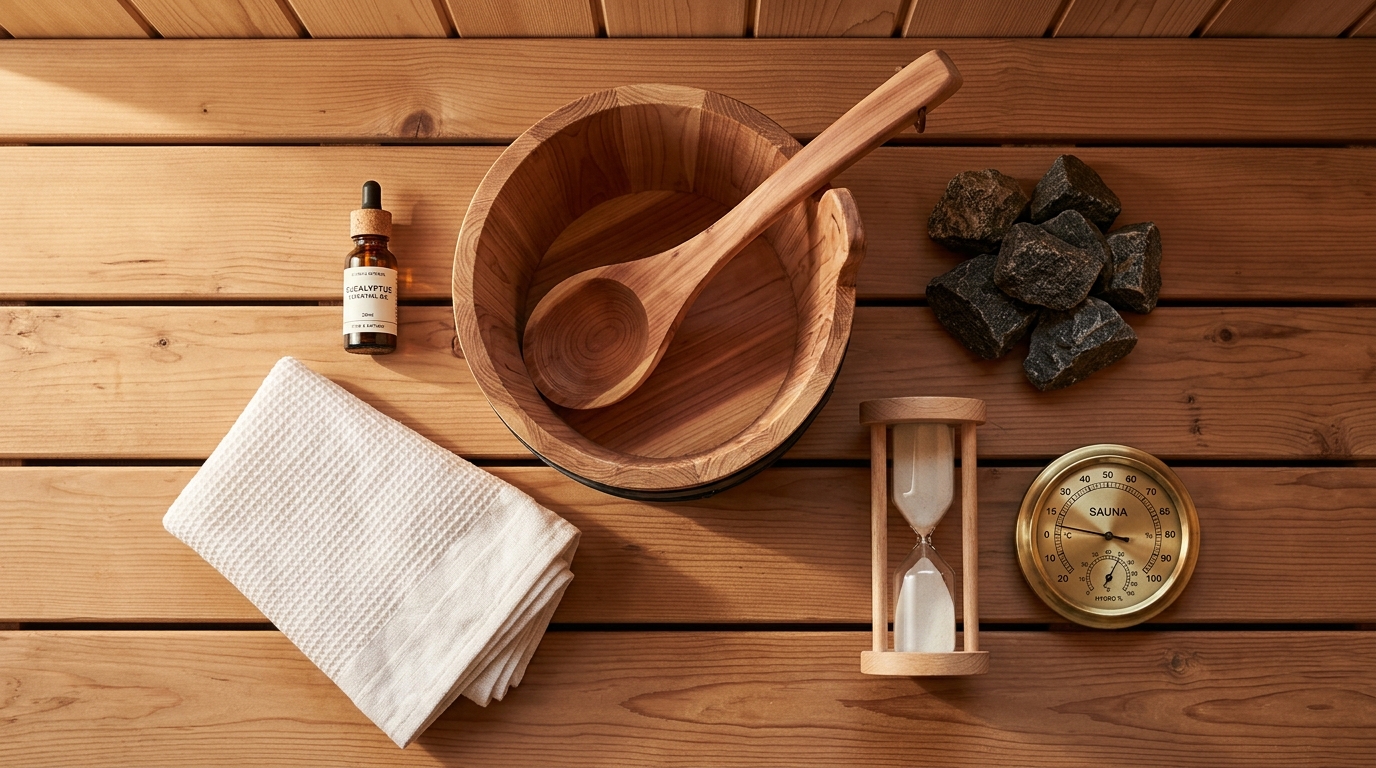
Sauna accessories sit in a weird category — most of them aren’t strictly necessary (you can use a sauna with nothing but a towel), but the right ones materially improve the experience and add years to your equipment’s lifespan. The trap is the opposite: spending $300 on “luxury wellness accessories” that don’t change anything. This guide separates the accessories that earn their place from the gift-shop souvenirs.
The essentials (real saunas need these)
Igneous rocks (traditional saunas only)
Traditional and barrel saunas need stones on the heater. The stones absorb heat, then release it (steam when you ladle water on them) — they’re the entire point of “wet” sauna. Two rules:
- Use igneous rocks specifically. Peridotite, olivine, or vulcanite. Sedimentary rocks (river rocks, sandstone, granite) split and explode when heated. Cheap “sauna rocks” bundled with budget heaters are often the wrong type — check before first use.
- Replace every 5-7 years for regular-use saunas. The cycling between 600°F and room temperature breaks down the rock matrix; degraded stones don’t hold heat as well and dust the heater elements.
Best for proper traditional or barrel saunas; replacement stones every 5-7 years
Olivine/Peridotite Sauna Stones (40-50 lb bag, Finnish-imported)
Olivine and peridotite are the canonical Finnish sauna stones. They're dense, slow to heat (stores more thermal energy), and crucially they don't explode under thermal stress. A 40-50 lb bag covers most home heaters; \$80-130 is the typical price. Finnish-sourced stones (Made in Finland or Karelia stones labels) are the gold standard — but commercially-quarried alternatives from the US Pacific Northwest are also excellent.
★★★★★ (1,400 reviews)
Check current price on Amazon →Hardwood bucket and ladle
You need a vessel to hold water and a ladle to throw it onto the stones. Plastic doesn’t survive the heat; metal handles get hot enough to burn. Hardwood is the only material that works long-term.
Best for every traditional or barrel sauna; the most-used accessory after the stones
Cedar Sauna Bucket + Ladle Set (with plastic liner)
A cedar bucket with a removable plastic liner is the standard. Plastic liner means the wood never holds water (which would warp and split it); the cedar exterior is what touches your hand. Long-handled ladle (12-16 inches) lets you reach across the heater without getting your hand close to 200°F air. \$40-80 buys a set that lasts 8-15 years. Replace the plastic liner every 3-5 years (cracks at the rim from heat exposure).
★★★★★ (2,200 reviews)
Check current price on Amazon →Thermometer + hygrometer
The temperature gauge that ships built into most sauna heaters reads the air near the lid (often 30-50°F off from the actual sitting-bench temperature). A standalone gauge mounted at bench height is meaningfully more accurate.
Best for any sauna where you want to know the actual bench-level temperature + humidity
Sauna Thermometer + Hygrometer (analog, brass)
Brass analog gauges hold up to 250°F+ where digital thermometers degrade. Mount at bench height (4-6 feet off the floor). \$30-60 for a quality combo unit. Digital alternatives exist but require battery changes and the LCD displays fade under repeated high-heat cycles. For traditional saunas where temperature accuracy matters: brass analog is the right call.
★★★★★ (1,800 reviews)
Check current price on Amazon →Nice-to-have (real benefit, not strictly required)
Aromatherapy oils
Adding 2-5 drops of essential oil to the water bucket before ladling onto stones produces a gentle aroma during löyly. Eucalyptus, pine, birch, and spruce are the traditional Finnish picks. Avoid synthetic fragrances — they degrade under heat into compounds you don’t want to inhale.
Best for users who want to enhance traditional sauna sessions with proper essential oils
Sauna Aromatherapy Oil Set (eucalyptus, pine, birch, spruce — 100% essential)
Real essential oils — not generic scented sauna products. \$20-40 for a 4-pack of traditional Finnish scents (eucalyptus, pine, birch, spruce). 2-5 drops in the water bucket is the right dose; more becomes overwhelming. A single set lasts 50-80 sauna sessions. Skip sauna fragrance products that aren't pure essential oils — they often contain synthetic compounds that smell fine cold but turn acrid at 200°F.
★★★★★ (920 reviews)
Check current price on Amazon →Backrest
A simple curved hardwood backrest meaningfully improves comfort during longer sessions (15+ minutes), particularly for users with back issues. Most premium saunas include built-in backrests; barrel saunas sometimes don’t.
Best for users who do 15+ minute sessions or have lower back issues
Sauna Backrest (curved cedar or aspen)
A simple curved hardwood backrest (cedar or aspen) attaches to the wall behind the bench with stainless mounting brackets. \$40-80 for a quality model. Aspen is preferred (resin-free, lighter weight, doesn't get as hot to the touch as cedar). Skip plastic-coated or padded backrests; they degrade fast under repeated thermal cycling.
★★★★☆ (680 reviews)
Check current price on Amazon →Sand timer
A simple sand timer (typically 15 minutes) sits next to the door and gives you a sense of time without checking a phone (which shouldn’t be in a hot sauna anyway). The minimalist Scandinavian aesthetic also fits the room.
Best for users who want a no-electronics way to time sessions
Sauna Sand Timer (15-minute hardwood-frame hourglass)
A 15-minute sand timer is the standard sauna session length and a visual anchor that doesn't require keeping your phone in your hand. Hardwood-frame models (cedar or birch) hold up to the heat; plastic-frame timers warp within a year. \$15-30 buys a quality timer that lasts decades. Mostly aesthetic; not strictly necessary, but a satisfying ritual element.
★★★★★ (1,200 reviews)
Check current price on Amazon →What to skip
Categories of “sauna accessories” sold heavily but not worth buying:
- Branded “sauna pillows.” Padded headrests that get drenched in sweat, harbor bacteria, and require washing after every session. Just use a folded towel.
- Plastic sand timers, plastic ladles, plastic buckets. Plastic in a 200°F environment is a slow chemistry experiment. Hardwood only.
- “Detoxifying” sauna mats and sprays. No evidence base; sauna sessions don’t need additives.
- Decorative sauna scoops with engraved logos. Functionally identical to a $15 hardwood ladle at 3-5× the price.
- Branded thermometer + hygrometer combos with backlit digital displays. Backlight LED bulbs and battery casings degrade fast in 200°F+ environments. Brass analog gauges outlast them by an order of magnitude.
Quick comparison
| Product | Best for | Rating | Notes | |
|---|---|---|---|---|
| Olivine sauna stones (40-50 lb) | traditional/barrel saunas; replace every 5-7 yrs | ★★★★★ | $80-130. Igneous, won't explode. | Check price |
| Cedar bucket + ladle set | any traditional sauna | ★★★★★ | $40-80. Removable plastic liner. | Check price |
| Brass thermometer + hygrometer | accurate bench-level reading | ★★★★★ | $30-60. Analog. 250°F+ rated. | Check price |
| Aromatherapy oil set (eucalyptus, pine, birch, spruce) | enhances löyly sessions | ★★★★★ | $20-40 for 4-pack. 100% essential oils. | Check price |
| Curved hardwood backrest | longer sessions or back issues | ★★★★☆ | $40-80. Aspen preferred. | Check price |
| Sand timer (15 min hardwood) | session timing without electronics | ★★★★★ | $15-30. Birch or cedar frame. | Check price |
| Infrared sauna chromotherapy add-on | infrared users wanting color light | ★★★★☆ | $80-180. LED panel; cosmetic. | Check price |
FAQ
Frequently asked questions
How often do sauna stones need replacing?
Cedar vs aspen vs alder for accessories?
Real sauna aromatherapy vs essential oils for diffusers?
Should I use distilled water in my sauna bucket?
What about LED color therapy lights?
Do I need a sauna pillow or headrest?
Minimum kit for a new sauna
Spending priorities for a new sauna owner, in order:
- Olivine/peridotite stones ($80-130) — if traditional or barrel, non-negotiable
- Cedar bucket + ladle ($40-80) — if traditional or barrel, non-negotiable
- Brass thermometer-hygrometer ($30-60) — useful for any sauna type
- Aromatherapy oil set ($20-40) — quality-of-life upgrade for traditional/barrel
- Curved backrest ($40-80) — if you do 15+ min sessions
- Sand timer ($15-30) — purely aesthetic; can wait
Total essential kit: ~$200-350 for a real traditional/barrel sauna. Infrared cabins need significantly less (often just a thermometer-hygrometer and a towel).
Bottom line
Real essentials: olivine stones, hardwood bucket + ladle, brass thermometer-hygrometer. Strong nice-to-haves: aromatherapy oils, hardwood backrest, sand timer. Skip: sauna pillows, plastic anything, branded “luxury” accessories, detox sprays.
Round out the rest: setup overview, cost guide, installation guide, or infrared cabins.