roundups
Best Portable Steam Saunas of 2026
Portable steam sauna tent and pod picks for home use — ranked by steam output, heat retention, and build quality for real therapeutic wet heat.
 Marcus Reade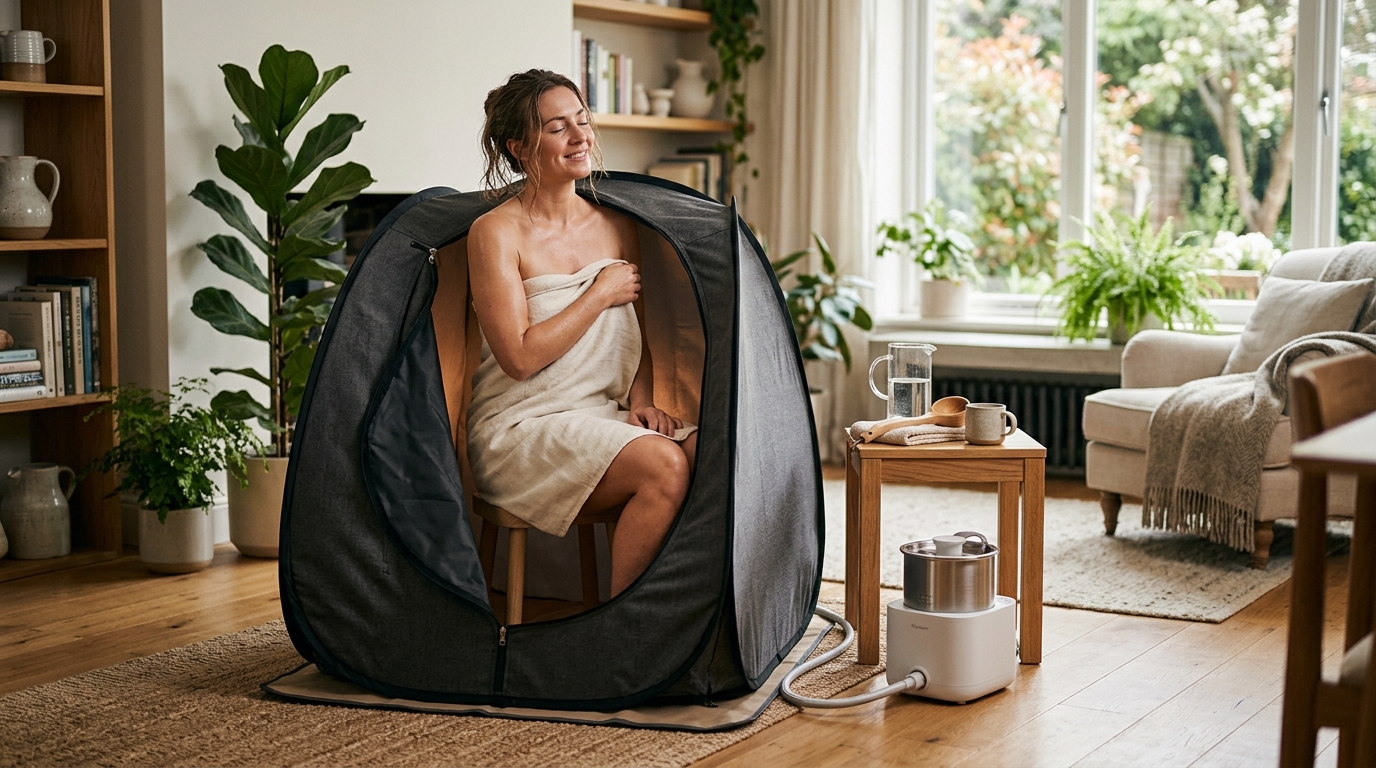
The best portable steam sauna for most buyers is the Durasage Portable Personal Steam Sauna — a head-out tent that delivers genuine moist heat from a dedicated 2L steam generator, heats to therapeutic temperature in under eight minutes on a standard 110V outlet, and costs around $120. For a roomier interior with better build quality, the SereneLife Portable Personal Steam Sauna is the step-up worth considering, with a wider seated footprint and better-sealed seams that retain steam more efficiently throughout the session.
Steam vs. infrared — which type of portable sauna is right for you
Portable steam saunas and portable infrared saunas are genuinely different products with different mechanisms, different experiences, and different maintenance requirements. The right choice depends on the kind of heat experience you want.
Steam saunas produce moist wet heat. A steam generator boils water and pipes hot steam into the sealed tent fabric. The air inside becomes hot and humid — near 100% relative humidity at 110-130°F — which is the same environment as a traditional Finnish sauna or commercial steam room. Wet heat opens pores aggressively, produces heavy sweat within five minutes, and delivers a skin-softening sensation that dry or infrared heat does not replicate.
Infrared saunas produce dry radiant heat. Carbon fiber panels emit far-infrared wavelengths that penetrate skin directly without significantly raising ambient air temperature first. The experience is warmer and drier — 120-140°F at low humidity — and the heat penetration depth into muscle tissue is the mechanism documented in most infrared sauna research.
Choose a portable steam sauna if: you prefer the wet heat of a traditional steam room, use the sauna primarily for skin and pore health, or find dry heat uncomfortable at therapeutic temperatures.
Choose a portable infrared sauna if: you want deeper muscle tissue heating, lower ambient air temperature with longer session tolerance, or a dry environment where you can use a phone or tablet during the session.
Steam portables also require more maintenance: the generator tank must be emptied and dried after each session, and the tent fabric must be air-dried completely to prevent mold. Infrared portables require essentially no maintenance beyond wiping down the chair and interior.
What matters in a portable steam sauna
Steam generator wattage and tank size
The steam generator is the engine of the product — and the most common source of buyer disappointment. A generator running at 800-1000 watts with a 2-liter tank can sustain continuous steam output for a 30-40 minute session without cycling off. Generators under 600 watts frequently cycle on and off to avoid thermal overload, which means you get bursts of steam followed by cool-down gaps instead of steady wet heat. A 1-liter tank often runs dry mid-session.
The specification to look for: 800-1000W, 2L minimum tank, adjustable steam output settings.
Tent fabric and seam construction
The fabric shell determines how well the tent retains steam — and how long it holds up under regular use. Double-stitched seams with heat-resistant backing retain steam significantly better than single-seam construction. Heavier fabric (210D nylon or above) resists sagging under steam pressure and holds heat more consistently than lighter 190D alternatives.
The neck opening seal is the most critical point: a loose or adjustable neck seal that does not close tightly loses heat rapidly and makes maintaining 115°F+ inside the tent difficult in a cool room.
Setup time and breakdown
A portable steam sauna takes 5-10 minutes to set up, 3-5 minutes to attach and prime the steam generator, and 5-10 minutes to dry and fold down after a session when done properly. Budget 20-25 total minutes of overhead per use. Units with integrated carry bags and simple color-coded connections are meaningfully faster to operate on a daily schedule.
Chair quality and weight rating
Every portable steam sauna includes a folding chair inside the tent. The quality of that chair matters more than it appears — you sit in it for 20-40 minutes in a hot, wet environment. Look for chairs rated to at least 300 lbs with a steel frame and nylon webbing. The plastic folding chairs included with sub-$80 units flex and creak under heat stress within a few months of daily use.
Quick comparison
| Product | Best for | Rating | Notes | |
|---|---|---|---|---|
| Durasage Portable Personal Steam Sauna | best overall; most owner reviews; reliable sustained steam output | ★★★★☆ | $110-150. 2L generator, 1000W. Nine steam settings. Folds flat. | Check price |
| SereneLife Portable Personal Steam Sauna | step-up build quality; better seam sealing; wider interior footprint | ★★★★☆ | $140-190. 2L generator, 800W. Double-stitched seams. Better neck seal. | Check price |
| ZONEMEL Portable Steam Sauna Tent | budget buyers who want a real 2L generator at the lowest price | ★★★★☆ | $80-120. 2L generator, 900W. Lighter fabric. Best for occasional use. | Check price |
| Radiant Saunas Rejuvenator Portable Sauna | buyers who want a fully enclosed cabin-style steam tent instead of head-out pod | ★★★★☆ | $160-220. Rigid internal frame. Full-enclosure zippered door. Better heat retention in cool rooms. | Check price |
The picks
Best overall — Durasage Portable Personal Steam Sauna
Best for first-time portable steam sauna buyers who want proven steam output and easy setup in a standard home or apartment
Durasage Portable Personal Steam Sauna Spa
Durasage is the benchmark in portable steam saunas for the same reason SereneLife holds that position in portable infrared: the product has been through enough owner cycles to reveal its real failure modes — the plastic steam tube fitting at 18-24 months of daily use, not the generator or fabric — and those are known quantities you can plan around. The 1000W steam generator with 2-liter tank sustains 35-40 minutes of continuous steam output without cycling, which is the key quality difference versus underpowered budget units. Nine adjustable steam levels let you dial heat from a mild 105°F warmup to a 125°F full-sweat session. Setup from carry bag to ready-to-use takes about eight minutes including generator connection.
★★★★☆ 4.2 · 4,800 reviews
Check current price on Amazon→Pros
- 1000W generator with 2L tank sustains continuous steam for a full 35-40 minute session without cycling off
- Nine steam output settings allow gradual heat-up in cooler rooms and lower-intensity sessions
- Folds completely flat with chair, tube, and generator into the included carry bag for closet storage
- Standard 110V plug-and-play setup — no electrician or dedicated circuit required
- Largest owner review base in the category — real-world failure modes and troubleshooting are well-documented
Cons
- Plastic steam tube fitting is the known failure point — typically shows wear at 18-24 months of daily use
- Included folding chair is undersized for users over 200 lbs; upgrade to a higher-rated folding chair for daily use
- Head opening seal is functional but not tight — noticeable steam loss if used in rooms below 65°F
- Requires distilled water only; tap water leaves mineral deposits that clog the generator within 4-6 months
Best step-up — SereneLife Portable Personal Steam Sauna
Best for daily users who want better seam quality and a wider interior footprint, and who find the standard Durasage neck seal too loose
SereneLife Portable Personal Steam Sauna
SereneLife makes both infrared and steam portable saunas, and the manufacturing discipline from their infrared line carries over in visible ways: the seams are double-stitched with heat-resistant backing, the head opening has a tighter adjustable neck seal, and the interior seated footprint is wider at the hips and shoulders. The 800W generator is slightly lower wattage than the Durasage but produces consistent steam in a better-sealed interior, so effective tent temperature is comparable despite the lower power draw. The $30-50 price premium over the Durasage is justified for daily users who expect 24 or more months of reliable use.
★★★★☆ 4.3 · 3,100 reviews
Check current price on Amazon→Pros
- Double-stitched seams with heat-resistant backing provide better steam retention and longer fabric durability than single-seam units
- Tighter adjustable neck seal reduces heat loss at the head opening — meaningful advantage in rooms below 65°F
- Wider interior footprint at hip and shoulder level — more comfortable for users over 200 lbs or with broader frames
- Consistent steam output despite lower wattage, because better sealing reduces heat loss from the interior
- Higher-rated folding chair than the Durasage default — better suited for heavier users from day one
Cons
- $30-50 more than the Durasage for build improvements most occasional users will not notice
- 800W generator heats up slightly more slowly than 1000W units in cold rooms
- Carry bag is smaller with less slack — harder to pack quickly if the tent is not folded in exactly the right sequence
- Fewer owner reviews than Durasage means less community troubleshooting data for edge cases
Best value — ZONEMEL Portable Steam Sauna
Best for budget-conscious buyers who want a real 2L steam generator at under $100 and use the sauna a few times a week rather than daily
ZONEMEL Portable Steam Sauna Tent
ZONEMEL delivers the critical specification — a 900W generator with a 2-liter tank — at a price point $30-40 below the Durasage. The trade-offs are visible on close inspection: lighter fabric weight (around 190D versus the Durasage 210D), single-stitched seams at the arm openings, and a less refined zipper pull on the generator compartment. For occasional use at 2-3 sessions per week, these trade-offs are invisible during the actual session. For daily use over two years, the seams and fabric will show wear sooner than the Durasage or SereneLife. The right choice when budget is the primary constraint and the usage pattern does not justify spending $120-150.
★★★★☆ 4.1 · 2,800 reviews
Check current price on Amazon→Pros
- The critical specification — 900W generator, 2L tank — matches the Durasage output at a lower price
- Consistent steam for a full 30-minute session without cycling off at standard room temperatures
- Lighter fabric means faster pack-down for users who break it down after every session
- Good value for occasional use at 2-4 sessions per week without requiring daily-use durability
Cons
- Lighter 190D fabric shows seam wear faster than 210D alternatives under daily use
- Single-stitched arm opening seams are the first structural failure point at higher session frequency
- Steam tube fitting quality is lower — plan to inspect and replace sooner than Durasage
- Neck seal is looser than both Durasage and SereneLife — more noticeable heat loss in cooler rooms
Best fully enclosed format — Radiant Saunas Rejuvenator
Best for buyers who set up a steam sauna in a cool basement or garage and want a fully enclosed cabinet-style unit with a zippered door
Radiant Saunas Rejuvenator Portable Steam Sauna
The Rejuvenator is the outlier in the portable steam sauna category: it uses a rigid internal frame with fabric panels to create a box-shaped steam cabinet with a full zippered door rather than the head-out pod format. The fully enclosed interior drives higher ambient steam temperature and better heat retention in cool rooms — important if your sauna space has ambient temperatures below 65°F, as a head-out pod loses heat rapidly through the neck opening in those conditions. The trade-off is that the Rejuvenator does not collapse flat and needs dedicated floor space. If you set it up once and leave it in place, this format outperforms pod tents on steam temperature consistency. If you break it down after every session, the pod-tent format is more practical.
★★★★☆ 4.0 · 1,400 reviews
Check current price on Amazon→Pros
- Full-enclosure zippered door drives higher interior steam temperature than head-out pods in the same ambient conditions
- Rigid internal frame does not sag or lose shape under steam pressure the way tent-pole designs can
- Better heat retention in cool rooms — meaningful advantage for basement or garage installations
- More structured appearance than a tent-pole pod; better fit for a finished room or dedicated wellness area
Cons
- Does not collapse flat — needs dedicated floor space when in use and semi-permanent storage when not in use
- Setup takes 15-20 minutes versus 5-8 for a standard pod tent — not practical for daily break-down routines
- $160-220 price approaches entry-level fixed-install steam unit territory; verify the math before committing to portable
- Fewer owner reviews than the main pod-tent brands means less community troubleshooting data
What to skip
Sub-$70 units with 600W or smaller generators. The generator is the product. A 600W generator with a 1-liter tank produces intermittent steam: it heats to steam output, emits for a short interval, drops below threshold, reheats, and cycles again. In a cool room you spend more time waiting for steam than sweating. These units satisfy the tent-shape specification without meeting the functional one. The $40-50 price difference between a budget unit and a Durasage is not worth compromising the core experience.
Units making specific detoxification claims. Sweating in a steam sauna removes water, sodium, and trace minerals — it does not selectively eliminate heavy metals or toxins at meaningful concentrations. Portable steam saunas are legitimate recovery and relaxation tools with real cardiovascular and skin benefits at sustained use. The benefit mechanism is heat adaptation and improved circulation, not a detoxification pathway. Products that lead with detox language are typically the same units with undersized generators, marketed differently.
Hybrid infrared-plus-steam claims. A fabric tent cannot simultaneously function as a far-infrared sauna and a steam sauna. Water vapor absorbs infrared wavelengths, which means an infrared panel surrounded by steam is heating the air rather than delivering far-infrared penetration. If you want infrared, choose an infrared portable. If you want steam, choose a steam portable. Ignore hybrid claims at this price tier.
FAQ
Frequently asked questions
How hot does a portable steam sauna get?
How long should a portable steam sauna session be?
Should I use tap water or distilled water in a portable steam sauna?
How do I prevent mold in a portable steam sauna?
What is the difference between a portable steam sauna and a portable infrared sauna?
Bottom line
For most buyers, the Durasage Portable Personal Steam Sauna is the right pick — 1000W sustained steam output, 2L tank, nine heat settings, and the largest owner review base in the category. Step up to the SereneLife if you use it daily and want better seam construction and a tighter neck seal across 24-plus months of regular use. Choose the ZONEMEL if budget is the primary constraint and your usage is 2-4 sessions per week. The Radiant Saunas Rejuvenator earns its premium only if you install it in a cool room and leave it in place rather than breaking it down daily.
To compare the steam format against infrared before committing, best portable infrared saunas covers the dry-heat category in depth. For a broader look at all portable sauna formats — steam pods, infrared pods, and blankets — see best portable saunas. For the broader category of home steam options beyond portable tents, including shower steam generators and room kits, steam sauna for home covers the full format range. And for context on how a portable steam sauna compares to a dedicated steam room experience, sauna vs. steam room covers the key differences in environment, heat mechanism, and outcomes.