comparisons
Sauna vs Steam Room: Which Should You Buy?
Sauna vs steam room compared on heat, humidity, health benefits, installation cost, and which fits your home best.
 Marcus Reade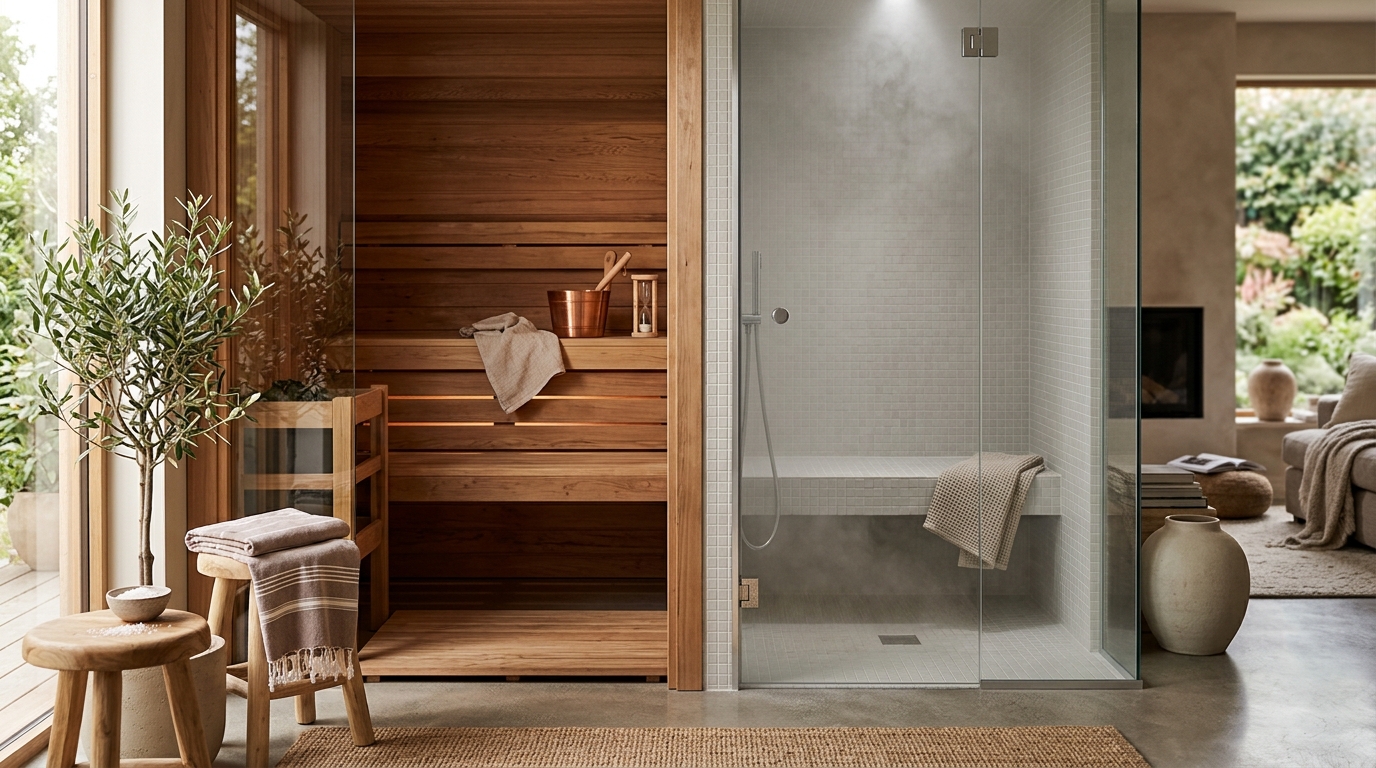
Quick answer: A traditional sauna runs at 160–195°F in dry air (10–30% humidity) and holds the strongest cardiovascular research of any heat therapy format. A steam room runs at 100–115°F near 100% humidity and wins for respiratory relief and skin hydration. For most home buyers a sauna is cheaper to install, easier to maintain, and more likely to become a daily habit.
What is a sauna vs a steam room?
A sauna is a small insulated room or cabin heated by a kiuas — an electric or wood-burning heater loaded with igneous stones. The stones absorb and hold heat; when water is poured on them, it flash-evaporates into a brief steam burst called löyly. Despite that steam spike, a sauna operates in fundamentally dry air: ambient temperature holds at 160–195°F and relative humidity stays at 10–30% even during löyly. The high temperature and low humidity are what define the traditional Finnish sauna experience.
A steam room is a sealed, tile-lined enclosure fed by a dedicated steam generator that pumps continuous pressurized moisture into the space. The air temperature stays far lower (100–115°F), but relative humidity reaches 95–100%. That saturated moisture is the entire point. The felt experience is enveloping rather than blazing — breathing feels heavier, skin feels coated, and the heat penetrates differently because humid air transfers warmth more efficiently than dry air at the same temperature.
The single most consequential difference is humidity, not temperature. That variable drives every practical and health consideration that follows.
Sauna vs steam room: head-to-head comparison
| Product | Best for | Rating | Notes | |
|---|---|---|---|---|
| Air temperature | Sauna: 160-195°F. Steam room: 100-115°F. | — | Humid air at 110°F feels as intense as dry air at 165°F due to more efficient heat transfer. | — |
| Humidity | Sauna: 10-30%. Steam room: 95-100%. | — | The defining difference — dictates skin effects, respiratory benefits, and maintenance burden. | — |
| Installation type | Sauna: pre-built cabin or kit room. Steam room: custom tile enclosure with generator and drain. | — | Saunas ship flat-pack and assemble in hours; steam rooms require a tile contractor and electrician. | — |
| Electrical requirements | Sauna: 110V outlet or 240V for larger units. Steam room: 240V/30-60A dedicated circuit. | — | Small infrared saunas need only a standard outlet; steam always needs dedicated wiring. | — |
| Cost to install | Sauna: $1,500-6,000. Steam room: $3,000-15,000. | — | Adding steam during a bathroom remodel is the most cost-effective steam path at $1,500-3,000 incremental. | — |
| Energy per session | Sauna: ~$0.25-0.55. Steam room: ~$0.40-0.85. | — | At $0.16/kWh; steam generators heat both the air and the tile mass continuously. | — |
| Maintenance | Sauna: weekly bench wipe, monthly deep clean. Steam room: daily post-session scrub and fan dry. | — | Mold and mineral scale are the primary ongoing challenges in any steam room. | — |
| Cardiovascular benefits | Sauna: strongest long-term observational research available. | — | Finnish population studies link 4-7 weekly sauna sessions to 50% lower fatal cardiac risk. | — |
| Respiratory benefits | Steam room: clear advantage for sinus and airway conditions. | — | Warm humid air loosens mucus and reduces airway resistance; dry heat cannot replicate this. | — |
| Skin effects | Steam room: better hydration during session. Sauna: more intense sweat volume. | — | Steam keeps skin surface moist; sauna sweat evaporates in dry air, which can feel drying. | — |
When a sauna is the better choice
Choose a sauna when:
- You want the most-researched heat therapy format. Decades of Finnish public-health data link regular sauna use to reduced cardiovascular disease, dementia risk, and all-cause mortality. This research base does not exist for steam rooms.
- Your budget is $1,500–5,000 for the full install. A pre-built 2-person electric or infrared sauna cabin assembles in a weekend with no contractors, no plumbing, and minimal or no electrical work (for smaller 110V infrared models).
- You want daily use. The low-friction setup of a home sauna — 15-minute heat-up, wipe clean after — makes it genuinely sustainable as a seven-day-per-week habit. Most of the cardiovascular research benefit accrues to people who use it four or more times a week.
- You have a garage corner, spare bedroom, or basement nook rather than a dedicated wet room with existing drainage.
- Post-workout muscle recovery is your primary goal. Deep tissue heating from infrared panels or the intense dry heat of an electric sauna at 180°F is the standard benchmark in athletic recovery protocols.
- You want something that lasts decades with modest upkeep. A quality cedar or hemlock sauna cabin resists moisture and can be wiped down in minutes. The bench wood itself is the only consumable that degrades with heavy use.
The most reliable predictor of sauna use frequency is installation friction. Cabins that heat up in 15 minutes and require a quick wipe-down get used daily. Custom steam rooms that need daily scrubbing and ventilation management get used on weekends — if at all.
When a steam room is the better choice
Choose a steam room when:
- You have chronic sinusitis, asthma, or respiratory congestion. Warm air saturated at near-100% humidity loosens mucus, reduces nasal airway resistance, and provides measurable symptom relief that dry heat simply cannot replicate. This is the clearest and most clinically meaningful advantage steam holds over any sauna format.
- You are already mid-remodel. Adding a steam generator to a new master bath or shower tile project costs $1,500–3,000 incremental — far less than building a standalone steam room or buying a quality sauna cabin. This is the best cost-per-experience path to steam.
- Skin hydration is a primary goal. Estheticians use steam for pre-facial prep because moist heat opens pores while maintaining the skin surface moisture that dry air removes. If you have dry or sensitive skin, steam is the better session environment.
- You want the immersive, enveloping spa experience. There is no dry-heat setting that approximates the sensation of a saturated steam room at 110°F. These are genuinely different experiences, and if the humid enveloping feeling is what you are after, a sauna will not satisfy it.
- Your existing shower can be sealed and fitted with a generator. A tight 3×4 shower with a door that seals and a floor drain can be converted for $1,000–2,500 in materials and labor, making it the most affordable steam entry point for many homes.
Health benefits: where each format wins
Sauna: cardiovascular and neurological edge
The most compelling research on heat therapy comes from Finnish observational studies following large populations over decades. In the Kuopio Ischemic Heart Disease Risk Factor Study (Laukkanen et al., 2018), men who used a sauna four to seven times per week had a 50% lower rate of fatal cardiac events compared to once-a-week users. Associations with reduced dementia risk and all-cause mortality have been replicated in follow-up analyses from the same cohort.
The mechanism appears to involve repeated cardiovascular stress and recovery cycles. At 170–185°F, heart rate rises to aerobic exercise levels (100–150 bpm in most adults). Blood vessels dilate, blood pressure drops in the hours after a session, and inflammatory markers decrease with regular use. Steam rooms at 100–115°F produce a real but smaller cardiovascular stimulus — the temperature and humidity combination simply cannot drive the same heart-rate response as high dry heat.
Steam room: respiratory and skin advantage
The case for steam is clearest for upper respiratory conditions. Warm air at near-100% humidity:
- Reduces nasal airway resistance and liquefies mucus secretions
- Provides measurable symptom relief for chronic sinusitis (Passali et al., 2008)
- Is the standard inhalation medium in respiratory therapy and spa medicine
For skin, saturated humidity keeps the stratum corneum hydrated throughout the session. Sweat produced in dry sauna air simultaneously evaporates — effective for thermoregulation but drying for the skin. Steam sweat sits on skin in moisture-saturated air, which is why estheticians consistently reach for steam before facial treatments.
Both formats deliver: acute stress relief, reduced cortisol, improved post-session sleep quality, and peripheral vasodilation. Neither has credible evidence for toxin elimination or meaningful fat loss — those are marketing claims, not clinical outcomes.
Maintenance and hygiene
This is a real differentiator that is often underweighted at purchase time.
Sauna maintenance is minimal. After each session: wipe the benches with a damp cloth and leave the door open to air dry. Once a week, scrub benches with a soft brush and mild sauna cleaner (or diluted hydrogen peroxide — never bleach on cedar). Sand the bench wood lightly once or twice a year to remove any graying. The kiuas stones should be replaced every two to three years as they crack with thermal cycling. Total time investment: 5 minutes per session, 30 minutes monthly.
Steam room maintenance is significant. Warm, perpetually wet tile is an ideal environment for mold and mineral scale, and preventing those requires discipline:
- Run the ventilation fan for 20–30 minutes after every session without exception
- Squeegee tile and glass surfaces immediately after each use
- Scrub grout lines with diluted white vinegar weekly
- Descale the steam generator every three to six months depending on water hardness
If you are unwilling to treat daily steam room scrubbing as non-negotiable, the room will develop mold issues within weeks. Epoxy grout and a thorough initial waterproofing membrane reduce (but do not eliminate) this burden.
Installation reality
Sauna installation
A pre-built electric or infrared sauna cabin is a product purchase, not a construction project:
- Clear a floor area of 4×4 feet (2-person) to 5×6 feet (3-person)
- Assemble flat-pack panels with basic hand tools — typically 2–4 hours
- Plug into a 110V outlet (small infrared) or have a 240V/20–30A circuit added for a traditional electric model
- Run a heat session; you are done
Custom sauna rooms built into garage walls, basement corners, or spare bedrooms cost $4,000–12,000 with contractors but feel like a proper room rather than a cabin and last indefinitely.
Steam room installation
Steam rooms require a tile contractor and electrician regardless of size:
- Build a fully sealed enclosure: cement board substrate, waterproofing membrane (RedGard or Schluter KERDI), tile, and epoxy grout throughout
- Install a steam generator in a nearby closet within 25 feet of the steam head
- Run a 240V/30–60A dedicated circuit for the generator
- Rough in a floor drain or slope tile to an existing drain
- Install a steam head (wall nozzle) and optionally an aromatherapy injection port
- Add a ventilation fan on an automatic timer
Labor and materials for a custom 4×5 steam room: $4,000–10,000. Adding steam to a new shower remodel: $1,500–3,000 incremental — the most cost-effective path if construction is already underway.
Product picks
Best home electric sauna for daily use
Best for people who want a traditional wood sauna experience at home without custom construction
Almost Heaven Pinnacle 2-Person Sauna
Hemlock construction, a 4.5 kW Harvia electric heater loaded with stones, and room for two. Operates at 160-185°F dry heat with the option for löyly steam bursts. Assembles from flat-pack in 3-4 hours and needs a 240V/20A circuit. Built like a real sauna, not an infrared cabinet. The closest home-assembly option to the Finnish original.
★★★★★ 4.5 · 870 reviews
Check current price on Amazon→Best home steam generator
Best for adding steam to an existing tile shower or new bathroom remodel
Mr. Steam MS Series 7.5kW Home Steam Generator
Mr. Steam is the residential steam generator brand most specified by tile contractors. The 7.5 kW unit handles up to 100 cubic feet of enclosure space — a standard 4x5 or 5x5 steam shower. Digital controls, auto-drain valve, and aromatherapy injection port. Two-year warranty. The professional-grade choice sold direct to homeowners.
★★★★★ 4.6 · 650 reviews
Check current price on Amazon→Best combination unit (sauna and steam)
Best for buyers who want infrared heat therapy with an optional steam feature in one unit
Clearlight Sanctuary Full-Spectrum Infrared Sauna with Steam
Full-spectrum infrared panels (near, mid, and far wavelengths) with a built-in steam module that injects moisture into the cabin. Deep penetrating heat plus the option to add humidity when you want the steam experience. Medical-grade low-EMF construction, chromotherapy lighting, and Bluetooth audio. The premium option for buyers who genuinely want both formats.
★★★★★ 4.7 · 310 reviews
Check current price on Amazon→What about a traditional sauna with löyly?
A Finnish-style traditional sauna with a kiuas produces brief steam bursts via löyly — water poured directly on hot stones that flash-evaporates in seconds. This is not the same as a steam room. The humidity spike is intense but brief (30–60 seconds), then the dry hot air reasserts itself. The ambient temperature remains 165–185°F — far hotter than any steam room.
Many people find the löyly experience more satisfying than either format in isolation: the shock of hot steam against your face at 180°F is qualitatively different from the constant saturation of a 110°F steam room. If you want both high heat and a steam element, a traditional electric sauna with stones is the answer. It is also dramatically cheaper and easier to install than a dedicated steam room.
FAQ
Frequently asked questions
Is a sauna or steam room better for weight loss?
Can I add a steam generator to my existing shower?
Which is better for muscle recovery — sauna or steam room?
How long should you stay in a sauna vs a steam room?
Is it safe to use a sauna every day?
Bottom line
For most home buyers, a sauna is the right choice: more flexible installation, lower cost, much stronger cardiovascular research, and a maintenance burden that amounts to a quick wipe-down after each session. A pre-built electric or infrared cabin is the most practical path to a daily heat therapy habit that you will actually sustain.
A steam room is worth the extra cost and construction complexity when moist heat is specifically what you need — chronic sinus or respiratory conditions, skin hydration, or the enveloping spa sensation that no dry-heat format can replicate. Adding steam during a bathroom remodel is the most cost-effective path; building a standalone custom steam room from scratch is the most expensive.
For detailed cost breakdowns on either format, see our home sauna cost guide. For full-unit recommendations, browse best indoor saunas and best outdoor saunas. If you are choosing between sauna types rather than between sauna and steam, see our infrared vs traditional sauna comparison.