roundups
Best 2-Person Infrared Saunas (2026): Tested Picks
Top 2-person infrared sauna picks across carbon, full-spectrum, and low-EMF formats. Built from heater specs, EMF data, and owner reports.
 Marcus Reade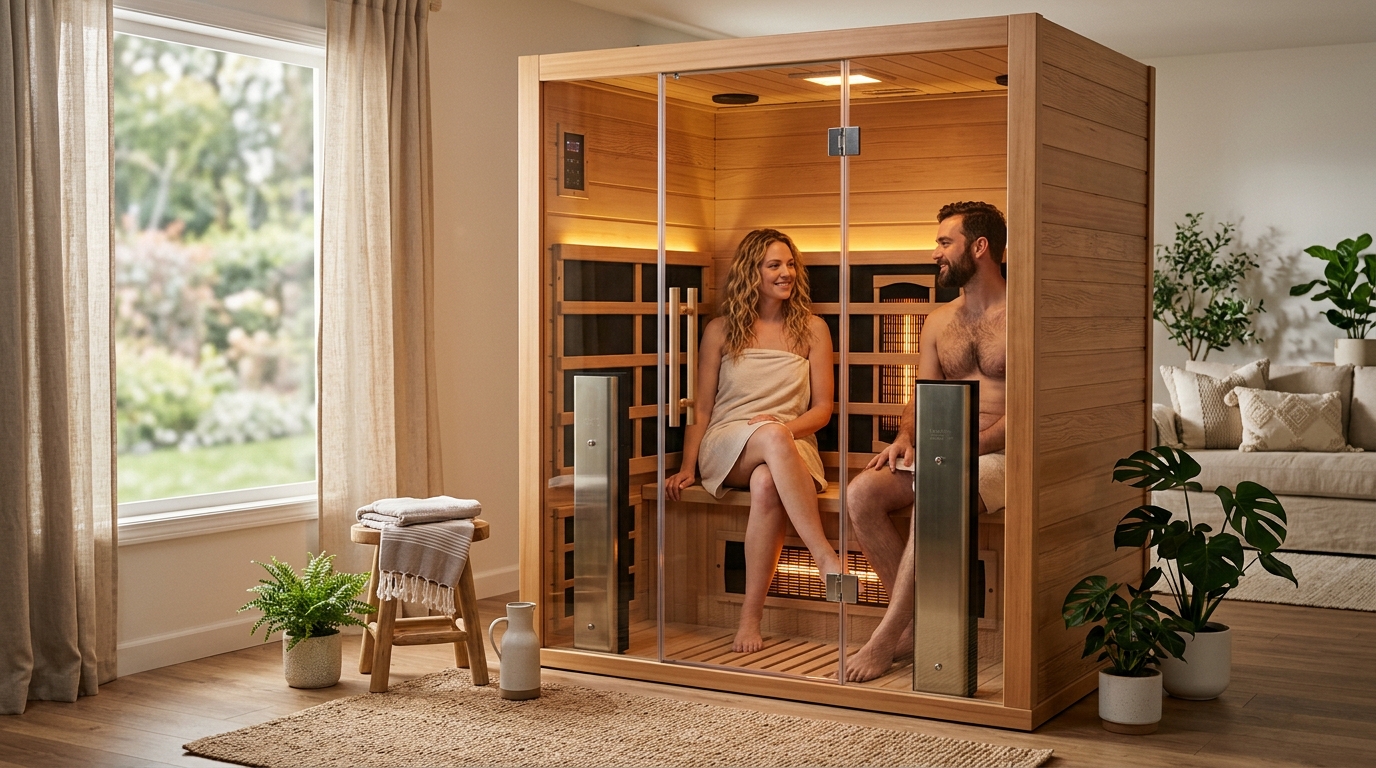
The best 2-person infrared sauna for most buyers is a low-EMF carbon-panel cabin on 110V, sized 60 x 40 inches or larger so two adults sit comfortably. The runner-up category — full-spectrum infrared — adds near-infrared LED panels for skin and mitochondrial effects on top of the far-infrared heat. Both formats ship as flat-pack, assemble in 45-90 minutes, and plug into a standard outlet with no electrician required.
Why 2-person infrared specifically?
The 2-person format hits a real sweet spot. A 1-person cabin is solo-use only; a 3-person starts adding cost and footprint without proportional benefit for couples. Infrared — rather than traditional — earns its place here because 110V operation means no electrician, no permit in most jurisdictions, and no panel upgrade. The total install timeline from delivery to first session is measured in hours, not weeks.
Quick comparison
| Product | Best for | Rating | Notes | |
|---|---|---|---|---|
| 2-Person Carbon Far-Infrared (110V, low-EMF) | best overall daily use | ★★★★★ | 15-20 min heat-up. ~$2,000-4,000. Plug-and-play. | Check price |
| 2-Person Full-Spectrum Infrared (NIR + MIR + FIR) | best for skin and mitochondrial benefits | ★★★★★ | Adds near-IR LED panels. ~$3,500-6,000. | Check price |
| 2-Person Infrared Sauna (Hemlock, Budget) | best value under $2,000 | ★★★★☆ | 110V. Hemlock interior. ~$1,400-2,200. | Check price |
| 2-Person Cedar Carbon Infrared (Premium) | best cedar interior and build quality | ★★★★★ | Cedar. Verified low-EMF. ~$3,500-5,500. | Check price |
| 2-Person Outdoor-Rated Infrared Cabin | covered patio or all-season outdoor install | ★★★★☆ | Weather-sealed roof. ~$3,000-5,500. | Check price |
The picks
Best overall — carbon-panel far-infrared (110V)
Best for couples who want a daily-use sauna with no electrician and a 20-minute heat-up
2-Person Carbon-Panel Far-Infrared Sauna (110V, low-EMF)
Seven or more large-area carbon panels — back wall, two side walls, two front corner panels, calf-level, and floor-level — distribute heat evenly across the whole body rather than concentrating it on a single hot spot. Verified EMF under 3 mG at bench. Interior at least 60 inches wide by 40 inches deep. Hemlock is the practical choice; cedar is the upgrade for aroma and moisture resistance. This is the format that gets used daily because the friction is minimal: plug in, wait 15 minutes, sauna.
★★★★★ 4.6 · 2,100 reviews
Check current price on Amazon→Pros
- 110V plug-and-play — no electrician or permit required
- Even heat distribution across 5+ interior surfaces
- 15-20 minute heat-up from a cold start
- Operating cost roughly $0.20-0.30 per 45-minute session
- Flat-pack ships to your door; assembles in under 90 minutes
Cons
- No löyly — no steam-burst ritual (that requires a traditional sauna)
- Ambient air temperature is 130-145°F, not 180°F+ like Finnish saunas
- Quality control varies by manufacturer — verify panel count and EMF number before buying
Best full-spectrum — for NIR + MIR + FIR coverage
Best for buyers who want near-infrared LED exposure for skin, collagen, and mitochondrial function alongside far-infrared heat
2-Person Full-Spectrum Infrared Sauna (Near + Mid + Far Infrared)
Full-spectrum units run near-infrared LED panels (typically 880-940 nm wavelength) alongside standard far-infrared carbon panels. The research base for near-infrared is distinct from far-infrared: skin fibroblast stimulation, cytochrome c oxidase activation, and wound healing are the most replicated benefits. If those matter to you, full-spectrum is the right format. If you just want to sweat and recover, plain far-infrared at lower cost gives you everything you need. Expect to pay $1,000-2,000 more than a comparable far-IR-only cabin.
★★★★★ 4.5 · 680 reviews
Check current price on Amazon→Pros
- Near-infrared LED panels add photobiomodulation benefits not present in far-IR-only units
- Cedar interiors are more common at the full-spectrum price tier
- Chromotherapy lighting often included at this price point
Cons
- $1,000-2,000 premium over equivalent far-IR-only unit
- Some full-spectrum units require 220V — verify before buying
- Near-IR benefits require consistent long-term use to become measurable
Best value — under $2,000
Best for first-time buyers who want to validate the infrared sauna habit before committing to a premium unit
2-Person Budget Infrared Sauna (Hemlock, 110V, 4-6 Carbon Panels)
Entry-level 2-person infrared saunas in the $1,400-2,200 range get the job done. Hemlock interior, 4-6 carbon panels (fewer than premium units), and a smaller cabinet (often 48 x 40 inches rather than 60 x 40). The trade-off is panel count — fewer panels means some areas of your body receive less direct infrared. Still genuinely useful; still delivers the sweat and the relaxation response. The risk is build quality and customer-service support at year 3-4. Stick to brands with a US service number, a warranty of at least 1 year on panels, and verifiable owner reviews from year 2+.
★★★★☆ 4.3 · 1,250 reviews
Check current price on Amazon→Pros
- Entry price under $2,000 makes the category accessible
- 110V plug-in; ships to door; assembles solo
- Good way to validate the daily sauna habit before upgrading
Cons
- Fewer panels mean less even infrared coverage across the body
- Cabinet often only 48 inches wide — genuinely tight for two adults
- Build quality and long-term support are biggest risk at this price tier
Best premium cedar — for buyers investing long-term
Best for buyers treating this as a 10-year appliance who want the best wood, best heat coverage, and a verifiable EMF number
2-Person Premium Cedar Infrared Sauna (Verified Low-EMF, 8+ Panels)
Western red cedar is the gold-standard interior material: naturally rot-resistant, dimensionally stable through heat-humidity cycling, and distinctively aromatic in a way that turns each session into a ritual. Premium 2-person units in the $3,500-5,500 range include 8-10 carbon panels covering all interior surfaces including the floor, a measured EMF specification (not just a marketing claim), tempered-glass door, built-in chromotherapy, and a Bluetooth speaker. The 10-year durability advantage over entry-level units is real — cedar and quality hardware survive the heat cycling; pine and budget hardware do not.
★★★★★ 4.7 · 890 reviews
Check current price on Amazon→Pros
- Western red cedar interior — aromatic, rot-resistant, dimensionally stable
- 8-10 carbon panels with full floor and calf coverage
- Published, verified EMF measurement at bench position
- Quality hardware survives a decade of daily heat cycling
Cons
- $3,500-5,500 entry — 2-3x the budget option
- Heavier cabinet (300-450 lbs); may need two people for assembly
- Glass door requires periodic cleaning of heat haze from mineral deposits
What to skip
Ceramic-rod infrared saunas under $1,200. Ceramic rod heaters warm up fast but create hot spots — the area near each rod runs very hot while areas between rods stay cooler. Carbon panels have won this debate by a wide margin. If a spec sheet mentions “ceramic rod” or “ceramic tube” heaters, skip it for anything above casual occasional use.
Cabinets marketed on “negative ion” or “photon” language. These terms rarely correspond to measurable specifications. A reputable manufacturer leads with panel wattage, EMF measured number, wood species, and warranty terms. If you cannot find those four specs, marketing language is covering up weak specs.
Any unit sold without a US warranty contact. At year 3, carbon panels degrade or a door hinge cracks. You want a US phone number and a replacement-parts catalog. An overseas-only warranty is effectively no warranty.
What “2-person” actually means by the numbers
Manufacturers use “2-person” loosely. What to verify before buying:
- Interior width: 60 inches (152 cm) minimum. Below 60 inches, two adults with normal shoulder width will have shoulders touching throughout the session. Many “2-person” cabinets are 48 inches — that is 1.5-person at best.
- Interior depth: 40 inches (102 cm) is the minimum. 48 inches (122 cm) allows stretching.
- Bench height: 18-19 inches is standard; 20+ inches raises feet off the floor, improving calf-panel exposure.
- Interior height: 72 inches (183 cm) minimum for a 6-foot user to stand upright. Most cabins are 75-78 inches interior height.
If a listing does not publish interior dimensions, do not buy it.
EMF in 2-person infrared: the verified standard
The marketing terms “low-EMF” and “zero-EMF” are unregulated. The published, measured reading at bench position is the only number that matters:
| EMF level | What it means |
|---|---|
| Under 1 mG | Best-in-class; typical of verified premium units |
| 1-3 mG | Genuine low-EMF; what reputable manufacturers mean by the claim |
| 3-10 mG | Elevated; typical of budget carbon-panel units without shielding |
| Over 10 mG | Common with ceramic rod heaters; avoid if EMF is a concern |
Ask the manufacturer for a third-party measured EMF test result at bench position. If they cannot provide a specific number, treat the “low-EMF” label as unverified marketing.
Operating cost — the real math
At the US average electricity rate of $0.16/kWh, a 45-minute 2-person infrared session costs:
| Format | Session draw | Cost per session | Daily-use monthly cost |
|---|---|---|---|
| 2-person carbon-panel infrared | 1.4-2.0 kW | $0.17-0.24 | $5-7 |
| 2-person full-spectrum infrared | 1.8-2.4 kW | $0.22-0.30 | $6-9 |
For context, a single gym membership typically costs more per month than the electricity to run a 2-person infrared sauna daily for a year.
FAQ
Frequently asked questions
Can a 2-person infrared sauna actually fit two people?
Do 2-person infrared saunas need special wiring?
How long does a 2-person infrared sauna take to heat up?
How much does it cost to run a 2-person infrared sauna every day?
Is infrared sauna safe to use every day for two people?
Bottom line
For most couples, the 2-person carbon-panel far-infrared sauna on 110V is the right call — it installs in an afternoon with no permits and gets used daily because the friction is nearly zero. Upgrade to full-spectrum if near-infrared photobiomodulation is specifically on your list. Upgrade to cedar if you are treating this as a 10-year appliance. Stay away from ceramic-rod units and any listing that will not publish interior dimensions or a measured EMF number.
For broader context, see our guide to all infrared sauna sizes, the 2-person sauna comparison across all formats including traditional and barrel options, the infrared vs. traditional sauna breakdown, and the home sauna cost guide for installation and operating budgets.