roundups
Best 2-Person Home Saunas (Indoor & Outdoor, 2026)
Independent 2-person sauna picks across infrared, traditional, and outdoor barrel formats. Built from heater specs, wood species data, and owner reports.
 Marcus Reade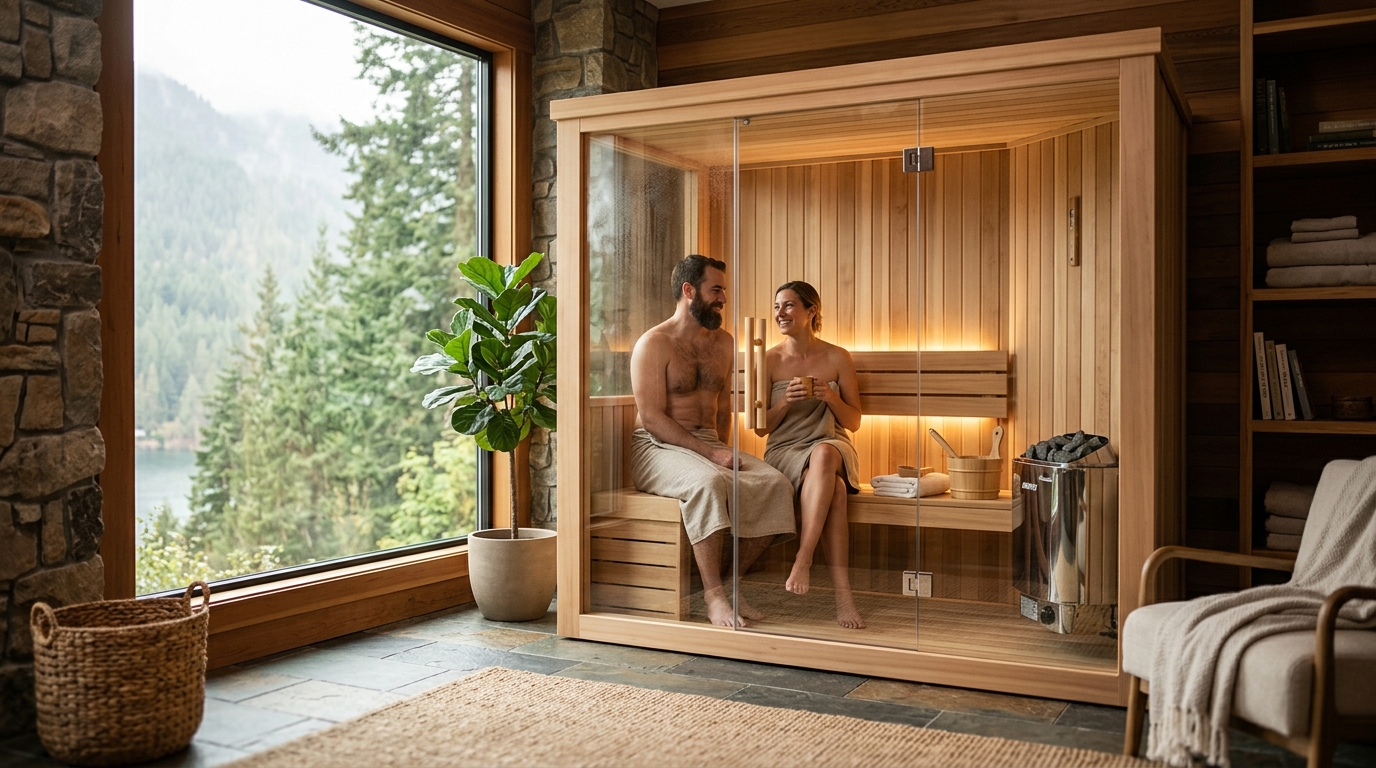
The 2-person sauna is the sweet spot of the home-sauna category. It’s small enough to fit a finished basement, a converted closet, or a back deck. It’s large enough that you can lie back, stretch a leg out, or share with a partner. And the price band — roughly $1,800 for entry infrared up to $7,500 for a quality outdoor traditional barrel — is where most buyers settle after weighing the upgrade math to a 3- or 4-person cabin.
This guide picks across infrared (the indoor default), indoor traditional (electric heater, plug-in), and outdoor barrel formats (wood-fired or electric, year-round).
Format choice — pick this first
Three sub-categories, three different experiences. You’re not picking a brand yet; you’re picking the format that fits how you want to use it.
- Infrared (indoor) — Heats your body, not the air. Runs at 130-145°F. 110V plug-in. Heat-up time 15-20 min. Operating cost ~$0.20-0.35/session. Closest to “a 45-minute hot bath.” No löyly (steam burst).
- Traditional indoor (electric heater) — Heats the air. Runs at 170-200°F. 240V circuit required. Heat-up time 30-45 min. Operating cost ~$0.80-1.20/session. Löyly works. Needs a drain or a humidity plan.
- Outdoor barrel (electric or wood) — Traditional experience, outdoors. Runs at 180-200°F. 240V if electric heater; no wiring if wood-fired. Heat-up time 35-50 min. Year-round in any climate when properly insulated.
If you’re not sure, default to infrared for the first sauna. It’s the lowest install cost, lowest operating cost, and the unit that gets daily use because the friction is lowest.
Quick comparison
| Product | Best for | Rating | Notes | |
|---|---|---|---|---|
| 2-person infrared cabin (carbon panels, 110V) | best overall for daily indoor use | ★★★★★ | ~$2,500-4,500. 16 sqft. Plug-and-play. | Check price |
| 2-person infrared cabin (full-spectrum, 110V) | near infrared + mid + far infrared coverage | ★★★★★ | ~$3,500-5,500. 16 sqft. Some need 220V. | Check price |
| 2-person indoor traditional (electric heater, 240V) | true Finnish-style indoor experience | ★★★★☆ | ~$3,500-6,000. 240V circuit. Vapor barrier required. | Check price |
| 2-person outdoor barrel (electric heater) | best traditional outdoor experience | ★★★★★ | ~$4,500-7,500. 240V. Cedar staves. 6-8 ft barrel. | Check price |
| 2-person outdoor barrel (wood-fired) | off-grid, no electrical install | ★★★★★ | ~$5,500-9,000. No wiring. Chimney install required. | Check price |
The picks
Best overall — 2-person carbon-panel infrared (indoor)
Best for daily indoor use; couples who want the sauna available in 20 minutes after work
2-Person Carbon-Panel Infrared Sauna (110V, low-EMF)
Seven or more carbon panels (back, two sides, two front corners, floor, calf-level), measured EMF under 3 mG at the bench, hemlock or cedar interior, and a 110V plug-and-play install. This combination is the genuine sweet spot of the category — small enough to fit in a 4-foot-wide alcove, large enough that you can stretch out, and inexpensive enough that the upgrade math to a 3-person cabin doesn't justify itself unless you specifically want to lie down.
★★★★★ 4.6 · 1,850 reviews
Check current price on Amazon→Pros
- 110V plug-and-play — no electrician
- Heat-up in 15-20 min from cold
- Carbon panel coverage on all five interior surfaces
- Operating cost ~$0.20-0.30 per 45-min session
- Footprint is a real 4ft x 4ft — fits most basements and bonus rooms
Cons
- No löyly — the sauna ritual purists will miss the steam
- Air temperature stays around 140°F — the heat sensation comes from infrared on the body, not ambient
- Glass-front designs (current popular look) are slightly less heat-retentive than full-wood
Best full-spectrum infrared — for buyers who want NIR + MIR + FIR
Best for users who specifically want near-infrared LED panels in addition to far-infrared heat
2-Person Full-Spectrum Infrared Sauna (Near + Mid + Far)
Full-spectrum units add near-infrared LED arrays in addition to the far-infrared carbon panels. The clinical research on near-infrared is meaningfully separate from far-infrared — wound healing, mitochondrial response, and skin effects are the most-studied. If those specifically matter to you, full-spectrum is the format. If you just want to sweat, plain carbon-panel far-infrared is fine.
★★★★★ 4.5 · 620 reviews
Check current price on Amazon→Best indoor traditional — true Finnish-style
Best for buyers committed to Finnish-style ritual: löyly, 180°F+, rocks on a heater
2-Person Indoor Traditional Sauna (240V electric heater, cedar)
Traditional indoor 2-person saunas are usually 4x4 or 4x5 feet with a 4.5-6.0 kW electric heater. You pour water on the stones; the steam burst raises perceived temperature and humidity. This is the Finnish experience scaled to a US home. The trade-offs are real: 240V circuit, a sweat-drain consideration, and a vapor barrier behind the cedar. Budget $300-800 for the electrician and ~$200 for vapor membrane materials beyond the cabinet price.
★★★★☆ 4.4 · 410 reviews
Check current price on Amazon→Best outdoor barrel — electric heater
Best for year-round outdoor traditional sauna where you have a 240V outlet outside
2-Person Outdoor Barrel Sauna (240V electric heater, cedar staves)
The cylindrical barrel form heats fast (smaller air volume, less surface for heat loss), lasts long (cedar staves can be re-sealed at year 5 and last another decade), and feels meaningfully different from a cube cabin (you sit facing a curved wall instead of a flat one). Electric-heater barrels are the easier install — you need a 240V outlet outdoors and a small concrete pad or pressure-treated platform.
★★★★★ 4.7 · 520 reviews
Check current price on Amazon→Best off-grid — wood-fired outdoor barrel
Best for properties without an outdoor 240V outlet; owners who want the wood-fire ritual
2-Person Wood-Fired Outdoor Barrel Sauna (cedar, chimney included)
A wood-fired barrel sauna needs no electrical install — the wood stove inside takes care of everything. The trade-off is the ritual: 30-45 minutes of fire-tending before your session, plus dry firewood storage. Most owners who pick wood-fired report they wouldn't go back. The ones who later regret it cite the fire-tending overhead on weeknights.
★★★★★ 4.6 · 340 reviews
Check current price on Amazon→What “low-EMF” actually means on a 2-person infrared
The marketing terms “low-EMF” and “zero-EMF” are unregulated. The published, measured number at the bench position is what matters:
- Under 3 milligauss (mG): the genuine low-EMF target. Reputable manufacturers publish a measured value, often 1-2 mG.
- 3-10 mG: typical for unshielded carbon panels. Not dangerous by current health-authority standards, but higher than what “low-EMF” implies.
- Over 10 mG: common with budget tube/rod heaters. Avoid if EMF matters to you.
If “low-EMF” appears in marketing without a measured number, treat it as a marketing claim.
Wood species — what to look for, what to avoid
You will smell this interior every session, every day, for the next decade. It matters.
- Western red cedar — gold standard. Naturally rot-resistant, low resin, distinctive sweet aroma, holds dimensional stability through heat-humidity cycling.
- Canadian hemlock — neutral aroma, low resin, dimensionally stable. The default “no-aroma” wood. Acceptable.
- Nordic spruce / Finnish spruce — traditional Finnish-sauna wood. Light color, mild aroma, fine grain.
- Aspen / basswood — extremely pale, very low aroma, often used for benches. Acceptable for bench wood, downgrade signal as cabin wood.
- Canadian fir — downgrade signal. Higher resin, can weep sap at sauna temperatures.
- Pine — avoid entirely. High resin content, sap pockets, not suitable for sauna interior temperatures.
Year-3 failure patterns
The first 90 days every owner says theirs is great. The reports that matter come from years 2-4:
- Carbon-panel degradation at year 5-8 on indoor infrared. Output drops 15-25%. Reputable manufacturers sell replacement panels as a catalog item ($150-300 per panel). Budget brands often don’t.
- Door gasket failure at year 2-3 on traditional cabins. Heat leaks past the gasket; pre-heat time grows. $30-60 replacement; verify the gasket profile is generic before buying.
- Cedar stave shrinkage on outdoor barrels at year 2-3 if not re-sealed. Re-seal with a UV-protective marine-grade oil annually in dry climates, every 2 years in humid climates.
- Heater element burnout on traditional indoor units at year 7-12. Standard 4.5-6.0 kW heaters use replaceable element cartridges; budget heaters use potted elements that fail the whole heater. Verify before buying.
- Glass-door seal failure at year 4-6 on infrared cabins with glass fronts. Small heat loss, mostly cosmetic — a thin haze line where the seal failed. Cosmetic only unless it lets visible drafts in.
Operating cost — the real math
For a 45-minute session at U.S. average electricity ($0.16/kWh):
| Format | Pre-heat + session draw | Cost per session | Daily-use monthly cost |
|---|---|---|---|
| 2-person infrared (carbon, 110V) | 1.8-2.4 kW heat-up, 1.2-1.6 kW running | $0.20-0.30 | $6-10 |
| 2-person traditional indoor (4.5 kW heater) | 4.5 kW pre-heat 35 min, 3.0 kW cycling | $0.80-1.20 | $24-36 |
| 2-person outdoor barrel (electric, 6 kW) | 6 kW pre-heat 40 min, 4 kW cycling | $1.10-1.50 | $33-45 |
| 2-person outdoor barrel (wood-fired) | ~$0.50 firewood per session | $0.40-0.70 | $12-21 |
Daily-use winner: indoor infrared. Traditional formats are 3-5x more expensive to operate but most owners cite the löyly experience as worth the difference for occasional use.
FAQ
Frequently asked questions
How small can a 2-person sauna actually be?
Do I need a vapor barrier for a 2-person indoor traditional sauna?
Can I install a 2-person sauna outdoors if it is sold for indoor use?
How much does the cedar-vs-hemlock decision actually matter?
Will my homeowner insurance cover a sauna?
How to pick yours
- Indoor or outdoor first. Outdoors changes the entire build — barrel form, weather sealing, electrical or wood-fired.
- Infrared or traditional second. For daily use, infrared. For ritual and löyly, traditional.
- Verify the heater spec, not the marketing. Carbon panel count + EMF measured number on infrared. Heater kW + heater country-of-origin on traditional.
- Confirm wood species. Cedar > hemlock > spruce > aspen > everything else.
- Buy from a brand that publishes a replacement-parts catalog. At year 5, you want a $150 panel swap, not a $2,500 cabinet replacement.
For full-category context, see our home sauna roundup covering single-person up to 6-person formats, the infrared vs traditional comparison if you haven’t decided between formats, and the home sauna cost guide for installation and operating budgets.