guides
Infrared Sauna for Relaxation: Benefits and How It Works
How infrared sauna triggers deep relaxation: parasympathetic activation, cortisol reduction, heat protocols, and the best home units for stress relief.
 Marcus Reade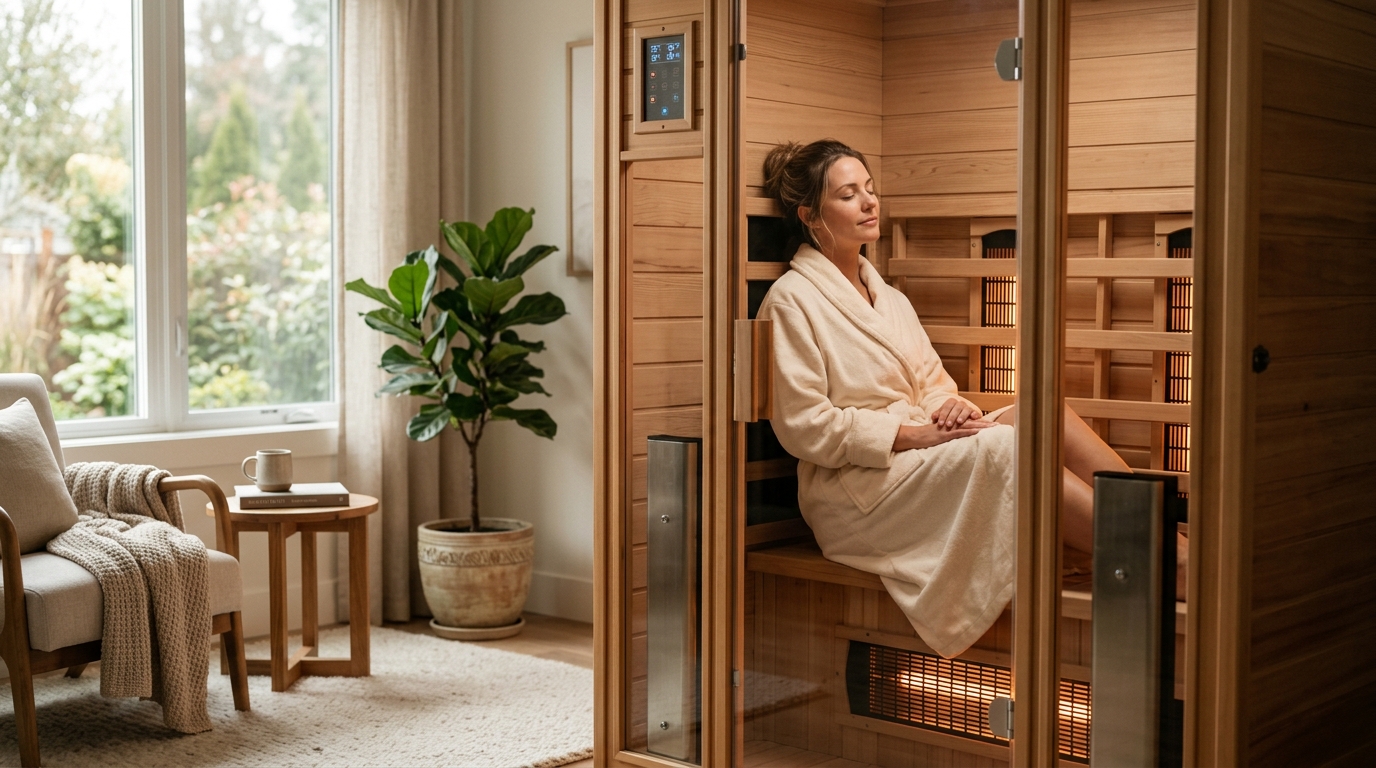
Quick answer: A 40-60 minute infrared sauna session at 120-135°F activates the parasympathetic nervous system, lowers cortisol by up to 30%, raises endorphins, and produces a deeply relaxed state that lasts 1-2 hours after exiting. Far-infrared cabins are the most practical home choice; a full-spectrum unit adds mild photobiomodulation for additional mood benefit.
Why infrared sauna produces deeper relaxation than traditional sauna
Traditional Finnish sauna reaches 170-195°F, which is hot enough to feel intense and even stressful for many users — the sympathetic nervous system can remain partially activated in extreme heat because the body interprets an aggressive thermal load as a stressor requiring active management. Infrared sauna operates at 120-150°F, a temperature range warm enough to produce genuine physiological heat effects but cool enough to feel safe and non-threatening throughout a long session.
That distinction is meaningful for relaxation specifically. The body enters the parasympathetic state most readily when the perceived threat level is low. A long, gentle infrared session — 40-50 minutes at 125-135°F — allows the nervous system to fully shift into rest mode because nothing about the experience signals an emergency. You can breathe normally, your heart rate climbs only moderately, and the sustained warmth creates the environmental cue the nervous system associates with safety.
Far-infrared wavelengths (3000-14,000nm) are absorbed at the skin surface and in the superficial subcutaneous layer, producing even warming across the entire body simultaneously. This uniform, enveloping warmth mimics the sensation of being held in heat — the same mechanism behind why a warm bath is reliably more relaxing than a cold shower of identical hygiene value.
The physiology: how infrared heat calms the nervous system
Four overlapping mechanisms explain the relaxation response infrared sauna produces:
Parasympathetic nervous system activation. Moderate heat exposure shifts autonomic tone from sympathetic to parasympathetic dominance. Heart rate variability (HRV), the gold-standard objective measure of parasympathetic tone, increases during and immediately after sauna sessions in studies that measured it. Higher HRV correlates directly with lower perceived stress, better emotional regulation, and faster sleep onset.
Cortisol reduction. Cortisol, the body’s primary stress hormone, is catabolic and activating — chronically elevated cortisol drives anxiety, disrupted sleep, and accelerated muscle loss. Single sauna sessions produce measurable cortisol reduction during the session; regular sauna users (3-4 sessions per week) show lower baseline morning cortisol levels compared to non-users across multiple longitudinal studies. The cortisol-lowering effect persists 1-3 hours post-session.
Endorphin and dynorphin release. Heat stress — even gentle infrared heat — triggers endorphin release from the hypothalamus and pituitary. Dynorphin, a related opioid peptide, suppresses the thermoregulatory set point during heat exposure, which is why the warmth feels manageable even as core temperature rises. The net effect is a mild opiate-like euphoria that regular sauna users describe as deeply calming and mood-elevating.
Muscle tension release. Direct infrared warming of skeletal muscle causes it to physically relax — the same mechanism behind heated massage tools and warm compresses. Trapezius, neck, and shoulder muscles — the primary tension-storage sites for desk workers and chronically stressed individuals — receive direct infrared energy and release accumulated tension without requiring manual manipulation. Many users find that the physical release of muscle tension is the most immediately noticeable relaxation effect, occurring within the first 15-20 minutes.
Infrared sauna temperature and duration: relaxation vs recovery
| Product | Best for | Rating | Notes | |
|---|---|---|---|---|
| Relaxation session (120-135°F, 40-60 min) | Stress relief, cortisol reduction, parasympathetic shift, evening wind-down | — | Lower temperature allows longer duration without cardiovascular stress. The extended time is what accumulates the full parasympathetic shift — do not cut sessions short. Works especially well in the evening 60-90 minutes before sleep. Sweat output is moderate but real. | Check price |
| Recovery session (130-150°F, 30-45 min) | Post-workout DOMS reduction, HSP activation, growth hormone, muscle repair | — | Higher temperature and shorter duration drive heat shock protein and growth hormone responses. Also relaxing, but the primary stimulus is thermal intensity — not the extended parasympathetic engagement of the lower-temp relaxation protocol. | Check price |
| Pre-sleep session (115-125°F, 30-40 min) | Sleep onset acceleration using post-sauna core temperature drop | — | Lowest useful temperature range. The goal is warming the body enough that post-session cooling triggers the circadian sleep signal, not pushing to peak sweat output. Exit 60-90 minutes before target sleep time. Compatible with a blanket unit if a cabin is not available. | Check price |
The key insight for relaxation purposes: lower is longer. A 50-minute session at 125°F produces a stronger parasympathetic response than a 20-minute session at 150°F even though it feels far less intense. The extended duration allows the nervous system to fully transition — the first 15-20 minutes of any infrared session are the warm-up phase where the shift is only beginning.
Evening relaxation protocol: step by step
- Pre-heat the cabin to 120-135°F and allow 15-20 minutes. Do not enter a cold or warming cabin — panels need to be emitting at full intensity to deliver the even whole-body infrared dose that produces relaxation. Sit in the cold cabin before it warms and you will wait significantly longer for the therapeutic effect.
- Dim ambient lighting or use the cabin’s chromotherapy setting. Reduced visual stimulation supports the parasympathetic shift; bright overhead lighting works against it. If your cabin does not have built-in lighting control, a low-lumen reading light or candle-equivalent is better than the default room lights.
- Leave your phone outside or switch to airplane mode. The relaxation benefit is substantially higher when the session serves as a genuine break from digital input. Passive audio — calm music, nature sounds, or low-stimulation podcasts — is compatible with the parasympathetic shift. Actively engaging with screens counteracts it.
- Position yourself in full contact with the back panel. Sit so your back, hips, and the backs of your thighs are in contact with or close to the infrared panels. The more direct your exposure, the more complete the warming and the stronger the cortisol response.
- Begin with deliberate slow breathing for the first 5-10 minutes. Slow exhalations (longer out than in — try a 4-count inhale and 8-count exhale) directly activate the parasympathetic branch via vagal nerve stimulation. This accelerates the autonomic shift the heat is already producing, and most people notice visible tension release in the shoulders within the first 10 minutes when they combine breathing technique with the infrared warming.
- Remain for the full 40-60 minutes. Set a timer and put the device face-down so you are not watching it. The complete cortisol and endorphin response requires staying through the 30-40 minute mark; early exits are incomplete sessions.
- Exit slowly and cool at room temperature for 10-15 minutes. Avoid immediate cold exposure if the goal is relaxation rather than contrast therapy — the gradual cool-down extends the parasympathetic state into the post-session period. Cold plunge after relaxation-focused sessions resets the nervous system rather than sustaining the calm.
- Hydrate with 16-24 oz of water or herbal tea. Avoid caffeine, alcohol, and stimulating screen content for 30-60 minutes after exiting to preserve the calm state and transition smoothly into sleep if that is the goal.
Best infrared saunas for relaxation
Best for couples or solo users who want space to fully recline during longer relaxation sessions
Clearlight Sanctuary 2 Full-Spectrum Infrared Sauna
The Clearlight Sanctuary 2 is the premium home infrared choice for dedicated relaxation use. Full-spectrum True Wave heaters combine near, mid, and far infrared — the near-infrared component adds mild photobiomodulation that complements the cortisol-reduction response of the heat. Low EMF construction (under 0.3mg at sitting distance) matters when spending 45-60 minutes per session multiple times a week. The 2-person width allows you to stretch out, shift positions, and settle into a genuinely restful posture that a narrow 1-person unit cannot provide. Built-in chromotherapy lighting and sound system are unusually well-executed for a sauna in this category — not afterthoughts bolted on. A significant investment, but this cabin is purpose-built for long, gentle sessions that maximize the parasympathetic response.
★★★★★ 4.8 · 640 reviews
Check current price on Amazon→Best for value-focused buyers who want a dedicated relaxation cabin without the premium price
Dynamic Sauna Andora Far-Infrared Sauna
The Dynamic Andora delivers consistent far-infrared heat from 8 carbon fiber panels in a 2-person Canadian hemlock cabin that runs quietly and holds temperature steadily — both important for relaxation sessions where environmental consistency matters. Reaches operating temperature in 15-20 minutes and runs efficiently at 120-135°F for extended sessions. Hemlock construction stays odor-free even at sustained operating temperatures, which matters when you are spending an hour per session breathing the air inside. Digital temperature and timer controls are usable in low-light conditions. Ships in two boxes and assembles in about 45 minutes with no specialized tools or electrician required (standard 120V plug). At roughly half the price of premium competitors, it delivers the majority of the relaxation benefit.
★★★★☆ 4.4 · 1,850 reviews
Check current price on Amazon→Best for apartment dwellers and frequent travelers who want infrared relaxation without a dedicated cabin
HigherDOSE Infrared Sauna Blanket V3
When a cabin is not practical, the HigherDOSE blanket delivers genuine far-infrared therapy with eight temperature settings. For relaxation specifically, use settings 1-3 (lower heat) for 30-45 minutes in the evening — the cocoon format provides the enveloping warmth that supports the parasympathetic response even without full-body panel coverage. Machine-washable inner layer, rolls up for storage in a closet or suitcase. The blanket is best understood as a legitimate infrared tool rather than a sauna substitute: it produces real cortisol reduction and heat-induced calm even though it lacks the ambient temperature element of a full cabin. Particularly useful the week before a presentation or high-stakes event when travel has disrupted access to a home cabin.
★★★★☆ 4.3 · 3,400 reviews
Check current price on Amazon→What to skip
High-heat protocols above 155°F specifically for relaxation. Aggressive heat produces a stronger stress response in many users, not a gentler relaxation response. Traditional sauna can be deeply relaxing for experienced users who have fully acclimated to extreme heat, but for the specific goal of parasympathetic activation, cooler and longer outperforms hotter and shorter — especially for new and moderate users.
Sessions immediately after intense exercise. Post-workout infrared is excellent for muscle recovery, but is not ideal for deep relaxation — your nervous system is still processing the exercise stress and the sympathetic branch remains partially active. For relaxation as the primary goal, use the sauna as a standalone session or at least 90 minutes after completing training.
Multitasking and screen use during sessions. Reading work email, actively engaging with social media, or watching stimulating content in the sauna directly counteracts the autonomic shift the heat is producing. The relaxation response requires low cognitive demand — passive audio is compatible, but anything that requires decision-making keeps the prefrontal cortex engaged and the sympathetic branch active.
Sessions under 25 minutes when relaxation is the goal. The first 15-20 minutes of any infrared session are the warm-up phase. Exiting at 20 minutes is an incomplete session that produces limited cortisol reduction and a minimal parasympathetic response. Commit to 40 minutes or more when relaxation rather than recovery is the purpose.
Caffeine within 3 hours before an evening relaxation session. Caffeine raises baseline cortisol and sustains sympathetic nervous system activation — it directly opposes the calm state you are trying to produce. Decaffeinated herbal tea before and after the session supports the relaxation goal far better.
FAQ
Frequently asked questions
How long should I sit in an infrared sauna for relaxation?
Does infrared sauna reduce cortisol?
Can I use an infrared sauna before bed for better sleep?
Is infrared sauna good for anxiety?
How often should I use infrared sauna for stress relief?
What temperature is best for infrared sauna relaxation?
Bottom line
Infrared sauna is one of the most effective passive tools for nervous system regulation: 40-60 minutes at 120-135°F activates the parasympathetic branch, measurably reduces cortisol, releases endorphins, and releases stored muscle tension — without requiring the sustained mental effort that meditation demands. The lower operating temperature compared to traditional sauna is an advantage for relaxation specifically, enabling longer sessions that allow the full autonomic shift to complete.
For dedicated home relaxation use, a far-infrared or full-spectrum cabin in the 2-person size gives you the space to settle into a genuinely restful posture for extended sessions. A portable infrared blanket is a legitimate alternative for those without cabin space, using lower temperature settings for relaxation protocols rather than pushing to maximum heat output.
For the full evidence base on how sauna affects anxiety and mood, see sauna for anxiety relief. To use your sauna sessions specifically for better sleep, read sauna for sleep improvement. For infrared purchasing guidance across all use cases, see our best infrared saunas roundup. For a complete picture of all the ways home sauna use benefits your health, read home sauna benefits.