guides
Infrared Sauna for Homes: Buyer's Guide (2026)
How to pick the right infrared sauna for your home — size, electrical, heater type, and top picks from $1,200 to $5,000.
 Marcus Reade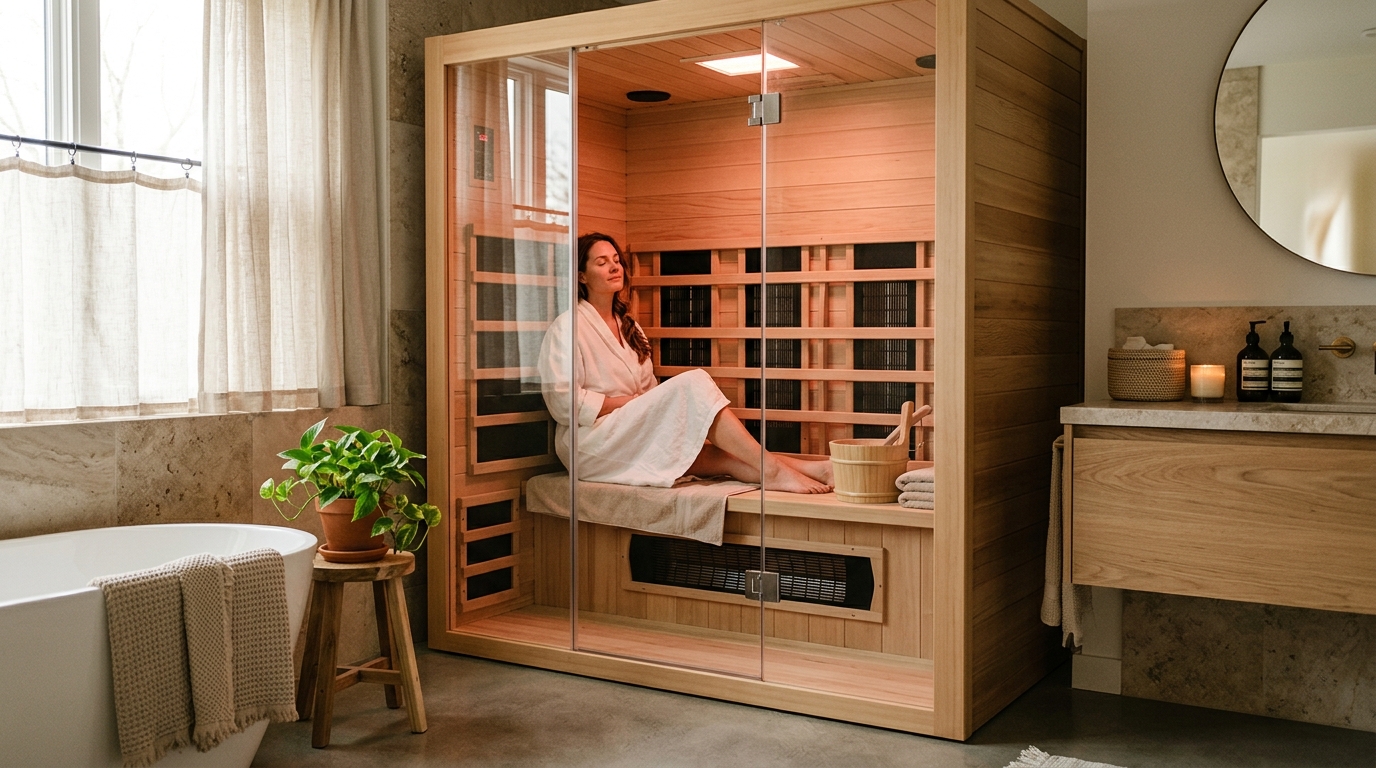
The right infrared sauna for most homes is a 2-person carbon-panel cabin (110V, $2,500–$3,500) that plugs into a standard wall outlet, heats in under 20 minutes, and fits in roughly 16 square feet — about the size of a large wardrobe. If you want to lie flat or share it regularly with a partner, step up to a 3-person model (240V, ~$3,500–$4,500), factoring in $400–$900 for an electrician. Size is the one decision that shapes everything else.
How infrared saunas compare for home use
| Product | Best for | Rating | Notes | |
|---|---|---|---|---|
| 1-person corner infrared (110V) | apartments, offices, tight spaces | ★★★★☆ | $1,200–1,800. ~12 sqft. Plug-in 110V. Under 15-min heat-up. | Check price |
| 2-person infrared cabin (110V) | solo daily use or couples — the home sweet spot | ★★★★★ | $2,500–3,500. ~16–20 sqft. 110V plug-in. Under 20-min heat-up. | Check price |
| 3-person infrared cabin (240V) | families, or if you want to lie flat | ★★★★★ | $3,500–5,000. ~24–30 sqft. Needs 240V circuit ($400–900 install). | Check price |
| 4-person corner infrared (240V) | larger families or social sessions | ★★★★☆ | $4,500–7,000. ~36 sqft. Corner format reduces wall footprint. | Check price |
How infrared differs from traditional — and why it matters at home
A traditional Finnish sauna heats stones to around 700°F; those stones heat the room to 170–195°F; the hot air heats you. An infrared cabin skips the air entirely. Carbon or ceramic panels in the walls emit infrared wavelengths (5–15 micrometers) that your body absorbs directly. The cabin interior stays at 120–150°F, but your core temperature rises just as efficiently.
For home buyers, the practical implications matter more than the physics:
No electrician required for most models. One- and 2-person infrared cabins draw under 1,800 watts at 110V — the same circuit as a hairdryer. Plug them in, assemble the panels (60–90 minutes), and you are done. No permit, no contractor, no $600 electrical invoice.
Lower structural demands. A traditional sauna requires framing, vapor barrier, insulated walls, and specialized flooring. An infrared cabin sits on your existing hardwood, tile, or concrete floor and leans against your existing walls. Most owners can place one anywhere a large piece of furniture would go.
Faster heat-up. Traditional saunas take 30–45 minutes to reach temperature. Infrared cabins heat in 15–20 minutes — a meaningful difference when you want a post-work session rather than planning your evening around it.
What you give up. There is no löyly — the steam burst from pouring water on hot stones. The sensory experience of infrared is closer to lying in intense sunlight than sitting in a Finnish bathhouse. If the steam ritual matters to you, infrared is the wrong category; see our infrared vs traditional sauna comparison for a full breakdown.
How to size an infrared sauna for your home
1-person: 12 square feet, 110V
Minimum viable footprint. A corner unit uses three of your existing walls and claims roughly 36 × 36 inches of floor space. Ideal for apartments, home offices, or finished basements where a full 2-person cabinet will not fit. One adult fills the bench; stretching out is not possible. Heat-up time is the fastest in the category — under 15 minutes — because there is less mass to warm.
2-person: 16–20 square feet, 110V
The home sweet spot. A typical 2-person cabin measures 47–55 inches wide and 43–47 inches deep. One adult can stretch across the bench at a diagonal; two adults sit comfortably side by side. 110V operation means no electrician — just an outlet within cord-reach. This is the right pick for approximately 80 percent of home buyers who are not space-constrained.
3-person: 24–30 square feet, 240V
The upgrade that delivers the most felt difference. The interior length of a 3-person cabin is long enough for most adults to recline fully across the bench — which changes the session character more than any single spec. The downside: nearly every 3-person unit requires a 240V dedicated circuit. Budget $400–900 for an electrician before committing to a 3-person model.
4-person and larger: 36+ square feet, 240V
Social sauna territory. A 4-person corner unit can substitute for a dedicated sauna room in a finished basement. It is the largest infrared format we recommend for indoor installs — beyond this size, a traditional barrel or cabin sauna often becomes more cost-effective per square foot.
Electrical requirements: the one decision that changes your budget
- 110V (1- and 2-person cabins): Standard 15- or 20-amp outlet, no work required. Total install cost beyond the unit: $0.
- 240V (3-person and larger): Dedicated circuit required. Typical electrician quote: $400–1,000 depending on panel distance, permit requirements, and local labor rates.
If you are unsure whether your panel has room for a new 240V breaker, get an electrician quote before buying the sauna — not after. A full panel needs a subpanel ($300–600 additional) and that math can shift the size decision significantly.
Our top picks for home use
Best for most homes: 2-person carbon-panel (110V)
Best for daily solo use or couples; the best all-around home infrared pick
2-Person Indoor Infrared Cabin (Carbon Panel, Low-EMF, 110V)
Seven carbon panels — back, two sides, two front corners, floor, and calf-level — deliver even full-body heat without hot or cold zones. 110V plug-in operation means zero installation cost beyond assembly. Two adults fit comfortably; one adult can stretch across the bench at a diagonal. Heat-up time runs 15–18 minutes from a cold start.
★★★★★ 4.6 · 1,850 reviews
Check current price on Amazon→Pros
- 110V plug-and-play — no electrician and no permit required
- Seven carbon panels for even heat across the back, sides, and floor
- Low-EMF rated: measured values typically 1–2 milligauss at bench position
- Western red cedar interior with tongue-and-groove construction
Cons
- Two adults is a tight fit for sessions over 30 minutes
- No steam — löyly is not possible in any infrared cabin
- Assembly takes 60–90 minutes and benefits from a second person
Best for solo use and small spaces: 1-person corner
Best for apartments, home offices, or any room where a 2-person cabinet does not fit
1-Person Corner Infrared Sauna (Carbon Panels, 110V)
The triangular footprint of a corner unit uses three existing walls and claims just 36 × 36 inches of floor space — the smallest viable sauna footprint available. Carbon-panel heaters in the back, floor, and both side walls deliver a full-body infrared session in 12–15 minutes. Single-occupant bench with no room to stretch; this is a seated-only, single-user experience.
★★★★☆ 4.4 · 870 reviews
Check current price on Amazon→Pros
- Smallest viable footprint — fits anywhere a large armchair would go
- 110V plug-in, no installation cost whatsoever
- Fastest heat-up time of any cabin format (under 15 minutes)
- Good value for single-user households with limited floor space
Cons
- Genuinely single-occupant only — no room for a second person
- Seated-only posture; no reclining option
- Corner placement constrains furniture arrangement around it
Best for families: 3-person (240V, lie-flat interior)
Best for families of three, or any buyer who wants to recline rather than sit upright
3-Person Infrared Cabin (240V, 8-10 Carbon Panels, Reclining Bench)
The interior length of a 3-person cabin is long enough for most adults to lie flat across the bench — a qualitative upgrade from the 2-person seated posture that owners consistently cite as the single most useful difference. Eight to ten carbon panels across the walls, roof, and floor eliminate cold zones. Budget a 240V circuit install on top of the unit price.
★★★★★ 4.5 · 540 reviews
Check current price on Amazon→Pros
- Interior length allows full reclining — a significant upgrade from seated-only 2-person cabins
- Two adults fit with genuine room to spread out
- Carbon-panel coverage from floor to ceiling across all walls
- Built-in chromotherapy and Bluetooth audio standard in most 3-person units
Cons
- 240V circuit required — factor in $400–900 for a licensed electrician
- Larger footprint (typically 57–63 inches wide, 47–53 inches deep)
- Assembly is a 2-person, 2-hour job minimum
What to skip
Units with ceramic-only tube heaters. Ceramic rod and tube heaters run hotter than carbon panels — which sounds like an advantage but in practice means uneven heat: scorching near the tubes and cooler at the periphery. They also produce higher EMF readings and have shorter average lifespans (5–7 years versus 10–15 for carbon). Unless you have specific experience preferring ceramic heat, choose full carbon-panel units.
“Zero-EMF” claims without measured numbers. Zero-EMF is a marketing phrase. No sauna is zero-EMF — it has an electrical heating system. The number that matters is the measured EMF at the bench position in milligauss. Under 3 mG is the genuine low-EMF target; reputable brands publish this figure. If a listing claims zero-EMF without a measured value, treat it as a red flag.
Budget units below $800 for regular home use. Sub-$800 infrared cabins often use thin MDF panels (versus solid cedar or hemlock), lower-wattage ceramic heaters, and inconsistent seam construction that lets heat escape. The wood warps within two years of regular use; the heaters often fail within three to five. A $2,000–$3,000 unit costs less over a decade than replacing a cheap cabin twice.
FAQ
Frequently asked questions
Where is the best place to put an infrared sauna in a home?
Do I need a permit to install an infrared sauna at home?
How long should an infrared sauna session last?
Are infrared saunas safe for daily home use?
What is the difference between near-infrared and far-infrared home saunas?
How much does it cost to run an infrared sauna at home each month?
Bottom line
For most homes, the 2-person 110V carbon-panel cabin is the right answer: it requires no electrical work, fits in the space of a large armchair with a few feet of clearance, heats in under 20 minutes, and costs less than $30 per month to run daily. If your household has three or more regular users — or if you simply want to recline — the 3-person (240V) model is worth the electrician visit.
For detailed model comparisons, see our best infrared saunas roundup. For the full cost picture including delivery, electrical, and accessories, see our home sauna cost guide. Once you have chosen a model, our home sauna installation guide covers setup start to finish. And if you are still weighing infrared against traditional, our infrared vs traditional sauna comparison will settle the question.