roundups
Best Sauna Kits for Garage (2026)
Top garage sauna kits for 2026. Electrical needs, insulation tips, and picks from 1-person infrared to full traditional cedar kits.
 Marcus Reade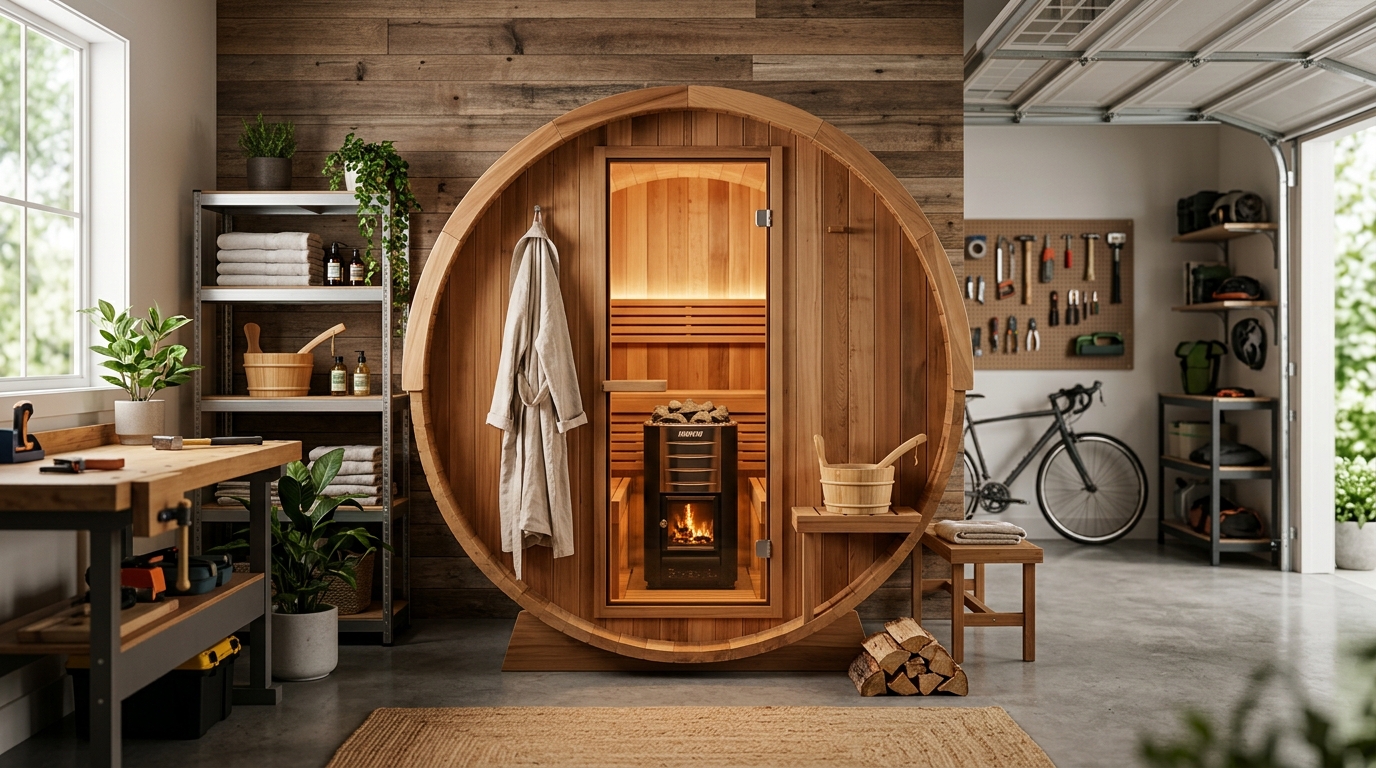
The best garage sauna kit for most buyers is a 2-person traditional indoor cedar kit ($2,200–3,500) — it reaches 180°F on a 240V circuit, assembles in one weekend, and fits in any 4 × 4 ft garage corner. If your garage lacks 240V service, a 1-person infrared cabinet ($1,200–1,800) runs on a standard 110V outlet and requires no electrical work at all.
Garages are one of the best locations for a home sauna. Concrete floors double as a natural vapor barrier, there is no carpet or finished drywall to protect from steam and condensation, and an open floor plan makes it easy to dedicate a 4 × 4 or 4 × 6 ft corner without losing much usable space. The main hurdles are electrical access and insulation — most garages have inadequate wall and ceiling insulation, which increases heat-up time and monthly operating costs if left unaddressed before installation.
This guide covers the four kit formats that work best in a garage, what to know before you order, and the garage-specific questions most buyers wish they had asked before delivery.
What to know before ordering a garage sauna kit
Electrical access
Verifying your electrical capacity is the most important pre-order step for any traditional sauna kit. Most attached garages have a sub-panel fed from the main panel. Before ordering, call a licensed electrician to check three things:
- Whether the sub-panel has an open slot for a dedicated 240V breaker
- Available amperage — a 2-person kit needs 30A, a 4-person kit needs 40–50A
- A quote for running the circuit to your chosen sauna location
In most cases, adding a 240V/30A circuit to an existing garage sub-panel costs $200–500. If the sub-panel is at capacity or undersized, upgrading it or running a new line from the main panel can push that to $800–1,500. Know this number before you commit to a kit size.
If electrical work exceeds your budget, a 1-person infrared cabinet is a fully capable alternative — most models draw 1.2–1.8 kW on a standard 110V/15A outlet and need no new wiring at all.
Insulation
Garages are typically under-insulated compared to living spaces. An uninsulated garage wall loses heat three to four times faster than a properly insulated interior wall. This does not prevent a sauna from reaching temperature — the cabin is itself an insulated room within the garage — but it does mean that ambient garage temperature will affect heat-up time and monthly electricity cost, especially in winter.
The practical solution is to insulate the walls and ceiling adjacent to where you plan to install the sauna before assembly. Adding R-13 fiberglass batts to a standard 2 × 4 stud wall takes a weekend and costs $200–400 in materials. That investment pays back in lower operating costs within the first heating season.
If you are working with a detached, unheated garage: the sauna itself will function fine year-round, but the surrounding space will be cold in winter. Plan for a dedicated robe or towel waiting outside the cabin door.
Ventilation
A garage sauna still requires an air exchange — fresh air entering at a low level and stale, humid air exhausting at a high level. Most traditional sauna kits include a vent slot in the cabin wall for this purpose. In a garage installation, the question is where to route the exhaust.
Exterior wall penetration is the cleanest option — a small 4-inch hole through the garage wall to the outside. Alternatively, leaving the garage door cracked a few inches provides adequate passive air exchange for most sessions. If the garage has windows, passive turnover is usually sufficient for the 45–60 minutes of a typical sauna session.
Permits
Most jurisdictions require a permit for the new 240V electrical circuit but not for placing a freestanding sauna kit on an existing garage floor. If you plan to frame new walls as part of the project — rather than using the kit as a standalone freestanding structure — check with your local building department before starting any framing work.
Quick comparison
| Product | Best for | Rating | Notes | |
|---|---|---|---|---|
| 1-Person Infrared Cabinet | No-electrician garage setup on a standard 110V outlet | ★★★★☆ | $1,200-1,800. 110V/15A. 120-140°F max. 15-25 min heat-up. 35x35 in footprint. | Check price |
| 2-Person Traditional Indoor Cedar Kit | Best overall garage sauna — authentic high heat in a weekend build | ★★★★★ | $2,200-3,500. 240V/30A. 180-190°F. 30-45 min heat-up. 4x4 or 4x5 ft footprint. | Check price |
| 4-Person Traditional Indoor Kit | Large garages and households of three or four people | ★★★★☆ | $3,500-4,800. 240V/40-50A. 180-190°F. 5x6 or 6x6 ft. Full two-tier benches. | Check price |
| Outdoor Barrel Sauna Kit (Cedar) | Large garages or pole barns where outdoor-rated construction handles temperature swings | ★★★★☆ | $2,000-3,500. Electric or wood-burning. 170-190°F. Requires level floor and cradle stands. | Check price |
The picks
Best easy install — 1-person infrared cabinet
Best for garage owners without 240V access who want daily heat therapy on a standard 110V outlet
1-Person Infrared Sauna Cabinet
A 1-person infrared cabinet is the fastest path to a garage sauna when 240V electrical work is not in the budget. Most models plug into any standard 110V/15A outlet, assemble in under an hour with a mallet and included hardware, and reach 120-140°F in 15-25 minutes. The compact 35x35 inch footprint uses roughly the same space as a workbench. You do not get the high-heat Finnish experience, but daily infrared sessions are well-documented for recovery, circulation, and relaxation — and this is the only sauna format that requires zero electrical modifications.
★★★★☆ 4.3 · 3,840 reviews
Check current price on Amazon→Pros
- Runs on standard 110V — no electrician, no permit, no electrical work required
- Full assembly in under 60 minutes with included hardware and a mallet
- Smallest footprint of any sauna format — approximately 35x35 inches fits in nearly any garage
- Heat-up in 15-25 minutes — fastest of all sauna types
- Low operating cost — draws 1.2-1.8 kW vs. 3-6 kW for a traditional sauna
Cons
- Max temperature of 120-140°F does not replicate traditional 180°F sauna heat
- No steam capability — pouring water on infrared panels damages the heating elements
- Cramped for users over 6 feet tall; bench depth limits some stretching positions
- Cedar quality varies at budget price points; verify panel thickness specification before ordering
Best overall — 2-person traditional cedar kit
Best for anyone with 240V access in their garage who wants authentic 180°F heat and steam capability
2-Person Traditional Indoor Sauna Kit (Cedar)
A 2-person traditional indoor cedar sauna kit is the best garage sauna for the widest range of buyers. The 4x4 or 4x5 ft footprint occupies one corner of a typical two-car garage without meaningfully reducing parking space. Pre-cut and pre-drilled cedar or hemlock panels assemble in 6-8 hours over a weekend. A 3-4.5 kW electric heater heats the cabin to 180°F in 30-45 minutes. Pour water on the included sauna stones for authentic Finnish-style steam — the defining feature that separates a traditional kit from an infrared cabinet. The concrete garage floor is ideal: no carpet to protect, no basement moisture concerns, and the concrete acts as a natural vapor sink beneath the wood sub-floor.
★★★★★ 4.5 · 1,620 reviews
Check current price on Amazon→Pros
- Authentic 180-190°F heat with full steam capability — the real Finnish sauna experience
- Pre-cut and pre-drilled panels make garage assembly achievable as a solo weekend project
- Concrete garage floor provides natural moisture management under the wood sub-floor
- A 4x4 ft footprint fits in the corner of almost any one- or two-car garage
- Cedar resists moisture and handles the humidity cycles of daily sauna use for decades
Cons
- Requires a dedicated 240V/30A circuit — budget $200-600 for licensed electrician installation
- 30-45 minute heat-up time requires planning ahead rather than spontaneous use
- Permanent installation — not practical to relocate if you move
- Most kits use hemlock rather than cedar at lower price points; verify the wood species listed
Best for families — 4-person traditional kit
Best for garages with 5x6 ft or more of free space and households of three or four people
4-Person Traditional Indoor Sauna Kit
A 4-person traditional indoor sauna kit turns a garage corner into a full sauna room — the same experience as a gym or spa sauna, at home. The typical 5x6 or 6x6 ft footprint fits comfortably in most two-car garages. The two-tier bench layout seats four adults and provides enough bench depth for the lying-down position that smaller kits cannot deliver. A 6-9 kW heater is correctly sized for the larger volume and reaches 180°F in 35-50 minutes. This tier is the long-term value play for households that use the sauna daily — cost per session drops significantly when the whole family uses it regularly.
★★★★☆ 4.4 · 480 reviews
Check current price on Amazon→Pros
- Seats four adults comfortably with a two-tier bench — family group sessions are practical
- Bench depth in a 6x6 layout accommodates the lying-down position, unlike smaller kits
- A 6-9 kW heater delivers proper heat per cubic foot without straining the electrical system
- Long-term cost per session is lowest in this tier for households that use it daily
Cons
- Requires a 240V/40-50A circuit — verify your garage sub-panel has capacity before ordering
- Footprint of 5x6 to 6x6 ft takes a significant portion of a single-car garage
- Assembly takes 12-16 hours for two people; professional assembly adds $500-1,200
- Large freight shipments at this size are more prone to shipping damage; inspect all panels on delivery
Best for large or detached garages — outdoor barrel sauna kit
Best for large detached garages or pole barns where outdoor-rated construction handles significant temperature swings
Outdoor Cedar Barrel Sauna Kit
An outdoor-rated cedar barrel sauna kit can be installed inside a large garage or pole barn, particularly a detached garage that experiences seasonal temperature swings. The cedar stave construction handles freeze-thaw cycles and humidity changes that would warp an untreated indoor kit in an unheated space. The barrel shape distributes heat evenly without cold corners. This format is available with both electric heaters (requiring 240V) and wood-burning heaters. A wood-burning barrel sauna in a detached garage is the only practical high-heat option for a location without accessible electrical service — just run a proper flue through the roof or wall.
★★★★☆ 4.4 · 890 reviews
Check current price on Amazon→Pros
- Outdoor-rated cedar handles the temperature swings of an unheated detached garage or pole barn
- Wood-burning heater option eliminates the need for any electrical work — only a proper flue is required
- Barrel shape distributes heat evenly with no cold corners
- Dramatically higher visual impact compared to a rectangular indoor kit
Cons
- Electric versions still require 240V brought to the garage location
- Wood-burning heater requires proper flue installation through the roof or wall — not a DIY job
- Assembly is more complex than flat-panel indoor kits; plan for two people and a full day
- Not all barrel kits are rated for covered indoor use — verify this before ordering for a garage install
What to skip
Indoor-rated kits in unheated detached garages. Most standard indoor cedar or hemlock sauna kits are built for climate-controlled interior spaces. Using an untreated indoor kit in a garage that drops below freezing in winter will cause joint cracking and panel warping within a few seasons. If your garage is unheated and exposed to cold winters, use an outdoor-rated kit or a barrel sauna kit.
Oversized heaters for your cabin volume. Some sellers bundle 6 kW heaters with 2-person kits and market this as faster heat-up. An oversized heater overshoots target temperature, cycles on and off repeatedly, and wears heating elements faster. Match wattage to volume: 1 kW per 45 cubic feet is the reliable standard. A 2-person 4 × 4 × 7 ft cabin (112 cubic feet) needs a 2.5–3 kW heater.
Kits with vague wood labeling. Listings that say “natural wood” or “pine” without specifying species are often using low-grade softwood that warps and cracks under daily sauna humidity cycles. Confirm the species — Canadian red cedar, Canadian hemlock, or Nordic spruce — before ordering.
Installing without a sub-floor inside the cabin. Garage concrete is cold, hard, and uncomfortable underfoot during a sauna session. Every kit should include a raised wood sub-floor; if yours does not, order cedar decking panels separately before the first session. Operating a sauna on bare concrete also creates condensation problems under the bench frames over time.
Skipping the electrician quote. Some buyers order a traditional sauna kit before checking whether their garage sub-panel can support a dedicated 240V/30A breaker. If it cannot, upgrading the sub-panel or running a new feed can cost more than the kit itself. Always get the electrical quote first.
FAQ
Frequently asked questions
Can you put a sauna in a garage?
Do you need a permit for a garage sauna?
What size sauna kit fits in a standard garage?
How much does a garage sauna cost to install?
Does a garage sauna need insulation?
Can a barrel sauna go inside a garage?
Bottom line
For most buyers, a 2-person traditional indoor cedar kit is the right garage sauna — authentic 180°F heat, a 4 × 4 ft footprint that fits any garage corner, and a build that most homeowners can complete in a single weekend. Get the electrical quote first; in most attached garages the cost is minimal. If 240V electrical work is not in the budget, a 1-person infrared cabinet on a standard 110V outlet is a genuine daily-use sauna that requires zero modifications.
For specific brand and model comparisons, see the best cedar sauna kits and best sauna kits under $5,000 roundups. The electric sauna heater sizing guide covers how to match heater wattage to your specific room volume. For total cost planning including electrical, permit, and accessories, the home sauna cost guide breaks it all down.