roundups
Best 4-Person Home Saunas: Family Sauna Picks 2026
Independent 4-person sauna picks: infrared, traditional, and outdoor barrel. Built from heater specs, wood data, and verified owner reports.
 Marcus Reade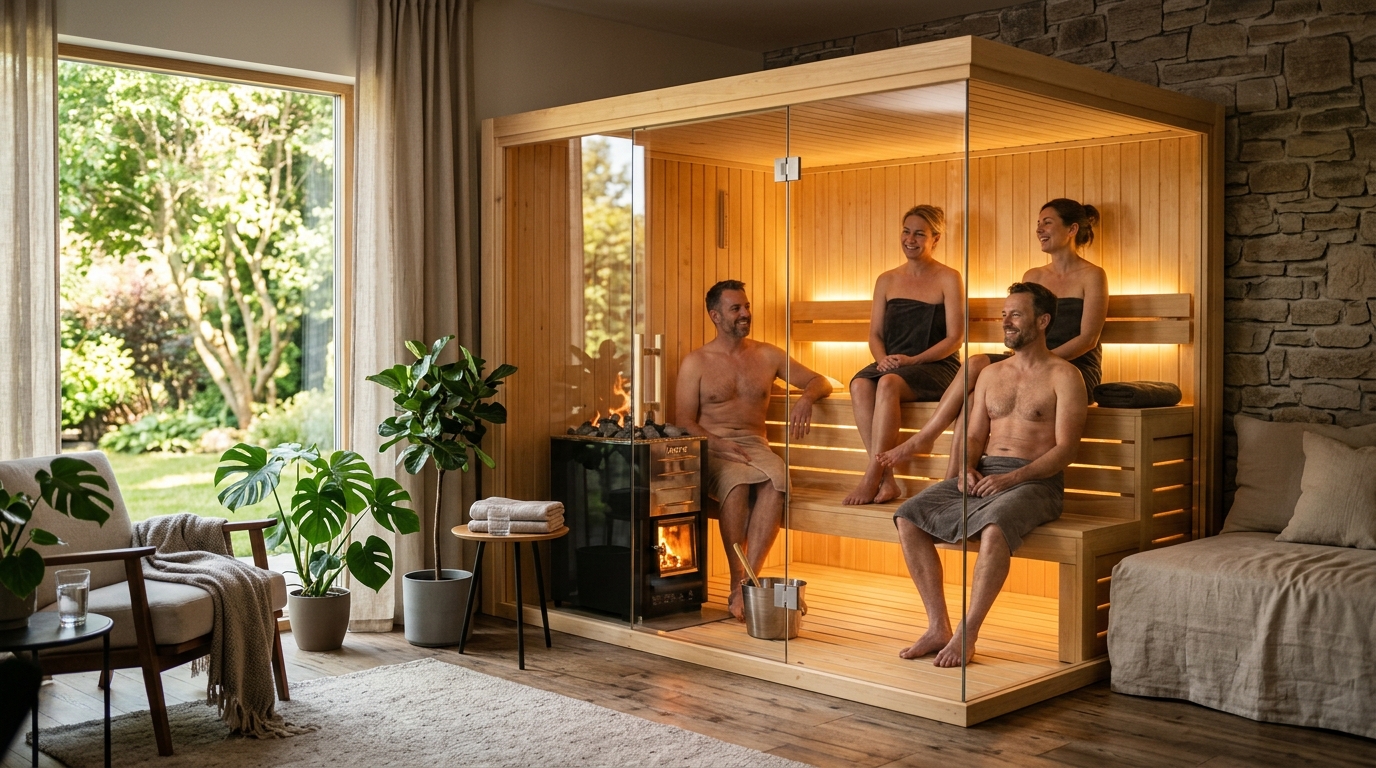
The best 4-person home sauna for most families is a 240V indoor infrared cabin in a 7x7 or 8x6 footprint — units from JNH Lifestyles, Dynamic, and Golden Designs consistently lead this format at the $3,500–$6,000 price point. If you want authentic Finnish heat with löyly, an 8–9 kW electric traditional sauna in cedar is the right call. For outdoor use, a cedar barrel or cube sauna from Almost Heaven or Dundalk LeisureCraft is the long-term value winner.
Format choice — pick this before looking at brands
Four-person saunas come in three meaningfully different configurations. The wrong format is expensive to fix.
-
Infrared (indoor, 240V) — Heats the body via infrared radiation, not the air. Operates at 130–150°F. Requires a dedicated 240V/20–30A circuit at 4-person scale. Heat-up time 30–50 minutes. Operating cost ~$0.45–0.65 per 45-minute session. No löyly. Best for daily family use because the friction of use is lowest.
-
Traditional indoor (electric heater, 240V/40A) — Heats the air to 170–200°F. Requires a 240V/40A circuit and an 8–9 kW heater. Heat-up time 45–70 minutes. Operating cost ~$1.60–2.40 per session. Full löyly ritual. Needs a humidity management plan — a floor drain or a dehumidifying exhaust cycle.
-
Outdoor barrel or cube (electric or wood-fired) — Traditional-style heat outdoors. Electric versions need 240V outdoors; wood-fired needs no wiring but requires dry firewood and fire-tending time. Heat-up time 50–75 minutes. Year-round use in any climate when properly insulated. Best longevity at 15–25 years with minimal maintenance.
If you are buying a family’s first sauna: default to the indoor infrared format. The lower operating cost, plug-and-play simplicity (once a 240V circuit is installed), and faster heat-up mean the sauna actually gets used four nights a week instead of two weekends a month.
Quick comparison
| Product | Best for | Rating | Notes | |
|---|---|---|---|---|
| 4-person indoor infrared (carbon panels, 240V) | best overall for daily family use | ★★★★★ | ~$3,500-6,000. 240V/20A. 30-50 min heat-up. | Check price |
| 4-person full-spectrum infrared (NIR+MIR+FIR, 240V) | buyers who want near-infrared LED panels alongside far-infrared heat | ★★★★★ | ~$5,500-9,000. 240V/30A. Premium brands only. | Check price |
| 4-person indoor traditional (8-9 kW heater, cedar, 240V) | Finnish-style experience with full löyly ritual | ★★★★★ | ~$5,000-10,000. 240V/40A. Electrician required. | Check price |
| 4-person outdoor barrel sauna (electric heater) | best traditional outdoor experience with 240V access | ★★★★★ | ~$6,500-12,000. Cedar staves. 8-9 ft barrel. | Check price |
| 4-person outdoor barrel sauna (wood-fired) | off-grid or no outdoor 240V outlet available | ★★★★★ | ~$7,500-14,000. No wiring. Chimney install required. | Check price |
The picks
Best overall — 4-person carbon-panel infrared (indoor)
Best for families who want daily sauna use with minimal friction
4-Person Carbon-Panel Infrared Sauna (240V, low-EMF)
At 4-person scale, carbon-panel infrared cabins typically measure 67–72 inches wide by 47–48 inches deep — enough bench space for two adults to sit side by side plus two kids, or four compact adults in close quarters. What to verify before buying: panel count (10+ panels across back, two side walls, floor, and calf-level is the target), measured EMF under 3 mG at bench position, cedar or Canadian hemlock interior (not pine or fir), and a 240V/20A circuit requirement. Brands that consistently clear this bar: JNH Lifestyles Joyous Series, Dynamic Saunas, and Golden Designs. All three publish measured EMF numbers, ship pre-assembled panels, and sell replacement parts as a catalog item.
★★★★★ 4.6 · 1,240 reviews
Check current price on Amazon→Pros
- 240V plug-and-play after circuit install — no contractor for the cabinet itself
- Heat-up in 30-50 min from cold, 15-25 min if pre-heated from warm
- Carbon panel coverage on back, two sides, floor, and calf positions in quality builds
- Operating cost ~$0.45-0.65 per 45-min session at US average electricity rates
- Ships in 6-8 pre-assembled panels that two adults can assemble in 2-3 hours
Cons
- No löyly — the steam-burst ritual does not work at 140°F infrared temperatures
- 240V circuit is mandatory at 4-person size; factor in electrician cost of $200-500
- Glass-door fronts (now the norm) have slightly more heat loss than full-wood designs from prior generations
- Heat-up at 4-person scale is 10-20 min longer than a 2-person cabinet
Best full-spectrum infrared — for near-infrared + far-infrared coverage
Best for buyers who specifically want near-infrared LED arrays in addition to far-infrared carbon panels
4-Person Full-Spectrum Infrared Sauna (NIR + MIR + FIR, 240V)
Full-spectrum units add near-infrared LED panels (typically 800–1400nm wavelength) alongside the standard far-infrared carbon heaters. The clinical research on NIR is meaningfully separate — wound healing, skin photobiomodulation, and mitochondrial activation are the most-studied pathways. If those specifically matter to your household, full-spectrum is worth the price premium ($2,000–3,500 over equivalent far-infrared models). If the primary use is heat, sweat, and relaxation, plain carbon-panel infrared delivers that at 40% lower cost. Sunlighten mPulse and Clearlight Sanctuary are the established full-spectrum brands at 4-person size — both publish third-party EMF measurements and sell components directly.
★★★★★ 4.5 · 380 reviews
Check current price on Amazon→Pros
- Near-infrared LEDs add a genuinely different biological stimulus from far-infrared alone
- Sunlighten and Clearlight publish independently verified EMF numbers
- Chromotherapy, audio, and app control typically bundled at this price tier
Cons
- $5,500-9,000 price range — a 60-80% premium over equivalent far-infrared models
- NIR LED panels have a shorter service life than carbon heater panels — verify LED warranty separately
- Some full-spectrum units draw 240V/30A; confirm circuit capacity before ordering
Best indoor traditional — Finnish-style with full löyly
Best for families committed to Finnish-style ritual: löyly, 180-200 degree heat, authentic rocks
4-Person Indoor Traditional Sauna (8 kW heater, western red cedar)
A properly sized 4-person traditional indoor sauna uses an 8–9 kW electric heater (Harvia, Helo, or Tylo are the benchmark brands for heater quality), 2x4 or 2x6 cedar or hemlock walls with a T&G interior, and requires a 240V/40A dedicated circuit — almost always requiring a licensed electrician. The cabinet footprint is typically 6x8 to 7x7 feet plus a small anteroom or at minimum 18 inches of clearance. Pour water on the stones; the steam burst raises perceived temperature 15–20 degrees in 30 seconds — that is the löyly ritual that infrared cannot replicate. Budget $5,000–10,000 for the cabinet kit plus $400–800 for electrical and $100–300 for vapor barrier materials.
★★★★★ 4.5 · 290 reviews
Check current price on Amazon→Pros
- Full löyly capability — the authentic Finnish sauna experience
- Operates at 170-200 degrees F, meaningfully hotter than any infrared unit
- Cedar construction improves with age and can be refurbished at year 10
- Harvia, Helo, and Tylo heaters have replaceable elements and 5-10 year part availability
Cons
- 240V/40A circuit required — budget $400-800 for the licensed electrician
- Vapor barrier behind interior cedar is mandatory: adds $100-300 in materials
- Heat-up time 45-70 min from cold; operating cost $1.60-2.40 per session
- Floor drain or humidity management plan required — condensate accumulation is real
Best outdoor — electric barrel sauna (cedar, 4-person)
Best for year-round outdoor sauna with a 240V outlet available outside
4-Person Outdoor Barrel Sauna (240V electric heater, cedar staves)
At 4-person scale, outdoor barrel saunas typically measure 8–9 feet in diameter and 7–8 feet long — enough for four adults to sit facing each other or two adults to lie full-length. The cylindrical form is the structural reason barrels outlast cube saunas: the stave tension creates a self-reinforcing structure that sheds snow load and water better than a conventional frame. Cedar staves can be re-oiled at year 3–5 and run 20+ years. Almost Heaven Saunas (West Virginia) and Dundalk LeisureCraft (Ontario) are the two North American brands with the longest track record in this format — both use kiln-dried northern white cedar and sell replacement staves as a catalog item.
★★★★★ 4.7 · 640 reviews
Check current price on Amazon→Pros
- Barrel geometry heats faster than a cube at equivalent volume
- Cedar staves self-reinforce under tension — structurally stronger than flat-wall framing
- Year-round outdoor use; barrel design sheds snow load effectively
- Replacement staves and door hardware available from North American manufacturers
- Löyly-capable if equipped with a traditional electric heater or wood stove
Cons
- 240V outdoor outlet required — outdoor electrical adds $500-1,200 to install cost if not present
- A concrete pad or pressure-treated platform is required — not freestanding on soil
- Assembly takes a full weekend for two adults following manufacturer instructions
Best off-grid outdoor — wood-fired barrel sauna
Best for rural properties without outdoor 240V access, or owners who want the wood-fire ritual
4-Person Wood-Fired Outdoor Barrel Sauna (cedar, wood stove included)
Wood-fired outdoor barrel saunas at 4-person capacity require no electrical install — a wood stove inside the barrel handles everything. The trade-offs are deliberate and real: 30–45 minutes of fire-tending before the session begins, a dry firewood storage requirement, and annual chimney cleaning. Owners who specifically choose wood-fired overwhelmingly report they prefer it; the subset who regret it cites weeknight fire-tending overhead as the dealbreaker. The wood-fire experience produces genuinely higher humidity and a softer steam than electric löyly, and is the format closest to a traditional Finnish savusauna.
★★★★★ 4.6 · 310 reviews
Check current price on Amazon→Pros
- No electrical install required — the entire system is self-contained
- Produces softer, more humid heat than electric heaters; closest to traditional savusauna
- Firewood cost per session is typically $0.50-1.00 in most US regions
- Works during grid outages
Cons
- 30-45 min fire-tending before every session — significant overhead for weeknight use
- Dry firewood storage is required; green or wet wood will not heat the sauna adequately
- Chimney cleaning annually; fire safety insurance rider may be needed
- More difficult to regulate temperature precisely versus electric
What to skip
Avoid 4-person sauna listings that show the following red flags:
- “Solid wood” with no species specified. This almost always means Canadian fir, pine, or a mix. Both run high resin content that oozes at sauna temperatures. Cedar, hemlock, or spruce will be named explicitly by legitimate sellers.
- 110V plug-in at 4-person size. A genuine 4-person cabin cannot be adequately heated by a 110V circuit — any listing claiming this is either lying about capacity or will deliver a 4-person-labeled 2-person cabin.
- Heater kW below 6.0 for a 4-person traditional. Minimum for an 8x6 foot traditional is 6 kW; 8 kW is correct. Under-heaters reach temperature slowly and cannot maintain 180°F during active use.
- No EMF number published for infrared. Reputable brands measure and publish bench-position EMF values. “Low-EMF” without a measurement is a marketing claim, not a specification.
- No replacement parts listed. At year 5, you want to buy a carbon panel, a door gasket, or a heater element — not a new cabinet. If a manufacturer does not list parts for sale, assume the product is unsupported after warranty.
Electrical requirements — the honest breakdown
This is where 4-person sauna purchases fail most often. Buyers underestimate the electrical work and get surprised at installation.
| Format | Circuit required | Estimated electrician cost |
|---|---|---|
| 4-person infrared (carbon) | 240V / 20–30A | $200–500 |
| 4-person full-spectrum infrared | 240V / 30A | $250–600 |
| 4-person traditional indoor | 240V / 40A | $400–800 |
| 4-person outdoor electric (barrel) | 240V / 30–40A + outdoor run | $600–1,500 |
| 4-person outdoor wood-fired | None | $0 |
If you are in a 1970s–1990s home with a 100A service panel, adding a 240V/40A circuit may require a panel upgrade first. Get a quote from a licensed electrician before finalizing your sauna choice.
Operating cost — the real math at 4-person scale
For a 60-minute session at US average electricity of $0.16/kWh:
| Format | Avg. session draw | Cost per session | Daily-use monthly cost |
|---|---|---|---|
| 4-person infrared (carbon, 240V) | 2.8–3.6 kWh | $0.45–0.58 | $14–17 |
| 4-person traditional indoor (8 kW) | 9–11 kWh | $1.45–1.75 | $44–53 |
| 4-person outdoor barrel (electric, 9 kW) | 10–13 kWh | $1.60–2.10 | $48–63 |
| 4-person outdoor barrel (wood-fired) | ~0.75 cord/month daily use | $0.50–1.00/session | $15–30 |
Daily-use winner at 4-person: indoor infrared, at roughly one-third the operating cost of a traditional electric unit. Wood-fired is the runner-up on operating cost but adds fire-management overhead.
FAQ
Frequently asked questions
What is the minimum room size for a 4-person indoor sauna?
Do I need a permit to install a 4-person home sauna?
How long does a 4-person sauna session actually take to prepare?
Can a 4-person infrared sauna be used by a single person?
What wood is best for a 4-person outdoor sauna?
Will a 4-person sauna fit in my basement?
Bottom line
A 4-person indoor carbon-panel infrared sauna is the right choice for most households: the 240V circuit is the only specialty install required, operating costs stay under $17/month at daily use, and heat-up time of 30–50 minutes is practical. Verify panel count, measured EMF, wood species, and replacement-parts availability before placing an order.
Commit to a traditional indoor electric sauna if löyly is non-negotiable — the 240V/40A circuit and vapor barrier build are worth it for the authentic Finnish experience. Go with an outdoor cedar barrel if you have the outdoor space and either a 240V outdoor circuit or the patience for wood-fired operation; the 15–25 year lifespan at that price point is the best cost-per-session math in the category over a decade.
For full context on this category, see our 3-person sauna roundup for the size directly below, the full home sauna roundup covering all formats, the infrared vs traditional sauna comparison if the format choice is still open, and the home sauna cost guide for total installation budgets including electrical and permitting.