comparisons
Barrel Sauna vs Cabin Sauna: Which Is Right for You?
Barrel sauna vs cabin sauna compared on heat-up time, install, aesthetics, and cost — with top picks for backyard and indoor setups.
 Marcus Reade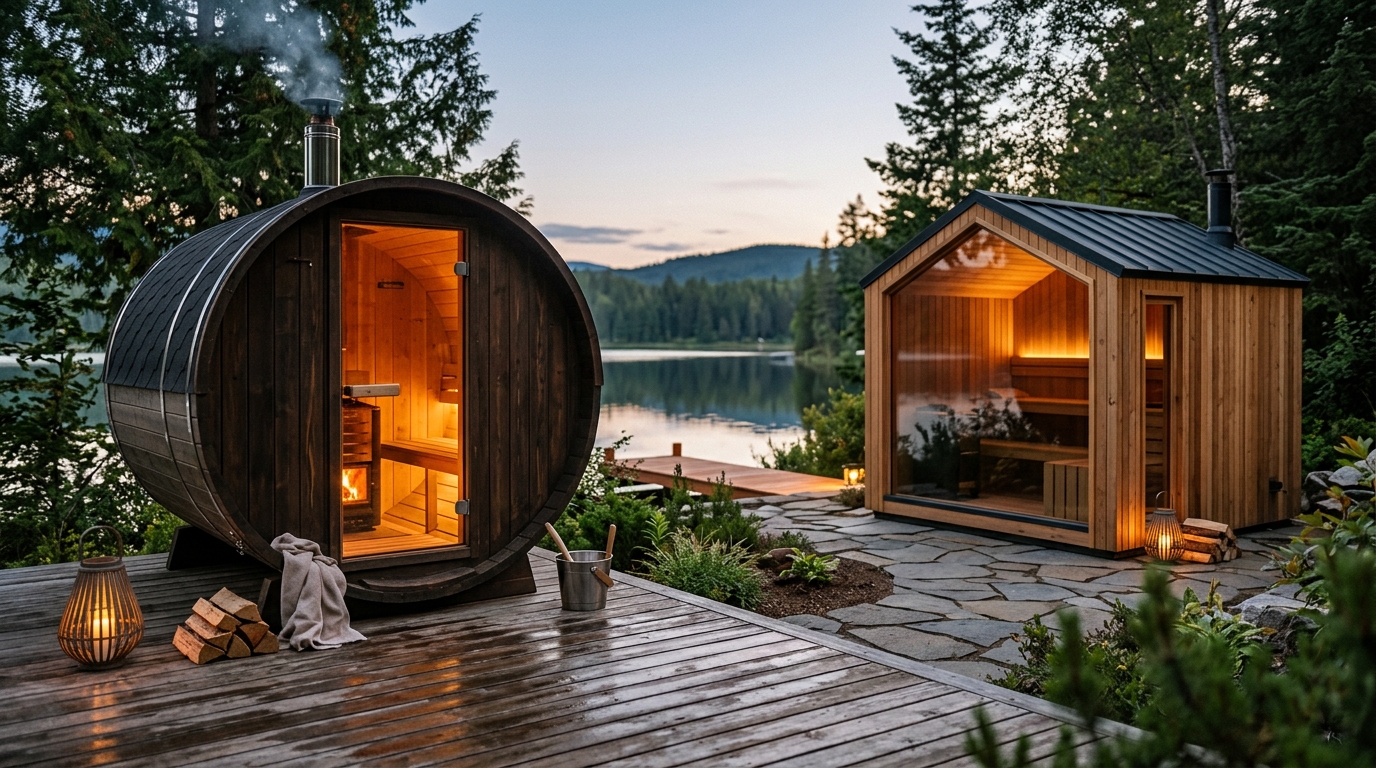
Barrel saunas win on backyard aesthetics and faster heat-up — the curved geometry reduces dead air space and cuts preheat by 10–15 minutes compared to a square cabin of equal capacity. Cabin saunas win on flexibility: they install indoors, scale to 6-plus persons more easily, and cost less per cubic foot to insulate. For an outdoor backyard install where the look matters, choose barrel. For indoor installs or larger groups, choose cabin.
What actually makes them different
The barrel sauna gets its name from its construction method: straight vertical staves of wood — typically western red cedar or Nordic spruce — are compressed together by steel tension hoops, exactly like a wine barrel or whiskey cask. The result is a cylindrical structure with no corners, no flat roof, and a self-sealing geometry that has kept wooden barrels waterproof for centuries.
The cabin sauna — also called a box sauna or traditional sauna cabin — is a standard rectangular structure: four walls, a floor, a ceiling, and a pitched or flat roof. It can arrive as a prefab kit you assemble on a gravel pad, or as a site-built permanent structure framed with lumber.
Both formats use the same heating technology: electric heaters or wood-fired stoves that heat sauna rocks, which then radiate heat into the sauna air to reach 170–195°F. The difference is purely structural — and that structural difference drives more consequential trade-offs than most buyers expect going in.
Side-by-side comparison
| Product | Best for | Rating | Notes | |
|---|---|---|---|---|
| Typical heat-up time | Barrel: 20-30 min. Cabin: 30-45 min. | — | Barrel has less dead air volume at corners; heats same cubic footage faster. | — |
| Indoor installation | Barrel: not practical. Cabin: yes, standard. | — | Barrel shape does not fit interior rooms; cabin installs in basements, garages, or spare rooms. | — |
| Outdoor durability | Barrel: excellent. Cabin: good with proper care. | — | Barrel stave construction sheds water naturally; cabin needs treated roof and adequate overhang. | — |
| Maximum capacity | Barrel: 2-6 persons. Cabin: 2-10+ persons. | — | Barrel diameter limits bench length; cabin scales linearly with square footage. | — |
| Aesthetics | Barrel: distinctive, rustic. Cabin: traditional, architectural. | — | Personal preference drives this — barrel looks unique; cabin blends with standard architecture. | — |
| Electrical requirement | Both: 240V for electric heaters. Wood option: neither. | — | Electric heaters for both formats draw 6-9 kW and need a dedicated 240V/40A circuit. | — |
| Entry-level cost | Both: $3,000-5,000 for a quality 2-person unit. | — | Price overlap is large — format does not strongly predict final cost at comparable quality. | — |
| Assembly complexity | Barrel: moderate. Cabin: moderate to complex. | — | Both ship as kits; barrel assembly is well-documented and typically faster at 6-8 hours. | — |
| Wind resistance | Barrel: excellent. Cabin: moderate. | — | Barrel shape deflects wind by design; cabin may need anchoring in exposed locations. | — |
| Interior bench layout | Barrel: curved single-wall benches. Cabin: L-shape or U-shape standard. | — | Cabin allows more flexible multi-tier configurations for larger groups. | — |
When a barrel sauna is the right choice
Choose a barrel sauna if:
The install is outdoor and the look matters. The barrel silhouette is visually striking in a way no rectangular cabin is. If the sauna is visible from your deck, yard, or main windows and curb appeal is a factor, barrel wins decisively. The natural cedar cylinder reads as a design statement rather than a utility box.
You want faster heat-up for daily use. A 4-person barrel typically reaches session temperature 10–15 minutes faster than a cabin of comparable capacity with the same heater wattage. That difference sounds small, but it compounds over hundreds of sessions — it is the difference between a sauna you use every evening and one you use when you have time to wait.
You are in a wet climate or high-snowfall region. The cylindrical construction drains rain and snow off all sides with no flat roof sections to pool water or load structurally. In Pacific Northwest conditions or northern climates with heavy snowfall, barrel saunas consistently require less maintenance intervention than cabin saunas.
You want a wood-fired option without a separate chimney structure. Many barrel sauna manufacturers offer integrated wood-stove configurations with a chimney that exits through the rear wall or endcap. The barrel itself provides structural support. The same retrofit is more complicated on a cabin and often requires a separate chimney chase.
The one limitation to know: barrel saunas have curved side walls, which means bench width is narrowest at the wall ends. Tall users — 6 feet 2 inches or more — can find lying down cramped in some models. Always check interior diameter and ceiling height before purchasing, particularly if multiple users are tall.
When a cabin sauna is the right choice
Choose a cabin sauna if:
The install is indoor. Basement, garage conversion, spare room, or a dedicated sauna alcove — the cabin is the only practical format. The cylindrical shape of a barrel simply does not fit through standard interior doorframes and requires significant ceiling height for installation. If your sauna will live inside the house, the decision is already made: cabin.
Your group is 5 or more people. Six-person and larger cabin saunas exist in abundance across price tiers. The rectangular layout allows L-shape and U-shape bench configurations that use interior volume more efficiently at larger sizes. A 6-person barrel is at the upper limit of the format; a 6-person cabin is a standard mid-range product.
You need maximum layout flexibility. Cabin interiors work with standard sauna bench kits, lighting configurations, and extensions. The rectangular walls make adding a second tier of benches, a separate changing room, or a window straightforward. A barrel’s curved walls make custom modifications substantially harder.
You want the sauna to integrate architecturally. Cabin saunas with proper pitched rooflines, painted or stained trim, and windows can match the aesthetic of the main structure in a way a barrel cannot. For homes with formal landscaping or contemporary architecture, the cabin format is less visually disruptive.
See our best outdoor sauna kits guide for specific cabin kit recommendations sorted by size and quality tier.
Heat-up time: the geometry explanation
The faster heat-up of barrel saunas has a structural explanation worth understanding. In a rectangular cabin, the right-angle corners trap air pockets that are harder to circulate than the main volume. Hot air from the heater rises and moves through the cabin, but the 90-degree corners create stagnant low-circulation zones that take disproportionate time to reach session temperature.
The barrel eliminates all corner dead zones. Air circulates continuously around the circumference with no geometric obstruction. The effective heated volume — the volume the heater must bring up to temperature — is smaller relative to the seated interior space.
In practice: a 4-person barrel sauna with a 6kW heater typically reaches 175°F in 20–25 minutes. A 4-person cabin of comparable interior volume with the same heater takes 35–45 minutes. The delta narrows as cabin size grows relative to heater capacity, but for the 2–4 person size range where most buyers shop, barrel is meaningfully faster.
For heater sizing guidance regardless of format, see our electric sauna heater sizing guide.
Installation and electrical requirements
Both barrel and cabin saunas require the same core infrastructure when running electric heaters:
- Dedicated 240V/40A circuit for heaters in the 6–9 kW range
- GFCI protection on any outdoor or wet-location circuit
- Level foundation: compacted gravel pad, concrete pad, or deck framing rated for the load
The electrician cost — typically $400–900 depending on panel distance and local labor rates — applies equally to both formats. If avoiding electrical work is a priority, both formats offer wood-fired heater configurations that require no circuit beyond standard 120V lighting. Wood-fired operation adds more prep time and active management per session but eliminates the electrical infrastructure cost entirely.
One exception: a small number of 1–2 person barrel saunas ship with 120V low-wattage heater options. These heat more slowly and suit occasional users, but eliminate the 240V requirement. Verify the spec sheet.
Durability over the long term
Western red cedar is the dominant material for both formats because it is naturally rot-resistant, dimensionally stable through humidity cycles, and contains aromatic oils that resist mold and mildew at the sustained heat and moisture of regular sauna use.
The construction method differs, and that difference shows up over years of outdoor exposure:
Barrel stave construction is held in compression by the hoop rings, and the wood naturally swells slightly with seasonal moisture — making the structure progressively more self-sealing over time. Well-maintained barrel saunas routinely last 20-plus years with minimal intervention: periodic hoop tightening as wood acclimates (first 1–2 years primarily), and re-oiling exposed external surfaces every 1–2 years.
Cabin sauna construction uses standard framed or tongue-and-groove paneled walls. The flat or low-pitch roof is the vulnerability in outdoor installs — inadequate slope, insufficient overhang, or failure to maintain sealant at joints leads to pooling and accelerated wood degradation. A cabin with a proper peaked roof, generous overhang, and periodic sealing lasts as long as any barrel. The key is buying a kit explicitly designed for outdoor exposure, not an indoor model moved outside.
Price ranges: what you actually spend
Quality pricing overlaps substantially between formats:
| Capacity | Barrel range | Cabin range |
|---|---|---|
| 2-person | $3,000–5,500 | $3,000–5,000 |
| 4-person | $4,500–7,500 | $4,500–8,000 |
| 6-person | $6,500–11,000 | $6,000–12,000+ |
These figures cover the sauna structure only, excluding the electric heater ($300–800 if not bundled), the 240V circuit ($400–1,200), and installation labor if you are not self-assembling. Use our home sauna cost guide to build a realistic total budget for either format.
Top barrel sauna picks
Best outdoor barrel sauna: 4-person cedar barrel
Best for backyard installs where fast heat-up and outdoor weather resistance are the priority
Almost Heaven Saunas Pinnacle 4-Person Barrel Sauna
Almost Heaven is one of the most consistently reviewed barrel sauna manufacturers in North America. The Pinnacle series uses 1.5-inch-thick clear white spruce staves with galvanized hoop rings and ships with a 6kW heater matched to the interior volume. Assembly takes one to two days for two people working from the included instructions. The interior bench height accommodates most users up to 6 feet, and the barrel geometry delivers the 20-25 minute heat-up that makes daily use realistic rather than aspirational.
★★★★★ 4.5 · 840 reviews
Check current price on Amazon→Best barrel sauna with wood-fired heater
Best for buyers who want a wood-fired barrel and prefer to skip the 240V electrical install entirely
Dundalk LeisureCraft Canadian Timber Harmony Barrel Sauna
The Dundalk Canadian Timber series is built in Ontario from responsibly sourced eastern white cedar and ships with a wood-burning sauna stove and chimney kit included. No electrical circuit is required beyond standard lighting. At 6 feet interior diameter, the 4-person model gives enough room for full-length benches on both sides. Dundalk builds are consistently praised for materials quality and longevity — this is a sauna you buy once.
★★★★★ 4.6 · 520 reviews
Check current price on Amazon→Top cabin sauna picks
Best outdoor cabin sauna: 4-person electric cedar kit
Best for backyard installs needing 4-plus persons or a cabin aesthetic that matches the home architecture
Outdoor Cabin Sauna Kit 4-Person Electric Cedar
Quality outdoor cabin kits arrive with tongue-and-groove cedar wall panels, a peaked roof frame rated for snow load, insulation, benches, and a matched electric heater. Look for kits with at least 1.5-inch wall thickness and a 6kW heater for the cabin volume. The rectangular layout allows U-shaped bench configurations for maximum seating density, and a properly pitched roofline handles drainage without any ongoing maintenance beyond periodic sealing.
★★★★☆ 4.4 · 610 reviews
Check current price on Amazon→Best indoor cabin sauna: plug-and-play 2-person
Best for indoor basement or garage installation where the sauna needs to fit through a standard doorframe
Dynamic Saunas 2-Person Indoor Cabin Electric Sauna
Dynamic Saunas builds the most popular indoor cabin saunas in North America because they optimize for indoor-specific constraints: low-profile footprints that clear standard interior doorframes, 120V low-wattage heater options for rooms without 240V access, and interior cedar paneling rated for sustained daily sauna humidity. The 2-person model is the most practical starting point for a first home sauna — use it for six months before deciding whether to upsize.
★★★★★ 4.5 · 1,240 reviews
Check current price on Amazon→FAQ
Frequently asked questions
Can a barrel sauna be installed indoors?
Which sauna heats up faster — barrel or cabin?
Do barrel saunas last as long as cabin saunas?
Can you add a wood-fired stove to a barrel sauna?
Which is easier to assemble — barrel or cabin?
Bottom line
Choose a barrel sauna for outdoor backyard installs where aesthetics, fast heat-up, and low-maintenance weather resistance matter. The format is genuinely difficult to beat for exposed outdoor use, particularly in wet or high-snowfall climates.
Choose a cabin sauna when your install is indoor, your group exceeds four persons, or you need a format that integrates with the existing architecture of your home or property.
For specific model recommendations in each format, see our best barrel saunas and best outdoor saunas roundups. If you are deciding between cedar kit options for either format, our best cedar sauna kits guide covers construction quality markers to look for.